QA to PM Without Quitting: Ganesh’s Internal Switch Story
Summary: The lowest-risk way to move from QA to product management is to transition internally before you quit. Ganesh Basankar […]

Summary: The lowest-risk way to move from QA to product management is to transition internally before you quit. Ganesh Basankar did exactly that inside his own company in the capital markets industry. He pitched his product head, got a 3-month trial split of 60% QA and 40% PM, and the module he built during that window became, in his words, the most revenue-generating part of the platform 2 years later.
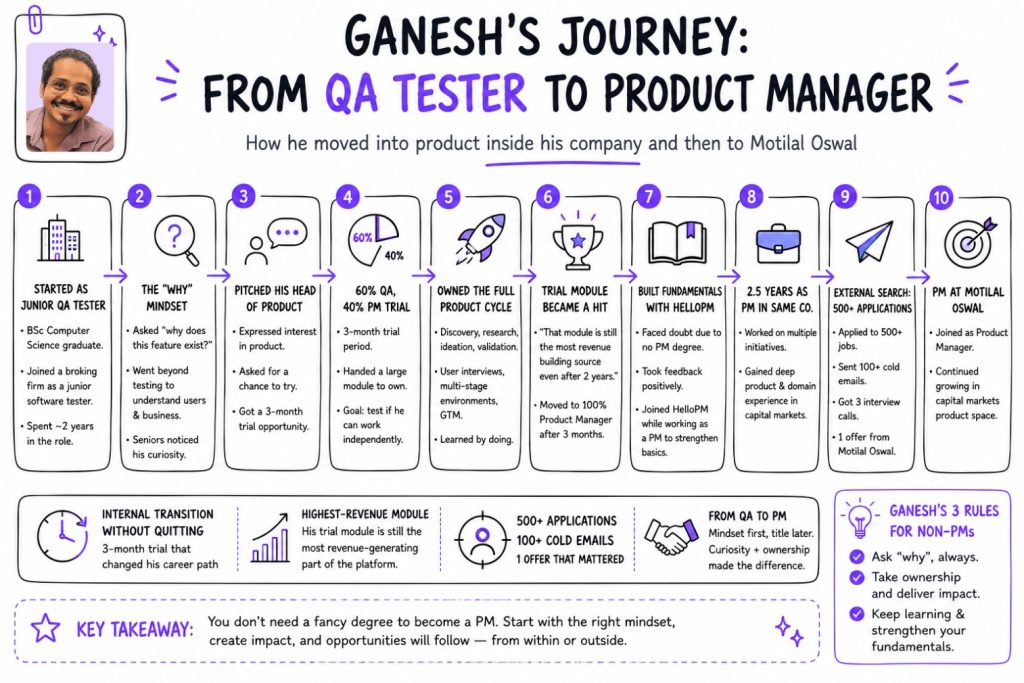
He stayed as a product manager there for about 2.5 years, then moved externally to Motilal Oswal. That external search took 500+ applications and 100+ cold emails to secure one offer. This is the practical breakdown of what he did, what worked, and what other QA engineers can learn from it.
Who Is Ganesh Basankar?
Ganesh Basankar is a product manager at Motilal Oswal, one of India’s largest financial services firms. He has spent roughly 5.5 years in one field: the capital markets domain.
He reached product management without an MBA, product degree, or product certification when he started. His academic background was a BSc in computer science, which helped him enter IT. His first role was as a junior software tester at a broking firm, where he stayed for about two years. He then moved to another company as a QA engineer.
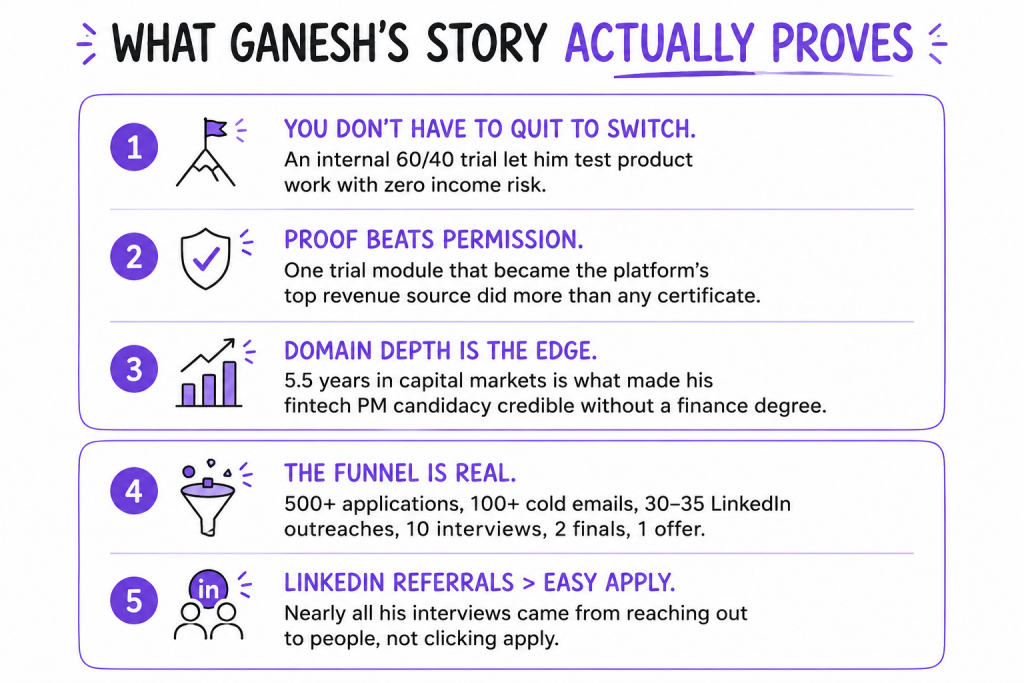
About a year into that QA role, he made the switch that defines this story: he moved from QA to product management inside the same organization, without leaving his job. He worked as a PM there for around 2.5 years before moving to Motilal Oswal.
Most transition stories start with someone quitting and betting on themselves. Ganesh’s story is different. He never left a job to “find out” whether he wanted product. He found out first, on the company’s clock, while keeping his salary.
Why QA Engineers Make Unusually Good Product Managers
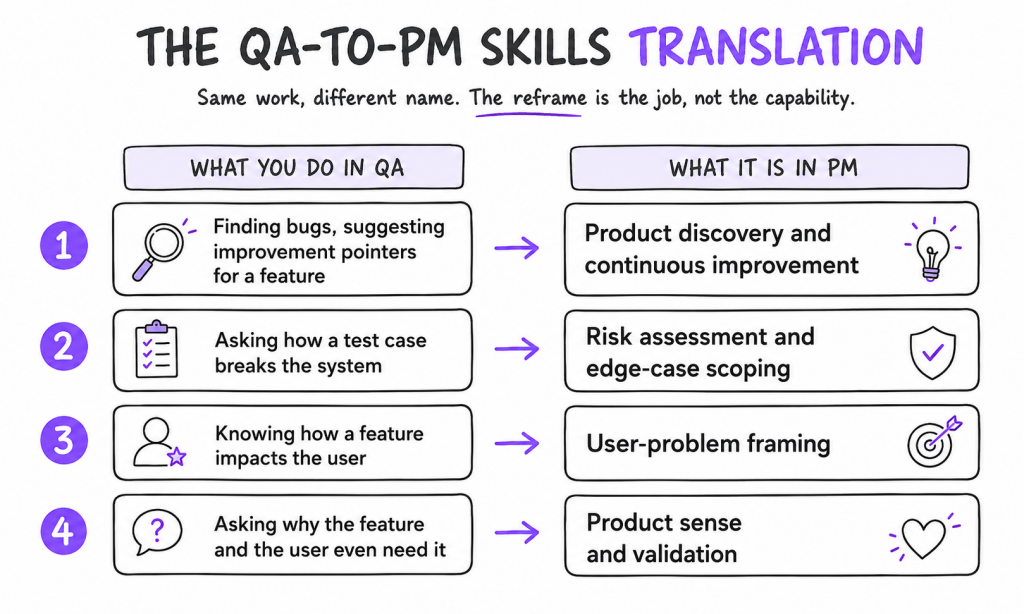
QA engineers already do one of the hardest parts of product management: they look closely at how a product behaves in the real world.
Ganesh was, by his own description, an exceptional QA. He was good at finding bugs and suggesting improvements. But what actually moved him toward product was a different habit.
As a QA, he kept asking questions that testing does not always require:
- Why does this feature exist?
- Which user needs it?
- What business problem is it solving?
- What would I have changed if I were making the product decision?
That instinct is product thinking. His seniors noticed it before he had a product title.
“Even before you get a tag of a PM, always play that role of a PM. Even if you don’t have that tag, even if you are working as a salesperson or a developer or a QA, always have that tag of a PM by yourself.”
Ganesh Basankar, Motilal Oswal
This is the through-line of his whole story. A PM mindset is not granted by a job title. It is a habit you start before anyone gives you permission.
Ganesh built that habit by interrogating his own product, and later by interrogating products he used as a customer.
There was also a ceiling he could see before he hit it. The QA track had a predictable path, and he did not like where it pointed.
“I always used to think: what’s next? Senior QA, then QA lead, and then what? I could see the next two or three designations, and I never wanted that. It never excited me.”
Ganesh Basankar
If you are in QA right now, this distinction matters. The pull toward product is not always about hating testing. Often, it is about seeing the next few rungs of your current ladder and realizing none of them is the job you actually want.
For a more structured version of this path, read HelloPM’s full QA to PM roadmap.
How to Transition From QA to PM Internally, Without Quitting Your Job
The move that worked for Ganesh was a low-risk internal pitch, not a resignation.
He went directly to the head of product and asked for a chance. He framed the request around the QA work that had already impressed the team. The answer was not an immediate full-time PM role. It was a trial.
His head of product offered a split: 60% QA and 40% PM for three months. Then he handed Ganesh a big module to own, specifically to test whether he could work independently.
“That module is still the most revenue-building source of the entire platform, even after 2 years.”
Ganesh Basankar, on the module he built during his 3-month PM trial
In that single trial module, Ganesh ran the full product cycle for the first time:
- Discovery
- Research
- Ideation
- Validation
- User interviews
- Multi-stage environments
- Go-to-market work
He did not know all the terminology going in. He learned the concepts by doing the work. After three months, his head of product moved him into a 100% PM role.
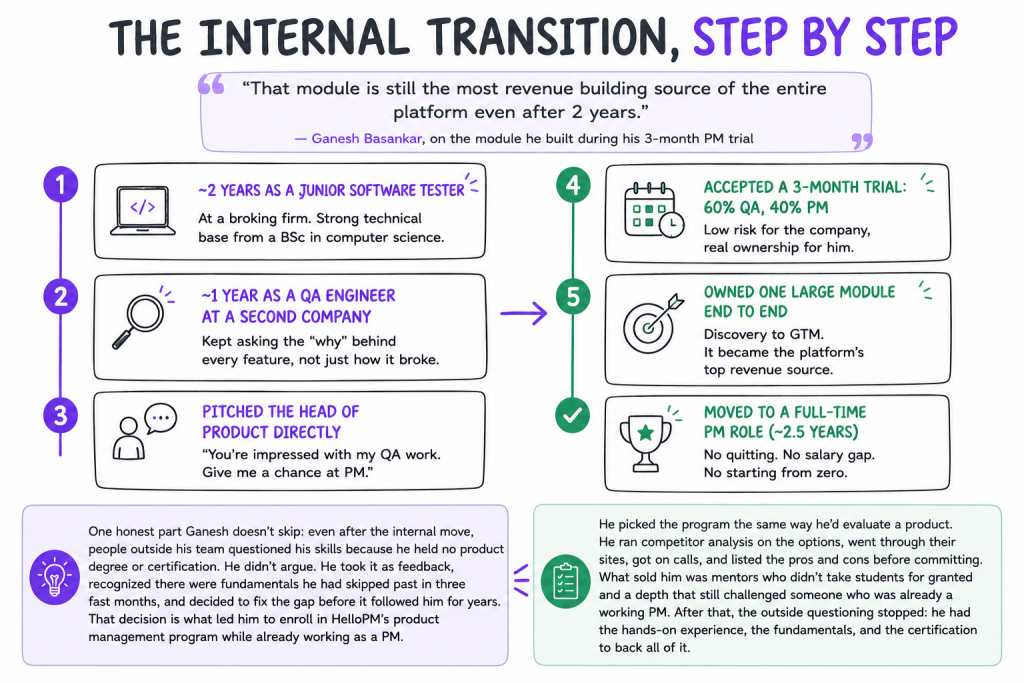
One honest part Ganesh does not skip: even after the internal move, people outside his team questioned his skills because he had no product degree or certification.
He did not argue with that feedback. He recognized that he had skipped some fundamentals during those fast three months and decided to close the gap before it followed him for years. That decision led him to enroll in HelloPM’s product management program while he was already working as a PM.
He chose the program the same way he would evaluate a product. He ran competitor analysis, reviewed websites, got on calls, and listed the pros and cons before committing. What sold him was the depth of the program and mentors who did not take students for granted.
After that, the outside questioning stopped. He had the hands-on experience, the fundamentals, and the certification to support the transition.
Why He Switched Internally Before Changing Companies
Ganesh chose the internal route on purpose because it removed every variable except the one that mattered most: could he do product work?
Moving to a new company to become a PM would have meant joining a new team, learning new processes, and proving himself from scratch, all while learning the craft itself.
By staying, he worked with people who already trusted him and knew his capabilities. He did not have to rebuild credibility while also learning what a PRD was.
As he puts it, if an organization is willing to transition you internally, they have already seen something in you and will back you for at least 3 to 6 months to prove it.
He is also honest that the internal path favored him. That is exactly why he later pushed himself to switch companies. He wanted to know whether he could be a PM somewhere that had not watched him grow up.
That is where the external search became real.
Breaking Into PM in Capital Markets Without a Finance Degree
Ganesh’s edge was not a finance degree. It was years of domain knowledge built inside one industry.
He has spent his entire career, around 5.5 years, in the capital markets domain: broking, trade applications, and mutual funds. When he moved to Motilal Oswal, he deliberately stayed inside that same domain.
For the LinkedIn outreach that drove his external search, he split his targeting.
- The people he messaged for referrals were mostly from the capital markets domain.
- The broader cold-email net was domain-agnostic because he was open to any PM role, in any city.
Why this matters for fintech PM roles
In a regulated, jargon-heavy field like capital markets, knowing how trades, brokerage, and mutual funds work is an edge a generalist PM may not have.
Ganesh did not compete only on PM polish. He competed on PM thinking plus a domain that many candidates cannot speak fluently.
For a broader view of the field, read HelloPM’s guide to fintech product management in India.
What the External Job Hunt Actually Took: 500+ Applications for One Offer
The external search was brutal, and Ganesh is specific about the numbers. That is what makes the story useful.
Landing his Motilal Oswal offer took:
- 500+ job applications
- 100+ cold emails
- About 10 interview calls
- 2 final rounds
- 1 offer
- Roughly 2 months of consistent effort
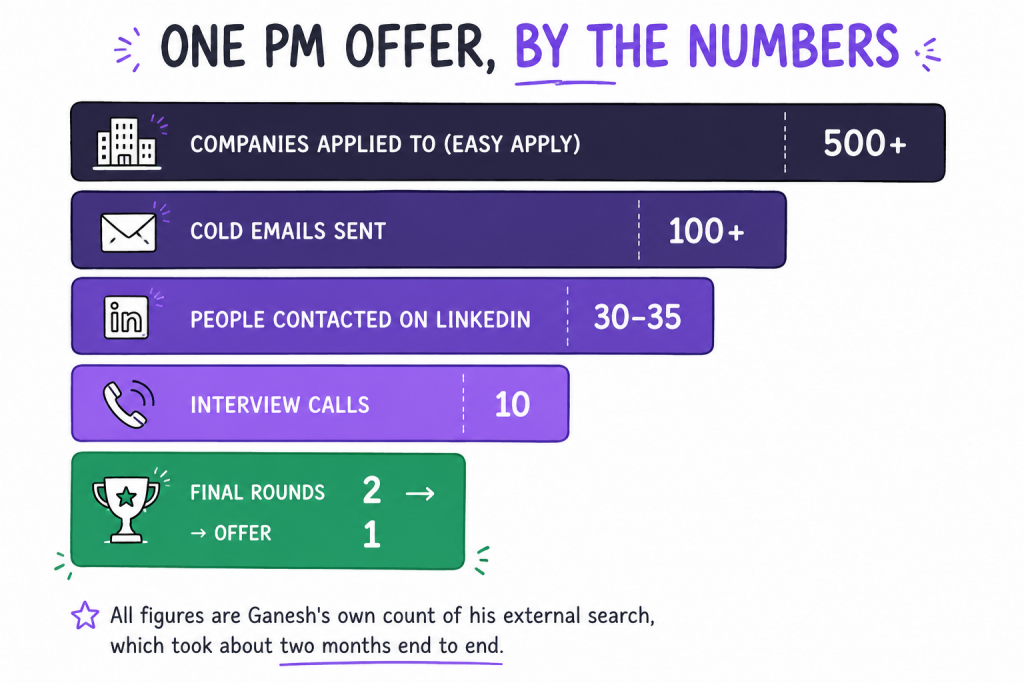
The channel breakdown matters as much as the totals.
Very few of his interviews came from cold emails, maybe one or two. Almost all of his interview calls came from LinkedIn, but not from the easy-apply button alone. He used LinkedIn to find the company’s own job portal and to directly message people for referrals.
His rule of thumb for outreach, offered as practical advice rather than logged data, is that roughly five or six out of ten people will reply to a genuine referral request.
His tactic when a job showed 100+ applicants within minutes was simple: do not give up on it. Search for the same role on LinkedIn, find three or four people on that team, send your CV, and ask for a referral.
That is how he got traction on the Motilal Oswal role itself.
“Don’t even wait for the perfect moment. Trust me, that moment will never come into your life. Never ever. There is no such moment called a perfect moment. Just go for it.”
Ganesh Basankar
Across roughly two months, he describes the hardest part not as rejection itself, but as silence: doing assignments, clearing rounds, and getting no feedback at all.
His answer was to keep the pipeline running. He did not pause applications while waiting for one company’s reply.
Inside the Motilal Oswal PM Interview
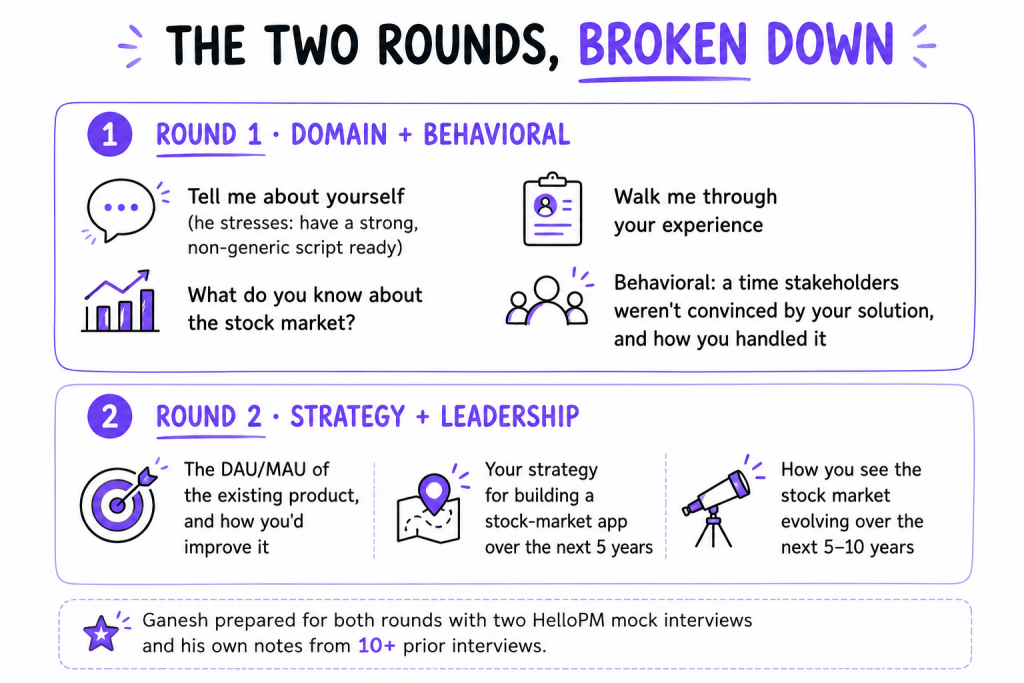
The Motilal Oswal process included a take-home assignment followed by two interview rounds.
Ganesh treated the assignment as the place to win. It became the bonus that set him apart from other candidates.
The assignment prompt was deliberately vague: how can a product manager tackle the emotional aspect of a trader?
Instead of jumping straight to a solution, he broke the vague statement into smaller pieces. He identified the real problem, validated whether it was a real problem at all, researched it, brainstormed solutions with ChatGPT because he had no one else to brainstorm with, built assumptions, ran a user interview inside his own organization, and built a prototype.
The interviewer was, in Ganesh’s words, “damn impressed.”
How he prepared for the interview
Two preparation tactics did most of the heavy lifting.
First, HelloPM mock interviews. He did two mock interviews with a HelloPM mentor and walked in feeling like he already had a question bank.
Second, AI-assisted interview preparation. He recommends prompting ChatGPT with the role and interviewer details, then asking it to generate the questions the interviewer is likely to ask. He used this to surface both behavioral and strategic questions before they came up live.
If you are preparing for PM interviews, you can also use HelloPM’s product management interview preparation guide.
The Part Nobody Warns You About in PM Job Search
The hardest part of the external search was not rejection. It was silence.
Two months of assignments, interview rounds, and final stages with almost no feedback can wear people down. That is not just a logistics problem. It is a psychological one.
“Even after doing so many assignments, going for the interview rounds, at least give me some feedback. If I’m rejected, selected, or on hold. If you do not get any sort of feedback, then that really demotivates you.”
Ganesh Basankar, Motilal Oswal
His response to the silence was the opposite of what most people do. He did not slow down and wait for one company’s reply. He kept the pipeline full and refused to spend two months hoping for a callback.
The same resolve had shown up earlier, when the internal PM role became hard and the safety of QA started to look appealing again. He came close to retreating, then talked himself out of it.
“I thought something, I took that decision. Let’s back that thought process and go ahead. What will happen, max to max? Nothing. You may find some other job. That is the maximum thing which can happen. If not now, then never.”
Ganesh Basankar, on nearly going back to QA
If you are a senior person making this switch, this is the cost that does not show up in any funnel diagram. The bet feels bigger because you have more to lose.
Ganesh’s framing is worth borrowing: name the worst realistic outcome out loud. Usually, it is “I keep looking for another job,” not a catastrophe. That is a survivable downside.
Ganesh’s Three Rules for Any Non-PM Trying to Switch
When asked what he would tell a QA or any non-PM trying to move into product, Ganesh gives three rules. Each one is tied to something he actually did.
1. Act as a PM before you have the tag
This is his core principle, and he repeats it for a reason.
Do not wait for the course, the resume, or the offer to start thinking like a PM. Question the products you already use every day.
- Why does Spotify run a subscription model?
- What are the pros and cons of that model?
- Why does an air conditioner remote work the way it does?
- What would you improve in a product you use daily?
Spend five to ten minutes a day interrogating a random product. That is how product sense gets built.
2. Don’t wait for the perfect moment; run everything in parallel
Prepare and apply at the same time.
Do not treat your transition like a stack where you finish learning first and only then start applying. The interview itself is practice, and rejections are part of the curriculum.
Keep learning, applying, taking interviews, reviewing feedback, and improving your portfolio in parallel.
3. Write everything down
Write down product observations, notes after every interview, and doubts you want to ask seniors.
Writing forces your brain to question things in a structured way. Structured thinking is a large part of the PM job.
Ganesh credits frameworks like Jobs To Be Done and The Mom Test for giving that thinking a shape during his three-month trial.
And a bonus rule, the one this whole story rests on: if you can transition inside your current company, do that first. It removes the cost of starting over with strangers and lets you focus on the craft.
Frequently Asked Questions
Can you become a product manager internally without changing companies?
Yes. The lowest-risk path is to pitch your manager for a trial split between your current role and product work. Ganesh negotiated a three-month, 60% QA and 40% PM arrangement, owned one module to prove himself, and then moved to a full-time PM role at the same company. You keep your salary and your credibility while you learn the craft.
How many job applications does it take to land a PM role?
It varies, but it is usually a large funnel. For Ganesh’s external move, it took more than 500 applications and over 100 cold emails to generate 10 interview calls, 2 final rounds, and 1 offer over roughly two months. The point is not the exact number. It is that volume and persistence, not a single perfect application, produce an offer.
Are cold emails or LinkedIn better for getting PM interviews?
For Ganesh, LinkedIn clearly worked better. Only one or two of his interviews came from cold emails. Almost all came from applying through the company’s job portal via LinkedIn and messaging team members directly for referrals. When a role already has 100+ applicants, find three or four people on that team, share your CV, and ask for a referral instead of relying only on the apply button.
Do you need a finance degree to become a fintech or capital markets PM?
No. Ganesh became a PM at a major capital markets firm with a BSc in computer science and no finance degree. What carried him was years of domain knowledge in broking, trade applications, and mutual funds. In regulated, jargon-heavy fields, deep domain familiarity is often more valuable than a formal finance qualification.
Do you need a product management certification to be taken seriously as a PM?
It is not mandatory, but it can close a credibility gap. Ganesh transitioned without one and still faced people questioning his skills because he had no product qualification. He used a structured PM program to cover the fundamentals he had skipped, which removed those doubts. Hands-on proof matters most; a credential can reinforce it.
How do you prepare for a product manager interview with limited time?
Run mock interviews and use AI to predict questions. Ganesh did two mock interviews with a mentor and reviewed notes from 10+ past interviews. He also prompted ChatGPT with the role and interviewer details to generate likely questions. Always have a strong, specific “tell me about yourself” script ready, since it sets the first impression.
Should you change industries when moving into product management?
Not necessarily. Staying in a domain you already know reduces how much you have to prove at once. Ganesh stayed inside capital markets across his transition, which let his domain expertise do part of the selling. If you switch domains, expect to rebuild credibility while also learning the PM role itself.
Become a product manager with structured mentorship
HelloPM’s live, hands-on product management bootcamp helps learners build real projects, prepare for interviews, get mentorship, and develop the confidence to move into product roles.