How to Develop Product Sense (Even If You’re Not a PM Yet)
Product sense is the ability to consistently make good product decisions: knowing what to build, judging whether a product is […]

What is product sense, really?
Product sense is the ability to make consistent, good product decisions. It shows up as three abilities: knowing what to build for a given user and problem, being able to judge whether a product is good and why, and predicting how real users will react to a change before you ship it.
People treat it like a mystical instinct. It isn’t. It’s the same thing an experienced doctor has when they glance at a set of symptoms, or a chef has when they taste a sauce and know what’s missing: pattern recognition built from thousands of reps. A PM with strong product sense has simply looked hard at a lot of products, asked why they work, and been wrong enough times to get calibrated.
That reframe matters, because it means product sense is learnable. You are not waiting to discover whether you “have it.” You are building it.
Is product sense innate, or can you learn it?
You can learn it, and most good PMs did. If you’re worried you weren’t born with some special instinct, here’s the direct answer: nobody was. Product sense is developed the same way taste, writing, or chess sense is developed, through deliberate reps and feedback.
We see this constantly. Across the 2,800+ of our alumni, the ones who developed sharp product sense weren’t always the “naturally intuitive” ones.
They were the ones who put in the reps: pulling products apart, asking why, doing the homework.
As one alumnus who moved from QA into product put it, product sense started building the moment he stopped using products passively and started interrogating them, asking why this feature, why this flow, and why a user even needed this.
So the useful question isn’t “do I have product sense?” It’s “what reps am I doing to build it?” The rest of this guide is about those reps.
The four parts of product sense
“Product sense” sounds like one fuzzy thing. It’s easier to build when you split it into four kinds of judgment. Strong PMs have all four; most people start strong in one and have to train the rest.
| The four parts | The question it answers | How you build it |
| User sense | What do people actually need, and what job are they hiring this product to do? | Talk to users, study behavior, learn jobs-to-be-done |
| Business sense | How does this product create and capture value? | Ask “how does this make money?” of everything |
| Craft sense | What makes this experience good or frustrating to use? | Study great (and bad) design closely, notice the details |
| Systems sense | How do the parts fit, and what are the second-order effects of a change? | Trace trade-offs; ask “and then what happens?” |
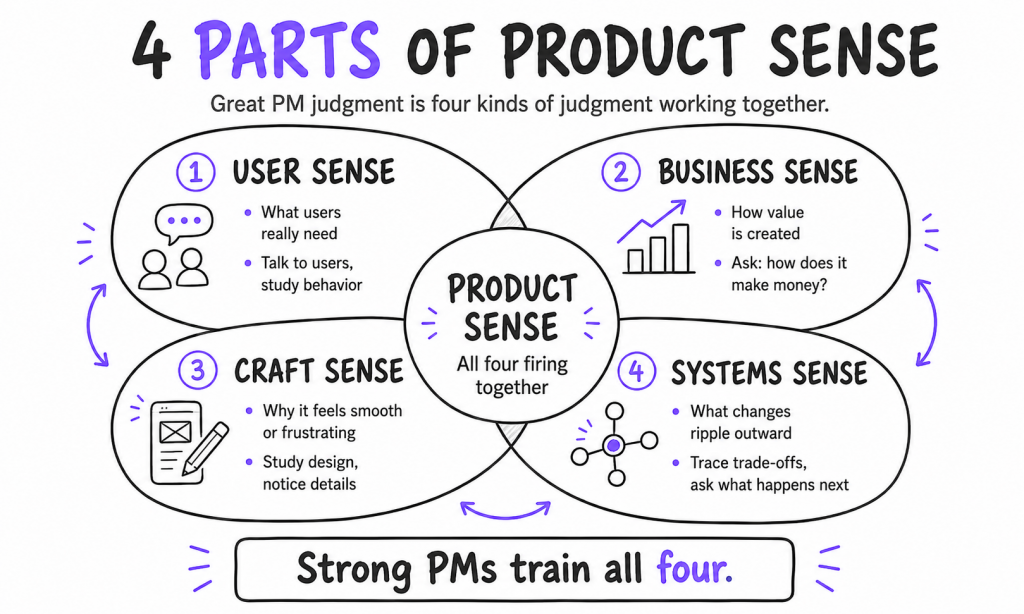
- User sense is empathy made rigorous. It’s about understanding the real problem behind what a user says they want, which is exactly what jobs-to-be-done trains you to do.
- Business sense keeps you honest. A feature users love that doesn’t move the business is a hobby, not a product.
- Craft sense is why two products that “do the same thing” feel completely different. It comes from noticing details, and the 12 product design principles are a good lens to sharpen it.
- Systems sense is what separates senior judgment from junior. It’s asking “if we ship this, what breaks, who games it, and what happens next?”
When someone says a PM “has great product sense,” they usually mean all four fire at once, fast.
Six reps that build product sense
You don’t build product sense by reading about it. You build it by doing reps on real products. Here are six, from easiest to deepest. Do a few every week, and the judgment compounds.
Rep 1: Tear down a product you use
This is the core rep. Take any product you use and pull it apart with a structured product teardown. Don’t review it (“I like it”). Reason about it. You can ask these 5 questions while doing this exercise:
- Who is it for, and what job are they hiring it to do?
- What’s the core loop, the main thing users come to do, and how smooth is it?
- How does it create and capture value for the business?
- What’s genuinely good, and what’s quietly frustrating?
- If you owned it, what’s the one thing you’d change, and why?
Write your answers down. The writing is where the sense actually forms, because it forces you to defend a position.
Rep 2: Play “favorite product, how would you improve it”
Pick a product you love and force yourself to improve it. This is the exact drill behind the classic favorite-product interview question, and it’s a great rep because loving a product makes it harder to see its flaws. Push past “it’s already great” to a specific, justified change, and explain who it helps and what it might cost.
Rep 3: Ask “why” of every product decision you see
This is the daily habit that quietly builds the most sense, and it’s free. Every product you touch has involved thousands of decisions. Start interrogating them.
- Why does Spotify open to your library, not search?
- Why does WhatsApp show two ticks, then blue?
- Why does that checkout ask for email before card?
One of our alumni described this as the switch that started it all: stop using products on autopilot, and start asking why behind each choice, then brainstorm what you’d have done differently. Do it on the apps already in your pocket, and you’re getting reps all day.
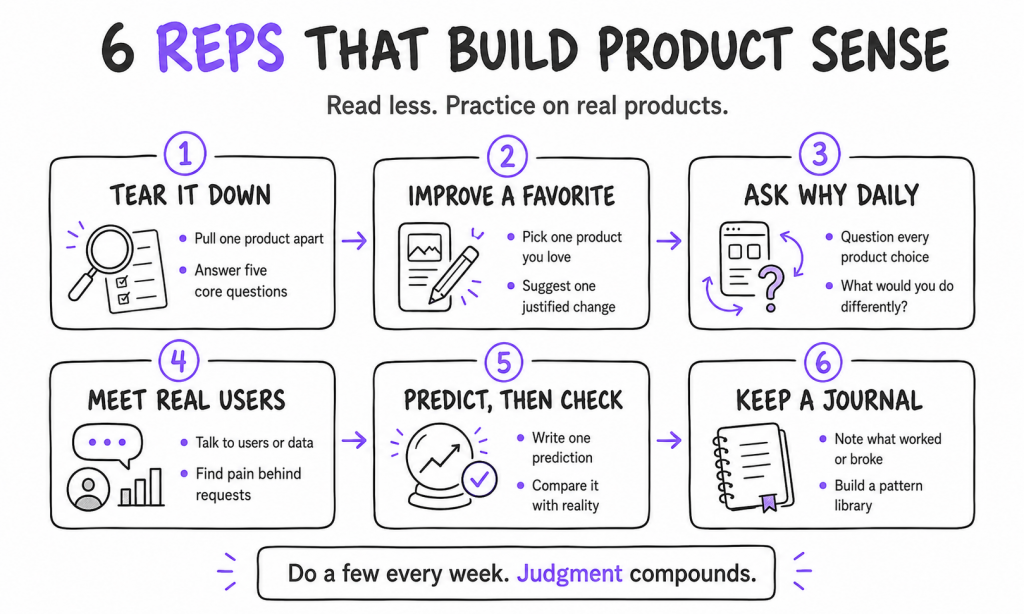
Rep 4: Talk to real users (or study real behavior)
A product sense that never meets a real user ends up as an opinion.
The fix is product discovery: talk to people who use the product, and listen for the problem behind the request. The discipline of asking about real past behavior instead of hypotheticals, the core of The Mom Test, is worth learning early (our summary covers it). If you can’t reach users yet, study behavior in engagement data: where do people drop off, and what do they repeat?
Rep 5: Predict, then check
This is the rep that calibrates you, and most people skip it. Make a real prediction: “This app should add X,” or “They’ll probably kill this feature.” Write it down. Then watch what actually happens and, more importantly, why. When you’re wrong, that’s the rep working. Calibration only comes from being wrong on record and updating.
Rep 6: Keep a product journal
Keep a running note of products you’ve studied: what’s good, what’s broken, what you’d change, and later, what actually happened. Over a few months, this becomes your pattern library, the raw material your “instinct” quietly draws on. Use multiple products, go through their ins and outs, and jot down the lessons. That habit, more than any single framework, is what our alumni credit with building real product sense.
Case Study: Let’s improve LinkedIn together
The fastest way to feel product sense working is to do the “improve this product” drill the way we teach it in our sessions. Most people get the very first move wrong: they jump straight to a feature (“add dark mode!”). A PM with product sense does the opposite. They start with the user.
Take a prompt we actually use: improve LinkedIn.
Step 1: What is it, and what job does it do? LinkedIn is a professional network. But “improve LinkedIn” is a meaningless brief until you ask the real question: improve it for whom?
Step 2: Segment the users. This is the move that signals real product sense, and where most people skip ahead. LinkedIn isn’t used by one kind of person. It’s used by very different people hiring it for very different jobs:
- Job seekers looking for a role
- Content consumers who come to read posts from people they follow
- Internship seekers early in their careers
- Salespeople trying to reach prospects
- Recruiters trying to fill roles
You’re already thinking like a PM, because a change that delights one of these can quietly hurt another.
Step 3: Pick one segment and find the real pain. Say you pick job seekers. Don’t reach for features yet. Sit in their situation. A job seeker’s real pain isn’t “I want more buttons.” It’s “I apply to dozens of roles and hear nothing back, and I can’t even tell whether my application was seen.” That’s the job to be done: kill the anxiety of the black hole.
Step 4: Now, and only now, solve it. With the pain named, solutions get sharper and more honest, show a job seeker where their application actually stands, or surface the few roles where their profile is a genuinely strong match, so they stop spraying applications into the void. Notice these fall out of the pain, not a feature wishlist.
Step 5: Say how you’d measure it. “Did it work?” can’t be a vibe. Here, maybe the application-to-response rate for that segment, or job seekers returning because the platform finally feels like it’s working for them.
That’s the entire method, and it’s the reverse of feature-first: understand the user, don’t retrofit a solution. Or, as we say, find the right product for your user; don’t go hunting for users to justify a feature you already wanted to build. There isn’t a single invented statistic in that teardown; it’s just reasoning based on who the product serves. Run the same five-step pass on Notion, WhatsApp, or the app you use most, and you’re no longer “using apps”, you’re building product sense. It’s also the exact structure that wins the favorite-product interview question.
How product sense shows up in interviews
Product sense is the single most-tested thing in a PM interview, and it hides inside familiar-sounding questions. If you can show structured sense here, you stand out immediately, because most candidates wing it.
It shows up as:
- “Design an app for X” or “improve product Y” (product design questions). They’re testing whether you start from the user and the job, not from features.
- “What’s your favorite product and how would you improve it?” (see the drill above).
- Estimation and root-cause questions, where structured thinking under pressure is really product judgment in disguise, are covered in guesstimates and RCA questions.
The way to demonstrate product sense is to be visibly structured: state who the user is, the job to be done, the trade-offs you’re weighing, and a clear recommendation with a reason. The broader interview prep in our ” Cracking the PM interview guide puts these together, and it’s just as useful whether you’re targeting a PM or one of the many types of product manager roles.
The mistakes that stall product sense
Four traps keep people stuck at “I use a lot of apps” without ever building real judgment:
- Feature-first thinking. Jumping to “add a button” before asking what problem it solves. Product sense starts from the user and the job, always.
- Copying without understanding why. “Let’s do what [big company] does” isn’t a reason. Copy the reasoning, not the feature, because their context isn’t yours.
- Ignoring business and feasibility. A change that delights users but can’t be built or paid for isn’t a good product decision. Judgment weighs all three.
- Consuming instead of doing reps. Reading another article on product sense (including re-reading this one) feels productive, but it builds almost nothing. The reps build it.
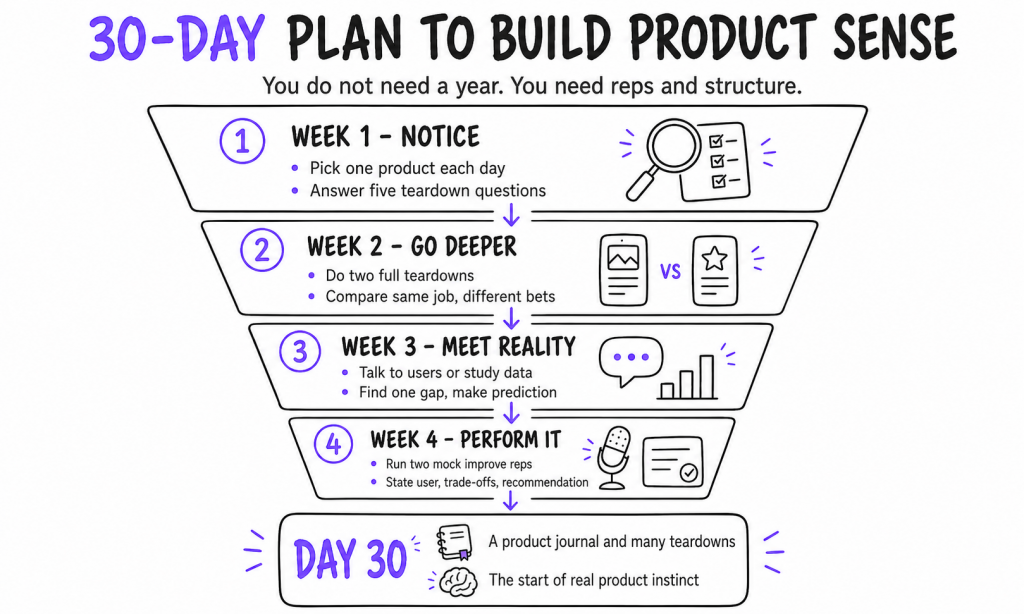
A 30-day plan to build product sense
You don’t need a year. You need reps and a little structure. Here’s a month that genuinely moves the needle.
- Week 1, notice. Each day, pick one product you already use and answer the five teardown questions in ten minutes. Write it down. Seven products, seven short notes.
- Week 2, go deeper. Do two full teardowns of products in a category you care about. Compare them: same job, different bets. Why did each choose what it chose?
- Week 3, meet reality. Talk to three real users of a product (or study its behavior data). Find one gap between what people say and what they do. Make one prediction and write it down.
- Week 4, perform it. Do two “improve this product” reps out loud, as if in an interview: user, job, trade-offs, one clear recommendation. Record yourself or have a friend record you.
By day 30, you’ll have a product journal, a dozen reasoned teardowns, and, more importantly, the beginnings of an instinct you can feel working.
Don’t Wait, Start Today!
You shouldn’t wait to feel “qualified.” Start a rep today.
Open the app you use most, set a 10-minute timer & answer the five teardown questions: who it’s for, the core loop, how it makes money, what’s good and frustrating, and the one thing you’d change. Write your answers down.
That single note is the first entry in your product journal, and the first real rep of your product sense.
When you want structured practice with feedback on your reasoning, check out our curriculum and free resources. But this first rep needs nothing but you and an app you already have.
Product sense was never a gift. It’s reps. Go run your first one today.
Happy Upskilling:)
Frequently asked questions
1. What is product sense in simple terms?
It’s the judgment to make good product decisions: knowing what to build for a user, being able to tell whether a product is good and why, and predicting how people will react to a change. It’s pattern recognition built from studying a lot of products, not a personality trait.
2. Can you actually learn product sense, or is it innate?
You can learn it. Product sense is built through deliberate reps, tearing products apart, asking why, talking to users, and making calls you then check against reality. Most strong PMs developed it on purpose; very few were “born with it.”
3. How long does it take to develop product sense?
You can feel real improvement in a month of consistent reps, and build genuine depth over six to twelve months. The speed depends entirely on reps done, not time passed. A focused 30-day plan (above) beats a year of passively using apps.
4. Do you need to be a PM to build product sense?
No. Every rep in this guide works on products you already use, no title or job required. In fact, showing up to interviews with visible product sense is exactly how career-switchers get hired without prior PM experience.
5. How is product sense tested in PM interviews?
Through product design questions (“design/improve X”), the favorite-product question, and estimation or root-cause questions. Interviewers are checking whether you reason from the user and the job, weigh trade-offs, and land on a clear, justified recommendation, rather than listing features.
6. What’s the difference between product sense and product thinking?
They overlap heavily. Product thinking is the broader habit of approaching problems from the user, business, and feasibility angles. Product sense is the sharpened judgment that habit produces, the ability to make the call quickly and get it right more often than not.