Book Summary: The Mom Test by Rob Fitzpatrick
The Mom Test summary for PMs and founders: learn the 3 rules of customer interviews, bad data signals, commitments, customer slicing, and better questions.

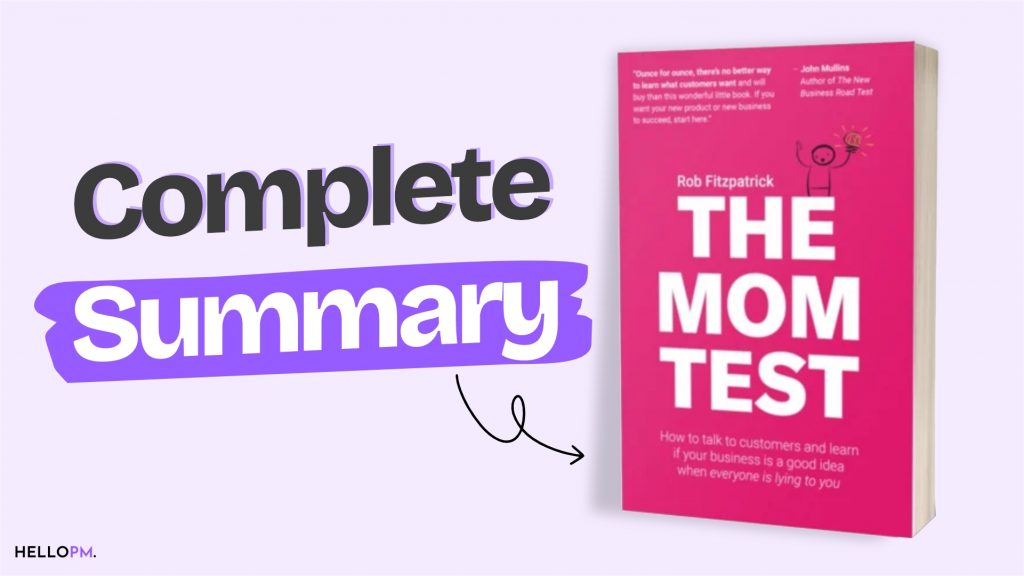
Got 60 seconds, start here-
The Mom Test is the single most important book on talking to customers ever written. Period.
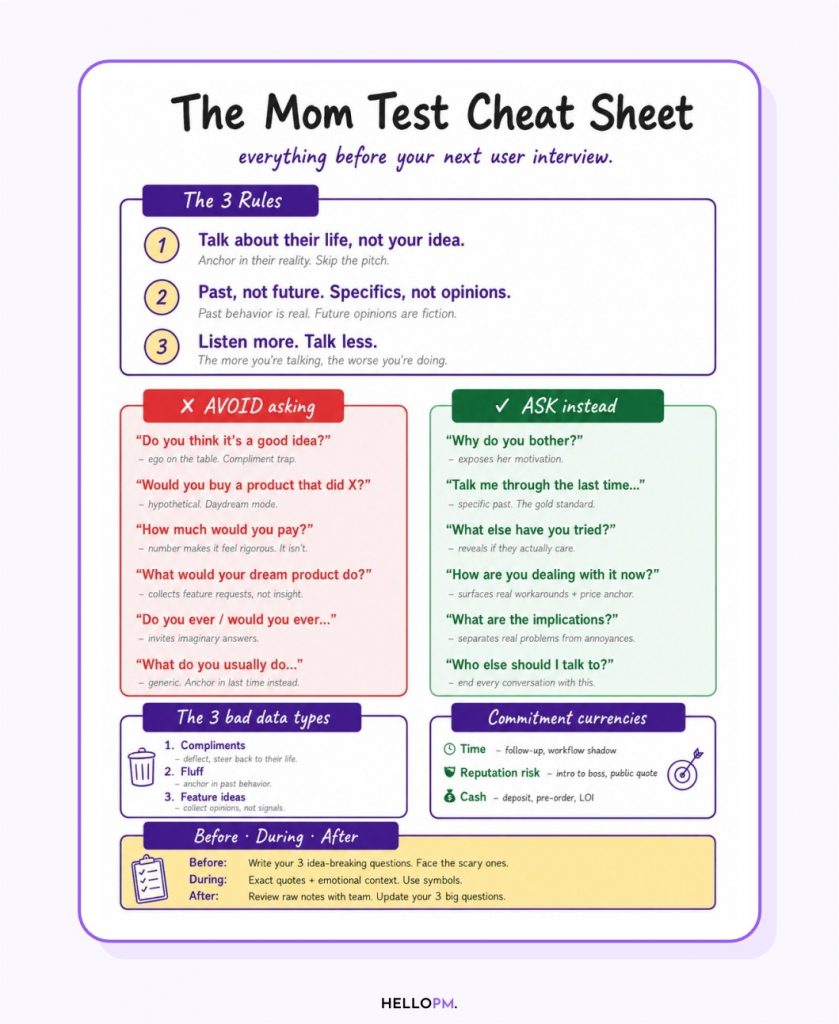
Is this book for you?
Rob Fitzpatrick gives you a system that gets you the truth from customers even when everyone around you is being polite. Absolutely no theory, no fluff, just the rules you can apply in your next user interview.
✓ Read this if you: Are a PM about to run user interviews. A founder validating an idea. A career pivoter who’s never done customer research. Anyone who has ever felt ‘users said they loved it,’ but the launch flopped.
✗ Skip this if you: Already run structured continuous discovery cycles. Your interview transcripts have zero compliments. Then go straight to Continuous Discovery Habits by Teresa Torres instead.
Now, if you decided to continue reading, I’d like you to
Imagine this…
After a lot of trials, you finally got five potential users on a call. You pitched your idea. Everyone was smiling & cheering. 3 of them even used these exact words, ‘I’d totally use this,’ and one even went against to confirm the dates of launch.
And you got on cloud nine, feeling like you cracked those interviews.
6 months & 40 lacs of engineering later.. You Launched!
Output- 0
But what went wrong?
At least the one who checked the launch date should have considered your product.
Understand this: often, people you think are your potential customers are just being polite humans when you’re conducting user research. And you didn’t know how to differentiate between a polite human and a potential customer, because u asked the wrong questions.
No, the politeness is not out of purpose or waiting to see you fail. Their politeness, or say they, because you handed them an idea and asked them to be nice about it & they obliged!
And this is the most expensive mistake a PM or founder makes.
Even Rob, the author of this brilliant book, made this mistake in his first startup. But worry not, he even wrote the cure…
| RULE OF THUMB: You shouldn’t ask anyone whether your business is a good idea. Only the market knows. |
Top 3 Rules to keep in mind!
Rule 1: Talk about their life, not your idea
The moment you describe your idea, the conversation becomes about you. The customer starts performing. They stop telling you the truth.
Let’s understand this with a simple example: imagine a son pitching his mother on a digital cookbook app. Same person, same topic, two completely different outcomes depending on whether he mentions his idea:
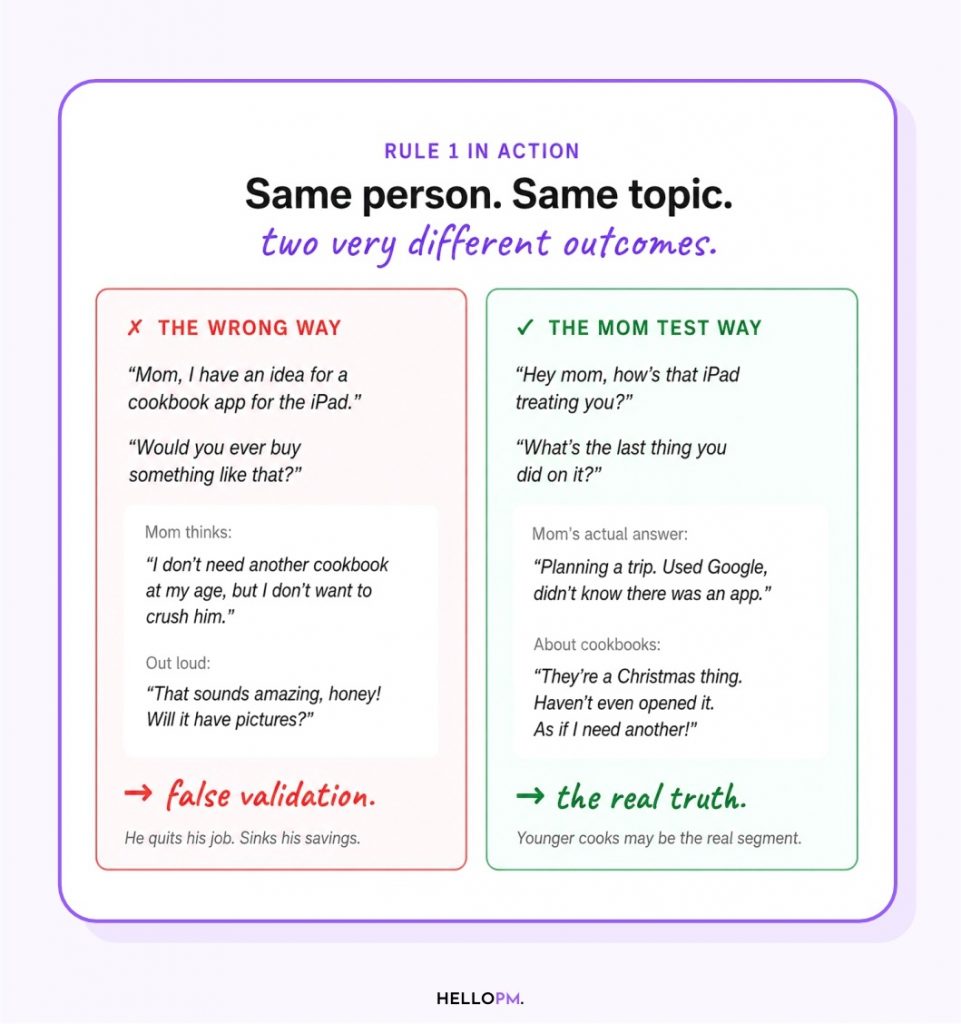
In one conversation, the son learns: Mom doesn’t search the App Store; she waits for recommendations. She gets cookbooks as gifts and never opens them. Younger cooks may be the real segment. He never mentioned his idea once.
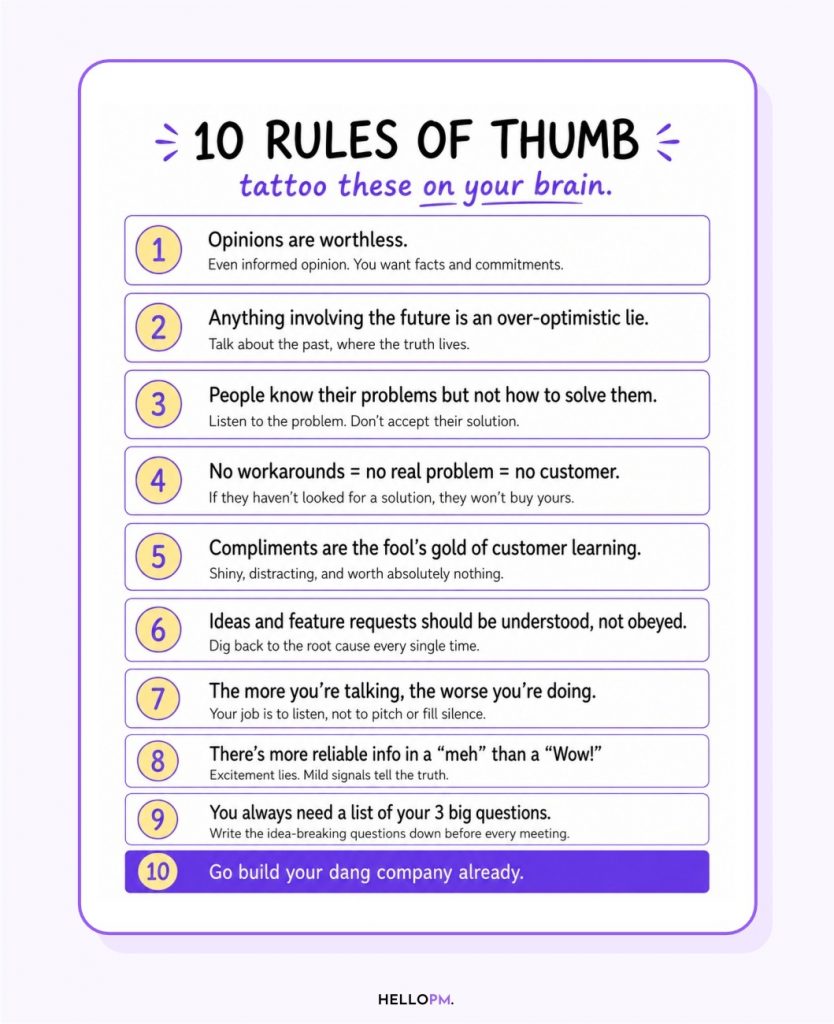
| RULE OF THUMBPeople know what their problems are, but they don’t know how to solve them. Listen to the problem, not their guess at the solution. |
Rule 2: Ask about specifics in the past, not opinions about the future
Humans are catastrophically bad at predicting their future behavior. But humans are excellent at recalling what they actually did.
For instance, don’t ask them whether they will buy your future gym membership; instead, ask them about their past behavioral questions, for instance, how many times in the past week they exercise. When was the last time they took the trainer’s help, etc.?
Past behavior is real. Future opinions are fiction.
| Avoid these questions (they all invite imaginary answers) | Replace it with this kind of question |
| Do you ever…’ | ‘When was the last time…’ |
| ‘Would you ever…’ | |
| ‘Do you think you…’ | |
| ‘Could you see yourself…’ | |
| ‘Might you… | |
| ‘What do you usually…’ |
Remember, the world’s deadliest fluff is: I’d definitely buy that!
Rule 3: Talk less, listen more
The more you talk, the worse your data. If you’re explaining, pitching, or defending, you’ve already lost.
Silence is uncomfortable. When customers pause, our instinct is to fill the space. We lead the witness.
The worst thing is that after you mention your idea, customers often start sentences with ‘So it’s similar to…’ or ‘I like it but…’
Most founders interrupt to fix that. Don’t do that. That interruption costs you a glimpse into their mental model.
Validation is a sales activity. Understanding is a research activity.
The Mom Test forces you to do the opposite of what feels good: go in trying to disprove your own assumptions, not confirm them.
| TRY THIS Before your next chat, write your idea on a sticky note and physically turn it face down. You’re not allowed to say it. Open with: “Can you walk me through the last time you faced X?” Count to three in your head after they finish a sentence before you speak. Let the silence pull more out of them. |
| RULE OF THUMBThere’s more reliable information in a “meh” than a “Wow!” You usually can’t believe enthusiasm. |
Do’s & Don’ts of every customer conversation
The good questions are never about asking what you should build; instead, they are all built around a single principle-
“Understanding the customer’s life”.
| ❌ DON’T | ✓ DO |
| Pitch your idea first. It turns the chat into a compliment-fishing exercise. | Ask about their life. “How do you currently solve X?” Their real workflow. |
| Ask hypotheticals. “Would you ever…” “Do you think you might…” All fluff. | Ask about specifics in the past. “Walk me through the last time” is the gold standard. |
| Ask about the future. “Would you pay $X for it?” Daydream mode = lies. | Ask, “Why do you bother?” Gets you from the perceived problem to the real problem. |
| Take feature requests at face value. Their guess at a solution is usually wrong. Dig deeper. | Ask “What else have you tried?” If they haven’t looked for a fix, they won’t buy yours. |
| Trust compliments. “I love this!” costs them nothing. Means nothing. | Ask “What are the implications?” Separates real pain from “kind of annoying.” |
| Trust enthusiasm. More info in a “meh” than a “Wow!” | Deflect compliments. Treat them as a warning. Steer the conversation back to facts about them |
| Talk more than the customer. If you’re filling silence, you just lost the data. | Ask “Who else should I talk to?” End every conversation with this question. |
| End without a commitment. No time/reputation/cash given = polite stranger. | Press for commitment. Ask for time, reputation, or cash before you hang up. |
| Remember, customers will lie to you if they think that’s what you want to hear. |
What separates Real Research from Validation Theater?
MTV told Habit that they needed analytics. Rob’s team spent three months building a beautiful dashboard — zillion options, technically lovely.
There are 3 kinds of bad data or sake fake data that sneak into your notes. You gotta catch them, or they poison your roadmap-
- Compliments
- Fluff
- Feature ideas
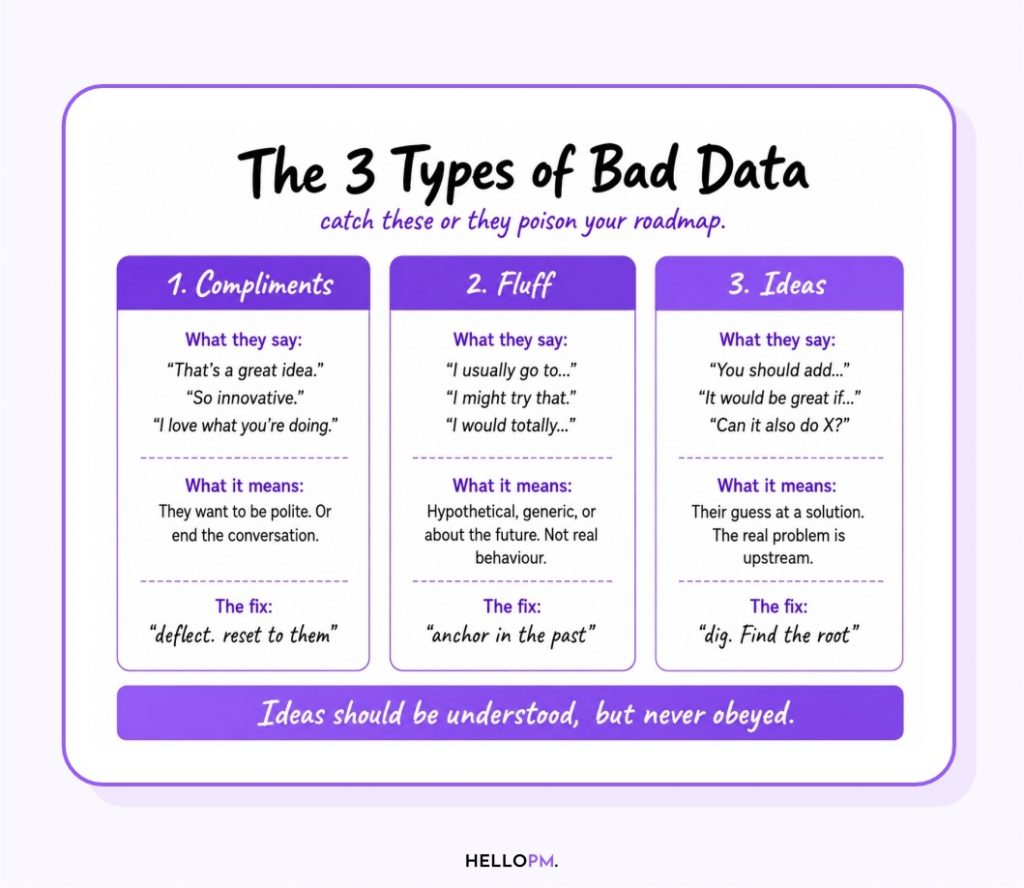
Out of the three, feature Ideas are the most dangerous kind. Let’s understand why with an example…
MTV Analytics Dashboard Disaster
The author of this book, Rob, got this wrong at his first company, Habit.
MTV ooh’ed and aah’ed at the demo.
- Then, MTV started calling every Friday, asking Rob to email a CSV. They even built a CSV export.
- Then, MTV wanted PDF. They built PDF export.
- Then, MTV wanted its logo on the reports.
That’s when Rob finally asked the right question: ‘Why do you want this feature? What do branded reports get you?’
The answer could have made anyone go nuts….’Nobody even reads these. Our clients just like getting something fancy emailed at the end of every week.’
MTV didn’t need an analytics dashboard.
They needed a way to keep their own clients happy, which could have been solved with an intern. But because they paid heed to bad data, 3 months of engineering efforts were burned!!!!
| RULE OF THUMBIdeas and feature requests should be understood, but never obeyed. Dig back to the root cause every single time. |
| TRY THIS Next time someone requests a feature, ask: “What would that let you do that you can’t do today?”Then ask: “How are you coping without it right now?” — the workaround tells you how real the pain is. |
Compliments vs Commitements- What do u think is real currency?
Compliments cost the customer nothing…
‘Great idea, I’d totally use it!’ costs zero time, zero money, zero reputation.
A compliment is a warning flag that the person is trying to get rid of you.
While a commitment costs something real:
- Time: follow-up meeting with known goals, wireframe feedback session, trial usage for a non-trivial period
- Reputation risk: intro to peers/team, intro to decision-maker (boss/spouse/lawyer), public testimonial or case study
- Cash: letter of intent, pre-order, deposit
The strongest signal combines multiple currencies: someone agreeing to a paid trial with their whole team is risking time + money + reputation simultaneously. A meeting ending without one of these isn’t a success; it’s a polite goodbye.
| Rule of Thumb: The more they’re giving up, the more seriously you can take their commitment. |
Getting Mixed Signals: Use Customer Slicing
If ten customers give you ten different problems, your segment is too broad. The book calls the fix Customer Slicing — drilling down until everyone in your segment shares the same pain.
Again, an example would help here,
There is a woman who is trying to make a business of powdered superfood condiment, which is sweet like brown sugar, nutritious like a multivitamin. She’d been pitching it everywhere.
- Bodybuilders wanted a protein shake mix.
- Restaurants wanted a sugar alternative.
- Moms wanted to trick their kids into eating healthy.
Making one happy disappointed the others. She was drowning.
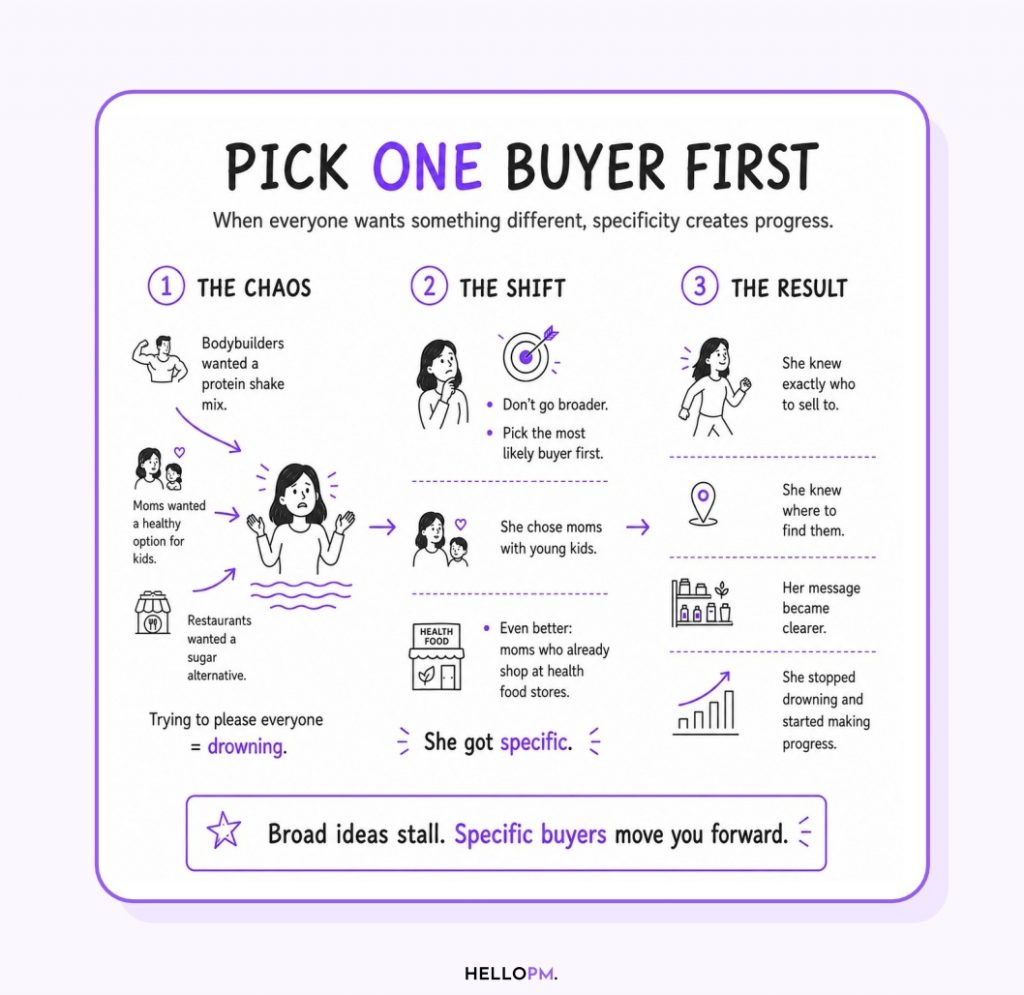
So the fix wasn’t to go all in, but to pick the most likely buyer first.
Hence, she picked moms with young kids who already shop at health food stores. She knew exactly where to find them. She got specific. She stopped drowning and started making progress.
| Rule of Thumb:Good customer segments are a who-where pair. If you don’t know where to find them, keep slicing. |
Every meeting either succeeded or failed
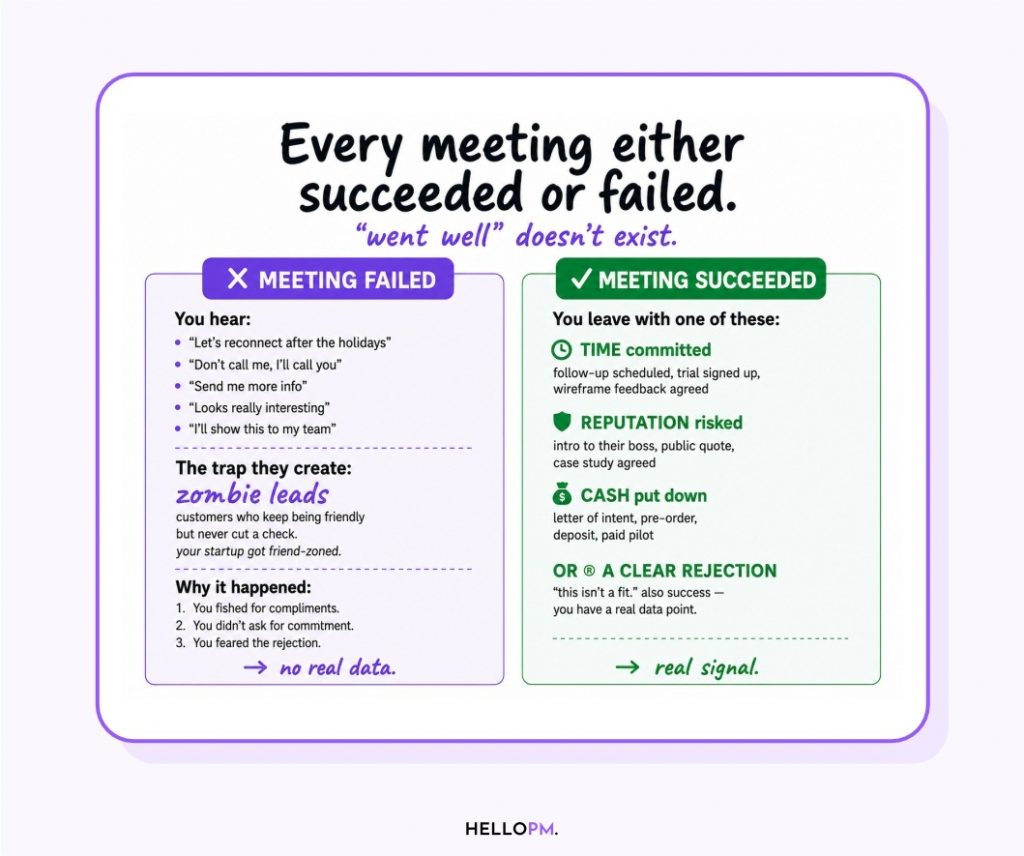
There is no such thing as a meeting that “went well.” That feeling is a trap. A meeting only did one of two things: it moved forward, or it quietly died.
It moved forward only if the other person gave up something real, their time, their reputation, or their money. If all you got was nice words, nothing happened. Nice words are free, so they are worth nothing.
So after any sales meeting, if you don’t know what happens next, the meeting was pointless. And a person isn’t a real lead until you’ve given them a real chance to say no.
Meet Your First Customer- Earlyvangelists
This is a word from Steve Blank: “early” + “evangelist.” Your first true customer is a little bit crazy, in a good way. They want what you’re making so badly that they’ll buy in before it even makes sense to.
When you’re selling a tool to companies, this customer has four things going on at once.
- They have a problem.
- They know they have the problem.
- They have money set aside to fix it.
- And they’ve already built some messy, patched-together fix of their own-
That last one matters most. Anyone can say, “Yeah, that’s annoying.” But the person who already made their own clumsy workaround has proven they care, because they spent real effort on it before you ever showed up.
The simple way to spot this person in real life: watch their emotions.
There’s a giant difference between someone saying “yeah, that’s a problem” and someone saying “THAT IS THE WORST PART OF MY LIFE AND I WILL PAY YOU RIGHT NOW TO FIX IT.”
When you meet the second kind, hold on to them tightly. They’re rare, and they’re the ones who’ll get you your first sale.
The 5-part way to ask for a meeting
How you ask for the meeting decides what you get out of it. There are five parts, and the trick to remember them is the sentence “Very Few Wizards Properly Ask”:
- Vision — say the big problem you’re trying to fix. Do not mention your actual idea, because the moment you do, they start judging your idea instead of honestly telling you about their world.
- Framing — tell them what stage you’re at, and if it’s true, that you have nothing to sell. This is the most calming thing you can say, because it removes their fear of being sold to.
- Weakness — admit the exact thing you’re stuck on. Strangely, admitting a specific gap makes you look more serious, not less, and it gives them a clear thing to help you with.
- Pedestal — explain why they, specifically, are the right person to help. People love helping when they feel uniquely able to.
- Ask — actually ask for the meeting. If you don’t ask, you don’t get.
Let’s understand this with an example
Say you’re building something to help people, and you want advice from someone who knows the field. Your message would sound like this:
- I’m trying to make it easier for small shops to handle their deliveries (vision).
- I’m just getting started and have nothing to sell yet (framing).
- I’ve only ever seen this from the customer’s side, and I really don’t understand how shop owners deal with it (weakness).
- You’ve run a shop for years, so you’d be perfect to help me figure this out (pedestal).
- Could we grab a quick chat sometime in the next week or two? (ask)
So in simple words, you tell them the problem you care about, you promise you’re not selling anything, you admit what you don’t know, you tell them why they’re the right person to ask, and then you ask for a short chat.
| Key Takeaway: The 5-part ask gets you in front of the right person, talking to them shows whether they’re an earlyvangelist, and the success-or-failure rule tells you whether the meeting actually counted. |
Keep things Casual
The best customer conversations happen when the other person doesn’t even realize it’s a conversation about your idea.
Don’t turn every customer chat into a scheduled meeting. A formal meeting eats up about four hours once you count scheduling, traveling, and writing it up, while a casual chat at an event takes ten minutes and teaches you the same thing.
And the moment it gets formal, people get guarded and expect to be sold to.
So how do u implement this in a day-to-day scenario:
- At an event, skip the business cards. Just open with something like, “Weird question, X has been driving me crazy. How do you deal with it?” You’re now learning, and they don’t feel sold to.
- On a call you didn’t set up, ask casually while waiting around: “How are you handling X these days?”
- When a customer contacts support, fix their issue first, then add, “While I’ve got you, can I ask you something?” Their guard is already down.
- Avoid anything that sounds formal, like “Thanks for agreeing to this interview” or “On a scale of 1 to 5…”
| Key Takeaway: Learning about a customer works better as a quick, casual chat than a long, formal meeting. And if it feels like they’re doing you a favor by talking to you, it’s probably too formal. |
How to find people for Interviewing?
Mom’s Test can’t help you if you can’t find people to interview. The theme here is simple: stop emailing strangers and make people come to you instead. Here is the 6-step playbook you can follow-
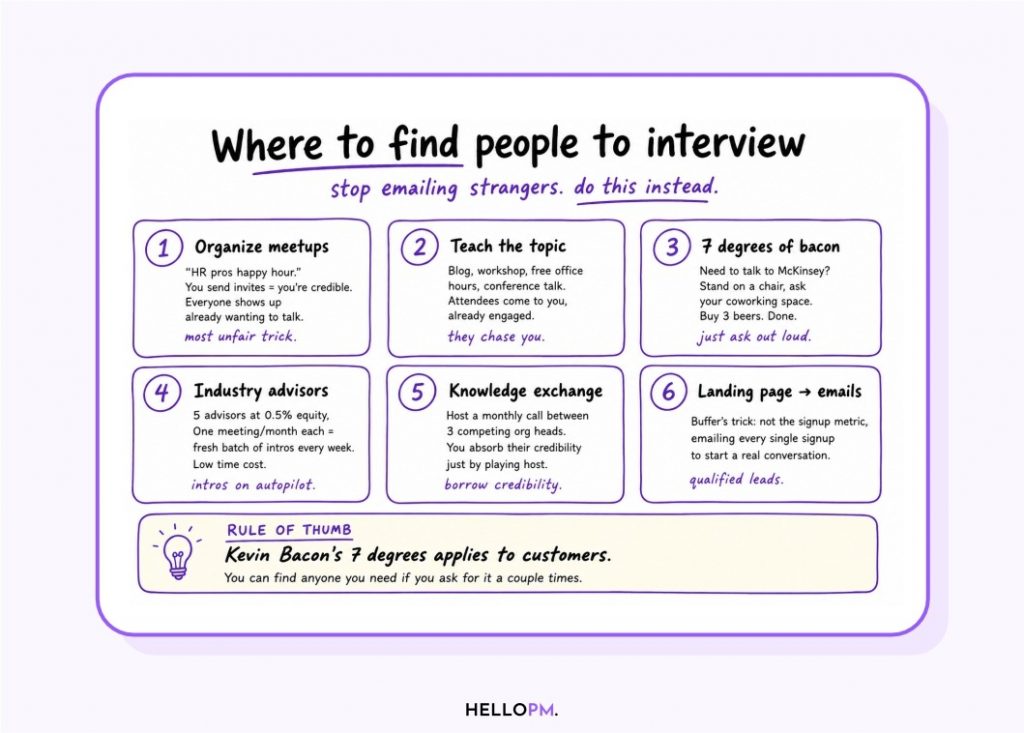
1. Organize meetups. Host your own event, like an “HR pros happy hour.” Because you sent the invites, people assume you’re credible & everyone who shows up already wants to talk about the topic. Rob calls this the most unfair trick he knows for fast learning, and almost nobody does it.
2. Teach the topic. Blog, run a workshop, give a talk, or offer free office hours. The people who attend are already interested, so they come to you.
3. 7 degrees of bacon. Everyone knows someone; just ask out loud. Rob once needed to reach McKinsey people, so he stood on a chair in his shared office, asked who had a connection, and got his intros.
4. Industry advisors. Bring on about five advisors, each for a tiny bit of equity (~0.5%). Meet each one once a month, spaced out, and you get a fresh batch of intros nearly every week without taking much time from anyone.
5. Knowledge exchange. Host a regular call between a few important people in your field. By simply playing host, you borrow their credibility and gain direct access to them.
6. Landing page to email. Put up a simple signup page, then personally email every single person who signs up to start a real conversation. The chats matter more than the signup numbers.
| Key Takeaway: Six degrees of separation apply to customers, too. You can reach anyone you need if you’re willing to ask a couple of times. |
Take notes, emoji way!
Notes are useless if you don’t look at them. Rob’s system has two rules for taking notes-
Write down exact quotes whenever you can, and wrap them in quotation marks so you know they’re word-for-word. You can reuse these later in your marketing, your pitch decks, and to settle arguments with doubtful teammates. When the exact words don’t matter, just jot the main idea.
Then mark each note with a symbol so you can spot what kind of signal it is at a glance. Rob uses about 12 symbols and invents more as needed. You don’t have to copy his; you’ll build your own over time. Here’s his set, grouped into three types.
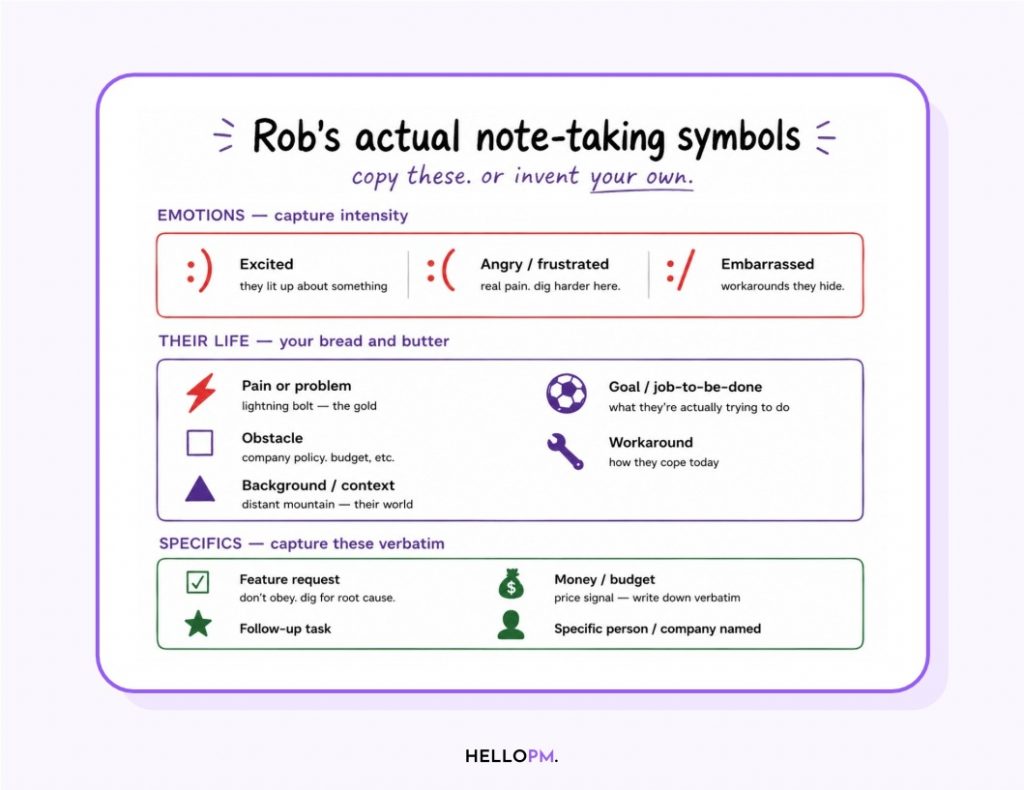
EMOTIONS (any strong feeling is worth capturing, because “that’s a problem” means something completely different when said calmly versus when said angrily):
- 🙂 Excited
- ☹️ Angry
- 😐 Embarrassed
Their LIFE (these five are the most important ones — Rob calls them his “bread and butter”):
- Pain or problem (a lightning bolt- ⚡)
- Goal or job they’re trying to get done (a goal post- 🥅)
- Obstacle — something blocking them from solving it, even though they want to (for example, a company IT rule that won’t let them use the tool they’d like- ☐)
- Workaround — the messy fix they’ve cobbled together themselves- ↺
- Background or context (a distant mountain- ⛰️ )
Tip: combine these with the emotion symbols. A pain or obstacle matters far more when the person is angry or embarrassed about it.
Then comes the SPECIFIC Group for the concrete, factual details that come up in a conversation, things you’ll need to act on later-
☑️ Feature request or must-have buying requirement. This is when they ask for something or name a condition for buying. There are primarily two flavors:
– A feature request is “it would be nice if it could do X” — note it, but don’t treat it as gospel.
– A must-have buying requirement is stronger: “I won’t buy unless it does X.”
That second kind matters a lot, because it tells you exactly what stands between you and a sale.
💷 Money, budget, or how they buy. Anything about cash. How much the problem is costing them, how much they already pay for a current solution, whether there’s a budget set aside, and who signs off on the purchase. These are the most valuable signals because they tell you if there’s real money behind the problem.
👤 A specific person or company they mentioned. Names of real people or companies. If they mention someone they know, that’s your cue to ask for an introduction at the end of the chat. If they mention a competitor or another tool they use, write it down so you can go research it later.
⭐ A follow-up task. Anything you promised to do after the meeting, send them that thing, set up the next call, make an intro. Star it so you don’t forget, especially if it was the next step you agreed on.
| Key Takeaway Emotions tell you how they feel, the “life” symbols tell you about their problems and world, and specifics tell you the hard facts, what they need to buy, where the money is, who to talk to next, and what you owe them. |
Stop Reading, Start Applying
In your next user interview-
- Open with one specific line: “Can you walk me through the last time you faced X problem?” Don’t reveal what you’re building or mention your idea; just get them describing what they actually did in the past.
- If they start tossing out feature requests, dig for the reason behind it with: “Why would you want that? What would it let you do that you can’t today?” That moves you from a surface request to the real underlying problem.
- And before you hang up, ask for one of the three signs of real commitment: time, reputation, or cash, for example, “Can I shadow your workflow for 20 minutes on a follow-up call?”
- If they won’t give up any of those, they’re not a customer; they’re just being polite.
In your next 1-on-1 with your manager or designer-
- When someone reports what users “want,” push back to the real behavior underneath.
- If a designer says “users want a search filter,” ask whether users actually asked for a filter, or described a problem that you turned into a filter. Usually, it’s the second, meaning the filter is just a guess, and the real problem sits further up.
- If your manager says “users are asking for feature X,” ask what they were actually trying to do and what they tried first. The point: chase what users did, not what they said they want.
In your next PM job interview-
- If they ask “how would you validate a product idea?”, give a structured answer: don’t pitch the idea; interview 10–15 people in the target group about how they currently solve the problem and what they did last time it came up.
- Look for three signals: they already pay for a workaround, they actively complain about current solutions, and they’ll commit time or money to a follow-up.
- No signals mean no real demand, no matter how much they say they like it.
TL; DR— 7 key takeaways at a glance
- The MTV story: they didn’t want an analytics dashboard. They wanted a branded weekly email for their clients. Feature requests are never the real problem.
- The biggest mistake in customer research is asking people what they think of your idea.
- The Mom Test = 3 rules: talk about their life, ask about specifics in the past, and talk less and listen more.
- Three types of bad data: compliments, fluff, and feature ideas. Catch them, or they’ll poison your roadmap.
- Compliments cost the customer nothing. Commitments cost them time, reputation risk, or cash. Only commitments mean anything.
- If you’re getting scattered signals, your customer segment is too broad. Use Customer Slicing to narrow to a who-where pair.
- A good interview ends with you slightly worried about your idea, not excited. ‘There’s more reliable information in a meh than a Wow!’