AI Agents for Product Managers: What They Are and When to Use Them
An AI agent is a model that takes action through tools, not one that only answers. Give it a goal […]

What an AI agent actually is
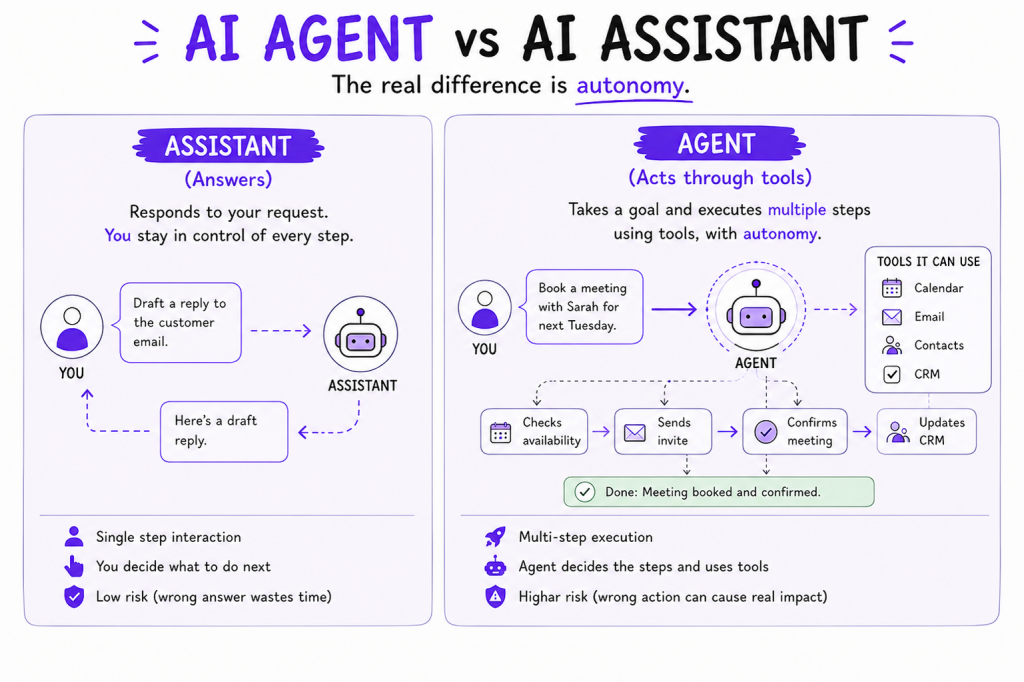
Most AI you’ve used just answers. You ask, it responds, done. An agent is different. It acts.
Give an agent a goal and a set of tools, and it can decide the steps, use the tools, check its own work, and keep going until the job is done. Book the meeting, not draft the email. Pull the data, run the analysis, and post the summary, instead of telling you how.
That’s the whole idea in a paragraph. If you want the full mechanics- how agents plan, use tools, and loop- our explainer on what AI agents are walks through it. This piece assumes you get the concept and takes you to the part that’s actually your job as a PM: deciding when to use one.
The way we describe agents: they’re like fire. Handled well, they cook your dinner. Handled carelessly, they burn the house down. That isn’t a throwaway line. It’s the whole reason a PM has to think carefully about when to reach for one.
Agent vs assistant: the difference that changes the stakes
These two get blurred, and the difference is exactly what you need to hold onto.
- An assistant answers. It responds to a request, and you stay in control of every step. A tool that drafts a reply for you to review and send is an assistant.
- An agent acts. It takes a goal and executes multiple steps on its own, using tools, without your approval for each one. A tool that reads the ticket, drafts the reply, sends it, and closes the ticket is an agent.
The moment you hand a system autonomy and access to real tools, the stakes change. An assistant who gives a wrong answer wastes a minute. An agent that takes a wrong action can send the wrong email, delete the wrong record, or spend real money.
That single shift, from answers to acts, is the line every product decision here turns on.
When an AI agent is the right call
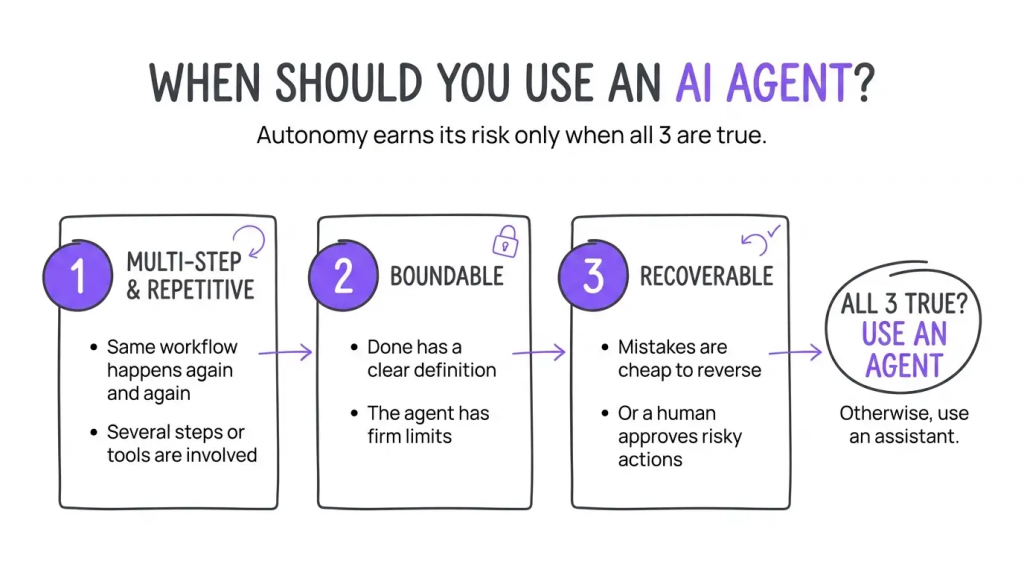
Agents are powerful, but they’re not the answer to everything. Reach for one only when the shape of the problem actually fits three tests:
| Test | Ask yourself | Agent fits if… |
| Multi-step & repetitive | Is this a task that a person does the same way, often, across several tools? | Yes |
| Boundable | Can you describe what “done” looks like and where the edges are? | Yes |
| Recoverable | If it acts wrong, is the cost low, or is there a human check before anything irreversible? | Yes |
Research assistants that gather and summarize, workflow automations that move data between tools, triage systems that route and draft: that’s natural agent territory.
Let’s understand this with an example- turn ticket triage into an agent
Say your team wants to turn support-ticket triage into an agent. Don’t say yes or no on vibes. Walk the three tests out loud:
- Multi-step and repetitive? Yes. Read the ticket, categorize it, route it to the right queue, and draft a reply. Same shape every time.
- Boundable? Mostly. Categorize and route have clear edges. “Draft a reply” is fuzzier because it touches the customer.
- Recoverable? Split. A wrong route is a shrug and a re-route. A wrong reply sent automatically is a customer-facing mistake you can’t take back.
The product decision that falls out of it: make it an agent for the read, categorize, route, and draft steps, and require human approval for the send. You get most of the speed, and you keep the one irreversible action behind a person. That reasoning, not the word “agent,” is the PM skill.
When an agent is the wrong call
Just as important, and skipped more often:
- When a simple assistant or a good prompt would do. Don’t hand autonomy to a task that never needed it. Agents add complexity and new failure modes for free.
- When mistakes are expensive or irreversible. Anything touching money, legal, safety, or a user’s data needs serious guardrails or a human in the loop.
- When you can’t define “done.” If the task is fuzzy and open-ended, an agent will wander. That’s where the house burns down.
Defaulting to “let’s make it an agent” because it sounds impressive is how teams ship something powerful and unpredictable. The judgment of agent-versus-not is a real product decision, and often the answer is “not yet.”
The risks a PM owns before it ships
If your product uses an agent, these are yours to own. Engineering builds it. You’re accountable for it behaving.
- Wrong actions. What can it actually do, and what’s the blast radius when it does the wrong thing?
- Guardrails. Where does it need a hard stop, a permission check, or a human approval before acting?
- Trust and transparency. Does the user understand what the agent did and why? Can they undo it?
- Evaluation. How do you measure whether it’s doing the job well, at scale, when its behavior varies from run to run? This is where you lean on real product analytics and the engagement metrics that show whether people actually trust it.
In our experience, the PMs who build good agent products are almost paranoid about guardrails and reversibility. They ship the autonomy last, after they trust the boundaries. The ones who lead with “look how autonomous it is” tend to learn the fire lesson the hard way.
Where agents sit in the AI PM stack
Agents sit on top of everything else: the model, prompting, retrieval, evals. You can’t reason well about agents until those lower layers make sense, because an agent is only as trustworthy as the evals underneath it.
If those layers are shaky, that’s the place to start, not here. Get comfortable with how the model behaves, prompting, retrieval, and evals first, and agents will make far more sense. A good way to build judgment in the meantime: run a product teardown of an AI agent you already use and reason about its guardrails.
Closing Note
Don’t start by building an agent. Start by judging one.
Pick an AI agent product you’ve seen, or a workflow someone wants to “make into an agent,” and pressure-test it against the three tests: is the task really multi-step and bounded, are mistakes recoverable, and where would you put a human check? That analysis is the actual PM skill, and it’s exactly what a hiring manager wants to hear.
When you want to go deeper on agents, evals, and building trustworthy AI products, take a look at our AI PM curriculum and free AI PM resources. But the judgment starts today. Go pressure-test one.
Respect the fire, and it’ll cook you dinner.
Frequently asked questions
1. What is an AI agent in simple terms?
An AI agent is a model that takes action through tools to reach a goal, not one that only answers questions. It can plan steps, use tools like APIs or a browser, and keep going until the task is done, with some autonomy.
2. What is the difference between an AI agent and a chatbot?
A chatbot (assistant) responds to requests while you stay in control of each step. An agent takes a goal and executes multiple steps on its own using tools. The agent has autonomy, which makes it both more powerful and riskier.
3. When should a product use an AI agent?
When the task is multi-step and repetitive, the steps can be clearly bounded, and mistakes are recoverable or caught by a human. If a simple assistant or a good prompt would do, or if errors are expensive and irreversible, an agent is usually the wrong call.
4. What are the risks of AI agents for a PM to manage?
Wrong actions and their blast radius, missing guardrails, lack of transparency and reversibility for users, and how to evaluate behavior that varies. A PM owns all of these even though engineering builds the agent.
5. Do PMs need to build AI agents themselves?
No. You need to decide when an agent is the right tool, define the guardrails, and own how it’s evaluated. Building it is engineering’s job. The judgment is yours.
6. Are AI agents just hype in 2026?
The capability is real, but “make everything an agent” is the hype. The valuable skill is telling the difference: knowing the narrow set of problems where autonomy earns its risk, and being honest that most tasks are better served by a well-designed assistant.