How to Switch to Product Management After 5-6 Years in Industry (No MBA, No Starting Over)
You can switch into product management mid-career without an MBA and without dropping to a junior salary. The move that […]

Why Vivek Wanted Out of Sales and Account Management
It wasn’t the work he hated. It was the part of the job that decided his day.
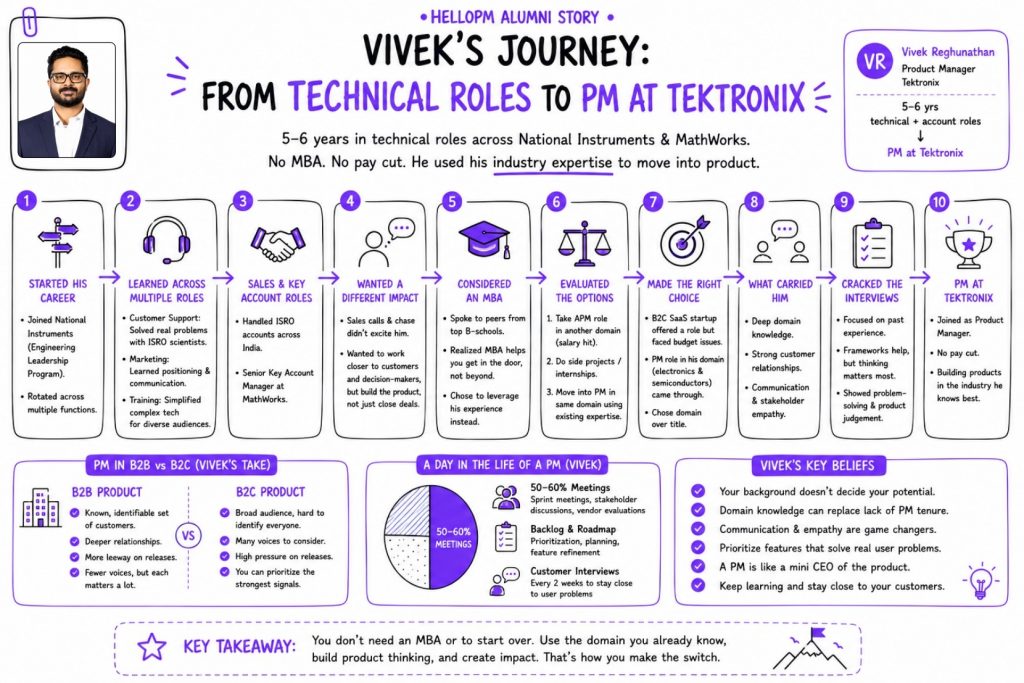
Vivek spent his early career rotating through almost every function in a technical company. He started at National Instruments in an engineering leadership program that moved him across four distinct functions. In customer support, he fielded calls from ISRO scientists trying to solve real problems with real equipment. That taught him something he kept coming back to: the problem in front of you is rarely the actual problem. You have to get to the root cause before you solve anything.
Then marketing, where he learned how products get positioned and communicated, not just built. Then training, which forced him to explain dense technical concepts clearly to completely different audiences. Each phase added a layer that the next one needed.
Finally, sales and key account management, handling ISRO accounts across the north and south of India, and later a senior key account role at MathWorks, working with R&D and executive leadership. The technical closeness to customers suited him. The sales rhythm did not.
His issue with sales was structural. In sales, one prospect converts out of many, and the day is built around chasing that conversion. Vivek wanted to work close to the customer and the decision-maker, but he wanted to shape the product from that vantage point, not just close the deal. That pull is what pointed him toward product management.
Do You Need an MBA to Switch Into Product Management?
No. Vivek seriously considered one, spoke with people who had done it, and decided against it for his specific goal: changing roles, not networks.
He spoke to colleagues who had done MBAs from tier-one schools inside and outside India, the ISBs and IIMs. His reading was practical. An MBA from a top school is excellent for one thing in a job hunt: it gets you filtered in early, before the interview. After that, it stops mattering. Once you are in the interview for a product role, the conversation is about what you have actually done.
| Tomorrow, if I am interviewing a person for a product management role, I would rather try to understand what he has done through his experience– Vivek Reghunathan |
So he made a bet: if the interview rewards experience over credentials, and he already had relevant experience, the MBA was an expensive way to solve a problem he could solve directly. He was right for his case. One honest caveat he adds: if you are earlier in your career and have less experience to point to, an MBA earlier in your career can be the better move. The calculation changes with how much real evidence you can already show.
How to Switch to PM Without Taking a Pay Cut: The Domain Move
The cleanest way to avoid the salary hit is to move into product management inside the same industry you already work in, so your domain knowledge stands in for the PM tenure you don’t have yet.
Here is the trap most senior switchers fall into. At five or six years in an MNC, the obvious path into product is an associate PM role in a B2C or SaaS company where you have no domain background. That route usually means a salary cut, because you are entering as a junior in an industry you don’t know.
| When you have 5-6 years of experience in an MNC, shifting to an APM kind of role, you will have to take a hit on your salary– Vivek Reghunathan |
Vivek looked at three real paths, not two.
- Option one: take an associate PM role, accept the salary hit, and reset into B2C or SaaS from the entry level.
- Option two: take side internships or project work alongside his job to build a product portfolio in a new domain before moving.
- Option three: use the domain knowledge he already had to move into a core PM role inside electronics and semiconductors, where his customer relationships and technical depth worked as assets instead of starting over.
Both options one and three produced offers. The B2C SaaS startup sent an offer letter, then ran into budget constraints and left the role waiting for 2 months. The other was a PM role in the same domain he had spent years in, where he already knew the customers, their problems, and the technical language. He took the in-domain role.
| With this domain knowledge, I could shift to a product management role within the same domain. I can go to the interviews and talk to people to get that part sorted out. – Vivek Reghunathan |
This is the whole mechanism. In an unfamiliar industry, your years count for little, and you reset. In your own industry, those same years are leverage you have already earned. The transferable PM skills carry across. Domain knowledge is what keeps you from starting over.
The Skills Translation: Technical Sales & Accounts → Product Management
Same work Vivek had already done. Different name once you’re in product.
| What Vivek already did | What it’s called in PM |
|---|---|
| Getting to the root cause of a customer’s stated problem | Problem definition & discovery |
| Managing ISRO key accounts, partners, and negotiations | Stakeholder management |
| Owning product messaging with R&D at MathWorks | Cross-functional collaboration |
| Knowing what domain customers actually need | Voice of the customer & requirements |
| Firefighting, partner negotiations, timelines | Trade-off & delivery management |
What Actually Carries You: Communication and Stakeholder Empathy
The skill that does the most work in product management is communication, and specifically the ability to step into the other person’s shoes before you say anything.
Vivek’s point is concrete, not motivational. You talk to a customer, your manager, and a salesperson about the same feature in three completely different ways, because each one wants something different from the conversation. The salesperson has targets and a relationship to protect. The technical architect wants the engineering problem solved. That architect’s manager cares about the roadmap and whether commitments will be met.
| It’s about stepping into their shoes, articulating it properly, taking ownership, and communicating it.– Vivek Reghunathan |
If you want a salesperson to introduce you to their customer for research, you don’t lead with what you need. You lead with the one thing on their list you can tick. That is the empathy a PM runs on. It is the same instinct Vivek built over years of account management, now pointed at internal stakeholders instead of external ones.
He is candid that this is hard to learn from outside the role and that he is still learning it. Honesty is the point. This is a craft you practice, not a box you check.
How a Product Manager Prioritizes Features?
When features pile up from sales, customers, and internal teams, Vivek prioritizes by working backward from revenue and customer needs, using a scoring framework called WSJF to make trade-offs explicit.
The starting filter is simple: which of these are nice-to-have, and which are must-have features that will actually bring revenue? He works closely with the sales and customer teams to answer that question, because effort spent on features nobody pays for is wasted.
From there, he uses WSJF (Weighted Shortest Job First) to structure the call.
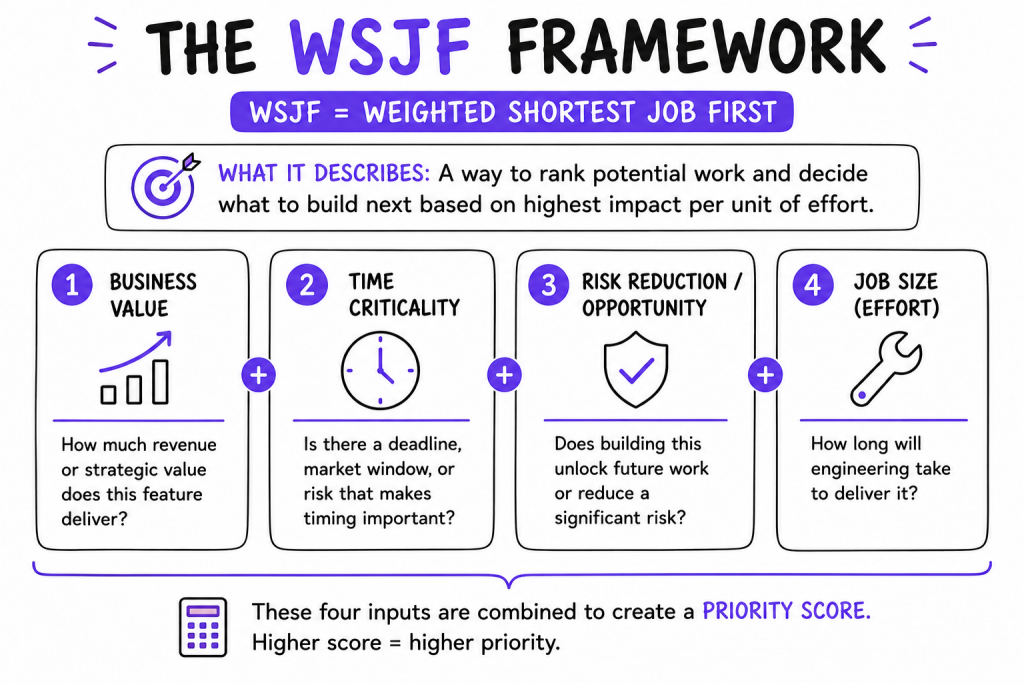
(value + criticality + opportunity) ÷ effort → priority score
Vivek is clear that the score is a starting point, not a verdict. Once the numbers rank the list, he takes it back to customers and engineering to pressure-test it. Do you really need this? Is this estimate real? The framework forces the conversation. It doesn’t replace it. In the end, prioritization comes back to two things: what the customer actually needs, and what brings in revenue.
Is a Product Manager Really a “Mini CEO”?
No. Vivek’s take is that, in “product manager,” the “manager” part is only in the title. You don’t control the product; you earn the right to influence it, over and over.
The “CEO of the product” line is flattering, and Vivek has seen it in his own job profiles. He doesn’t buy it. The product sits under engineering’s, the customer’s, and sales’s control as much as yours. You walk into every discussion having to prove your credibility again.
| As a product manager, the manager title is only in the title.– Vivek Reghunathan |
He goes further on sales specifically: they are your best friends in the building, and nothing moves if you are not aligned with them. The realistic version of the job is closer to this: you go to users, find the real root cause of their problem, bring it back to your team, get them to build it, keep it on time, and own the outcome when it slips. It is a lot of responsibility and very little command. Come in expecting to be the boss, and the role will disappoint you. Come in ready to take ownership of everything and figure out the rest, and it fits.
What a PM Interview Is Actually Like
A product interview tests how you think through a problem, not whether you reach the “right” answer. Vivek’s domain interview and his B2C SaaS interview tested this in completely different ways.
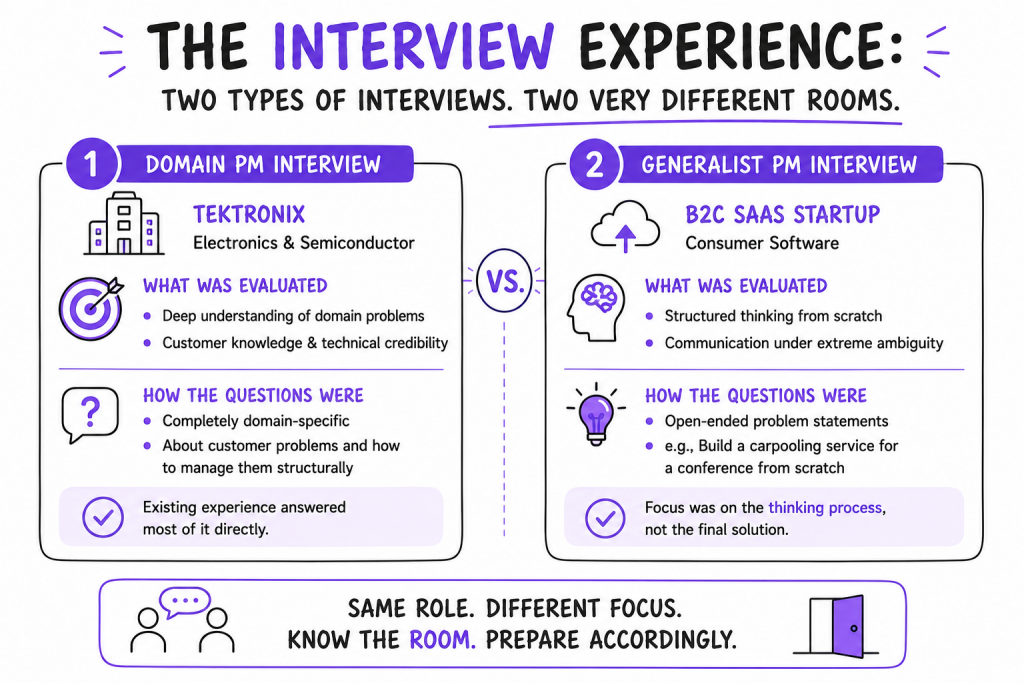
In his own domain, the questions were specific: the real problems in that market, how customers see them, how you’d manage them. His years in the field answered most of it. In the B2C SaaS interview, where he had no domain background, the questions were deliberately open-ended and generic.
One he remembers: there’s a conference, people are arriving by cab and bus, so design a carpooling service for them. The trap is rushing to a solution. The actual test is whether you first ask if a carpool service is even needed, reach a view on whether it’s a problem worth solving, and only then move to how you’d build the simplest version, which might be as basic as a Google Form for feedback. They are watching your process and whether you can think out loud on your feet.
| It’s not about how effective a solution you bring, but about the process of thinking it through.– Vivek Reghunathan |
Vivek credits the case scenarios he practised at HelloPM for this, where mentors walked through how they actually approached these problems on the job. The assignments mattered more than the classes. He ran a full project on CRED’s loan feature, doing real user research among his own contacts who used the app, then building the output with the course’s market-research tools. That applied practice is what let him think out loud calmly when it counted.
Vivek’s Actual Path
- Electronics & electrical engineering degree — Found he liked the project work; represented his college at international forums.
- National Instruments — four functions in one leadership program — Customer support (ISRO scientists’ calls), then marketing, then training, then sales and key account management. Learned to get to the root cause before solving.
- Key account management — ISRO accounts, north & south India — Loved the technical closeness to customers. The sales-call rhythm wore him down.
- Senior key account role at MathWorks — Global role with the makers of MATLAB. Worked with R&D and executive leadership; sharpened crisp, high-stakes communication.
- Decided against an MBA — Concluded experience would carry his interviews further than a credential would.
- Enrolled in HelloPM while working — Learned the market’s product terminology and frameworks, and mapped them onto what he’d already been doing. Built a full project on CRED’s loan feature.
- Three options: APM reset vs side projects vs in-domain PM — Chose the electronics-domain role where his knowledge was leveraged, not a liability.
- Product Manager at Tektronix — Data center and consumer electronics markets. No MBA. No pay cut. No starting over.
Vivek’s Advice for Senior Professionals Making the Switch
Talk to people in the role first, do product work inside your current job before you ever apply, and build a small body of side projects so you have something concrete to discuss in interviews.
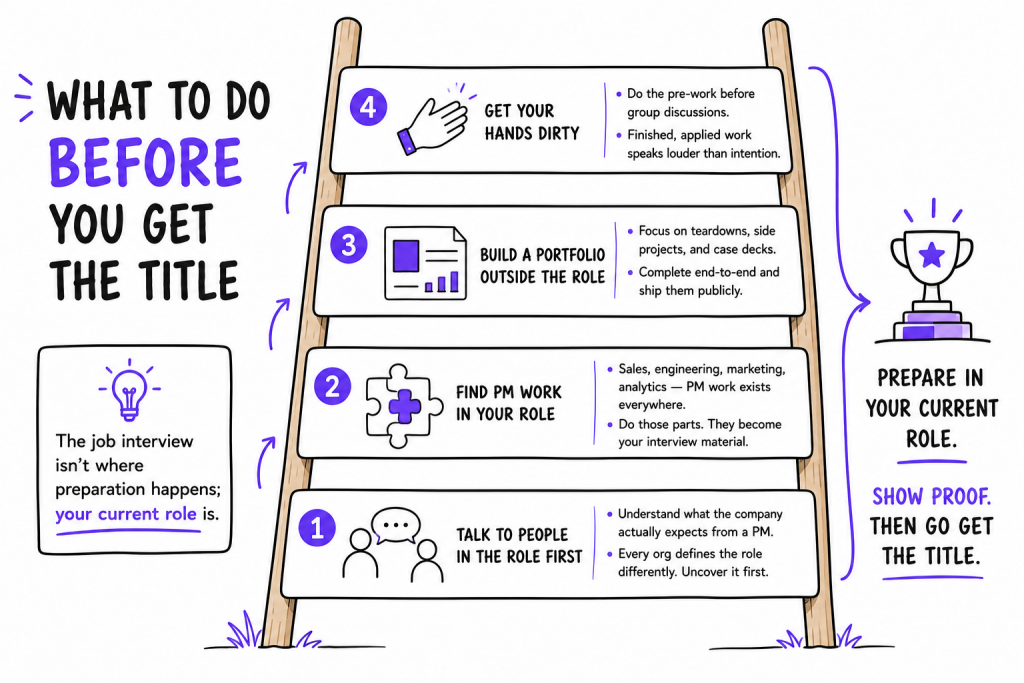
Talk to people before you plan. Whatever space you want to move into, speak to people already in that exact role and understand what is really expected. Product management means something different at every company, and that ambiguity is what trips people up. Figure out what a specific opening actually wants before you chase it.
Do PM work inside your current job. Whatever role you’re in, there are aspects of product management you can practice right now, and that practice becomes interview material later. Vivek had already done most of the job, except managing engineering teams directly, by the time he applied.
Build side projects. This is the one thing he says he’d do more of if he started again. He signed up for product teardowns, including one for the pay-later app Simple, but didn’t follow through on all of them. His advice: take up teardowns and side projects beyond your day job so you have more to talk about and more proof of product thinking.
| Get your hands dirty and try to gain as much experience as possible.– Vivek Reghunathan |
2,800+ HelloPM alumni from across sales, account management, engineering, and non-tech backgrounds – many of whom, like Vivek, switched into product without an MBA.
Frequently Asked Questions
1. Can you switch to product management mid-career without taking a pay cut?
Often, yes, if you move into a PM role inside an industry you already know. The pay cut usually comes from entering an unfamiliar domain as a junior PM, where your past experience counts for little. Staying in your own domain lets your existing knowledge substitute for PM tenure, as Vivek Reghunathan did to avoid the cut.
2. Do you need an MBA to become a product manager?
No. An MBA from a top school can help you get filtered in early during a job hunt, but in a product interview, the conversation is about what you’ve actually done. Many PMs transition without one. If you’re early in your career with less experience to point to, an MBA earlier on can make more sense.
3. Can you become a product manager from a non-technical background?
Yes, with a caveat about the company. A very technical company makes it easier to build credibility if you already know the domain, but many PM roles don’t require a technical background at all. What matters most is communication, analytics, stakeholder management, and a willingness to take ownership. You don’t need to be a software developer to get the role.
4. How do product managers prioritize features?
By working backward from customer need and revenue, then using a scoring framework to rank the options. Vivek uses WSJF (Weighted Shortest Job First), which weights business value, time-criticality, future opportunity, and delivery effort. The score is a starting point that gets pressure-tested with customers and engineering, not a final answer.
5. Is a product manager really the “CEO of the product”?
Your thinking process, not your final answer. Product-sense questions like “design a carpool service for a conference” test whether you first check whether the problem is worth solving, reason it through out loud, and communicate clearly. Practicing real case scenarios beforehand is what makes this feel natural in the room.