AI PM vs Product Manager: What Actually Changes in the Role (2026)
An AI PM and a product manager do the same core job: solve a real user problem with good product […]

What is the real difference between an AI PM and a product manager?
One thing. Traditional software is deterministic: the same input gives the same output, every time. AI is not. Ask a model the same question twice, and you can get two different answers.
AI is probabilistic. It doesn’t reason like a human; it predicts. That mindset shift changes how you design everything. It’s the whole difference in one line, and everything people list as a “difference” flows from it.
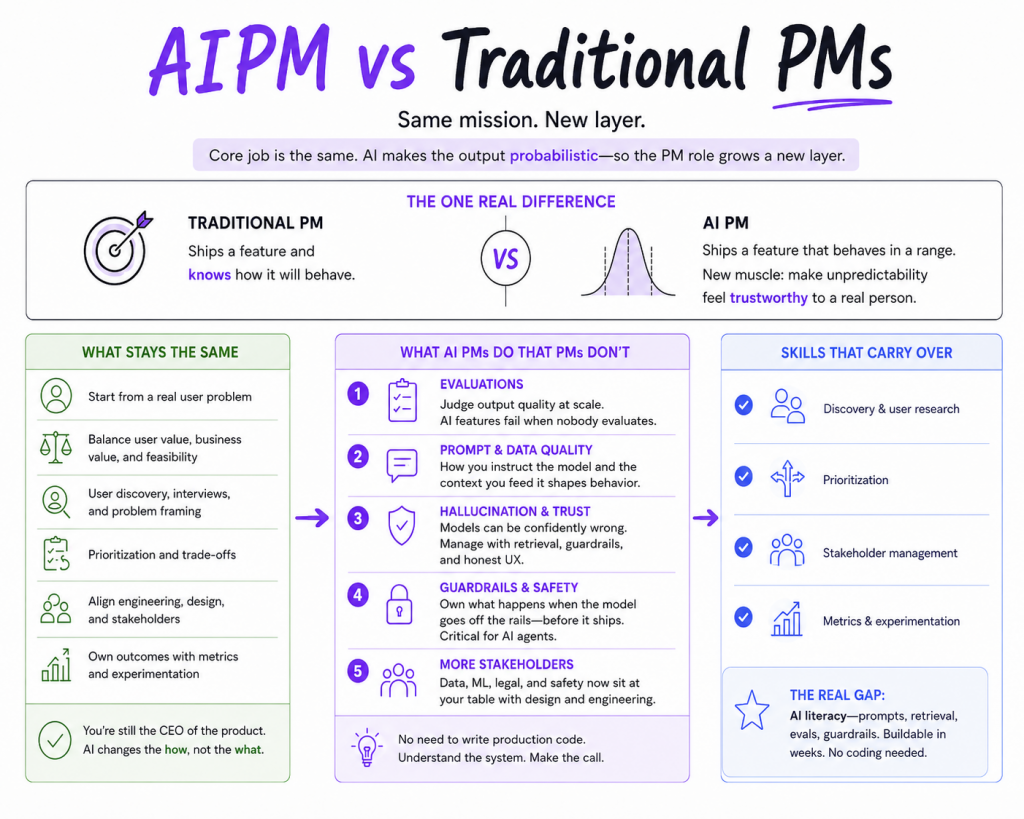
A regular PM ships a feature and knows how it will behave. An AI PM ships a feature that behaves in a range. So the job grows a new muscle: making something unpredictable feel trustworthy to a real person. Once that shift clicks, you design, test, and measure differently.
What stays the same when a PM becomes an AI PM?
Most of the job. This is the part nobody tells you, and it’s the reassuring part.
An AI PM still starts from a real user problem. Still balances user value, business value, and feasibility. Still prioritizes hard, talks to users, writes the problem statement, aligns engineering and design, and owns the outcome. The “CEO of the product” instincts don’t change. An AI PM is simply one of the many types of product managers; the AI is the how, never the what.
If you’re a PM today, you already own most of an AI PM’s job. You’re not starting over; you’re adding a layer. That’s why the switch is so much smaller than it looks, and why we spend the first weeks on product fundamentals before touching AI at all.
What does an AI product manager do that a traditional PM doesn’t?
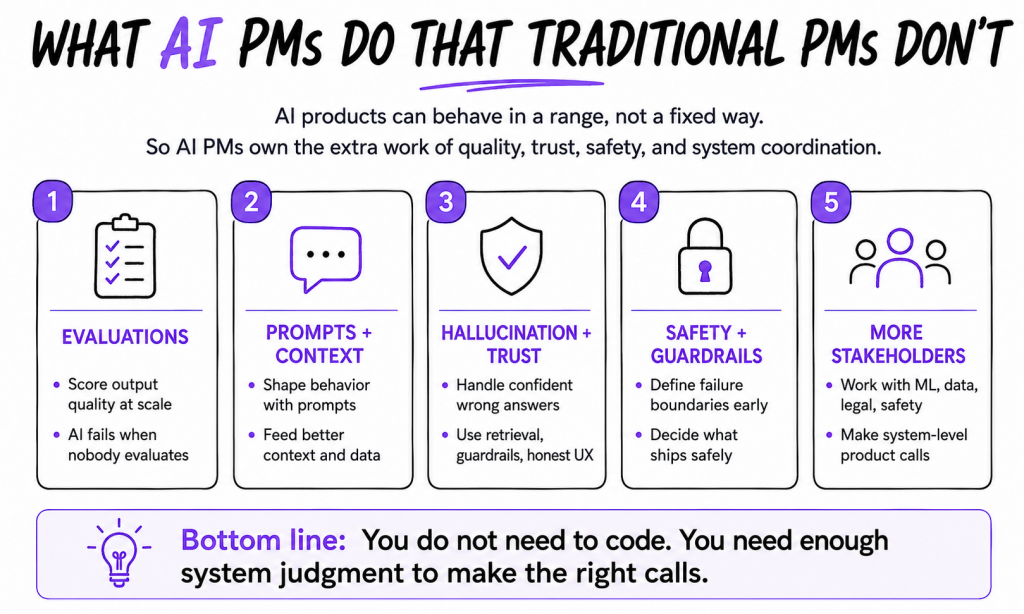
Here’s the new layer: five things a traditional PM rarely touches, all of them downstream of “the output is not fixed.”
- Evaluations. Because the output varies, you need a way to judge quality at scale (an “eval” is a repeatable test that scores the output’s quality). The blunt version to remember: an AI feature fails not because the model is weak, but because nobody evaluated it.
- Prompt and data quality. Your product’s behavior now depends on how you instruct the model and what context you feed it. That’s a product decision as much as an engineering one.
- Hallucination and trust. The model can be confidently wrong. Managing that, with retrieval, guardrails, and honest UX, is now your job.
- Guardrails and safety. What happens when the model goes off the rails? You own the answer before it ships. This matters most in products built on AI agents, which act on their own.
- More stakeholders. Data, ML, legal, and safety now sit at your table alongside design and engineering.
None of these requires you to write production code. They need you to understand the system well enough to make the call.
Which PM skills carry over to AI product management?
Almost all of them. Look at your current work, and you’ll find most of an AI PM’s toolkit already there.
- Discovery and user interviews stay the foundation. AI changes the how, not the what.
- Prioritization becomes even more valuable as AI opens more options than you can build.
- Stakeholder management carries straight over. You already influence without authority, now across a couple more functions.
- Metrics and experimentation transfer directly. You add a few AI-specific ones, like hallucination rate and acceptance rate, which are really just metrics vs analytics applied to a probabilistic product.
The gap isn’t your product skill. It’s AI literacy: enough understanding of prompts, retrieval, and evals to make good calls. You can build that in weeks, and you can do it without learning to code.
Do AI product managers get paid more than PMs?
Usually, yes. AI product roles are in high demand, and demand moves pay.
As of 2026, the average AI PM salary in India is around ₹30 LPA total pay (Glassdoor), with senior roles well above that and Bengaluru averaging higher. In the US, the average is around $197,600 (Glassdoor).
Compared with standard PM roles, AI PM roles carry a clear premium at the same level, and that premium widens with seniority as AI expertise remains scarce. For the full pay picture, see our guide to product manager salary in India.
Should you switch from PM to AI PM?
If you’re already a PM, this is one of the lowest-risk, highest-upside moves available to you in 2026. You keep most of your skills and add a layer that’s in heavy demand. Roles are converging, and the PMs who add AI fluency early will have the pick of them.
You don’t need to quit, learn to code, or get a new degree. You need three things: get AI-literate, build one small AI thing to prove it, and reframe your existing wins in AI-product language.
The mindset that matters most: AI doesn’t change what product management is. It gives you sharper tools. Product management has always been about understanding people and solving real problems, and that’s still the game.
Product managers who switched to AI PM
You don’t have to take our word for it. Experienced PMs come to add AI all the time, and the reassuring part is what they say afterward.
Take Prithwish Chakravarty. He spent 15+ years in banking and fintech, and 5-6 years as a Senior PM in B2B fintech, before joining to upskill in AI. Even at that level, the thing that stood out to him was not the AI wizardry. It was the emphasis on strengthening core product fundamentals before diving into AI, and he’s cleared several interviews since starting.
That’s the whole point of this piece. Even a senior PM found the value wasn’t in chasing AI buzzwords. It was in getting the fundamentals sharp and then adding the AI layer on top.
And existing PMs aren’t the only ones. People cross into product and AI product roles from QA, sales, and non-tech backgrounds, too. Read how a software developer became a PM and how a sales professional moved into AI product management.
Kickstart your AI Product Management Journey
If you’re a PM eyeing this move, don’t overthink it. You’re closer than you think.
Pick one AI product you use often, and write down how it handles the probabilistic problem: where it could be wrong, how it builds trust, what it measures. That single product teardown will teach you more about the real difference than any comparison table.
When you’re ready to add the literacy and build real proof, take a look at our AI PM curriculum and free AI PM resources.
The switch is smaller than it looks. You’re closer than you think.
Frequently asked questions
1. Is an AI PM just a product manager who uses AI tools?
No. Every PM now uses AI tools; that’s table stakes. An AI PM builds products powered by AI models and owns the parts unique to AI: evaluations, prompts, data quality, hallucination, and guardrails. Using ChatGPT to draft a PRD doesn’t make you an AI PM. Building the product does.
2. Do you need to code to move from PM to AI PM?
No. You need technical literacy, enough to reason about prompts, retrieval, evaluations, and guardrails, not the ability to write production code. Most applied AI PM roles are about product judgment on top of existing models.
3. How hard is it for a traditional PM to become an AI PM?
Not hard, if your product fundamentals are solid. You keep most of your skills and add AI literacy, which takes weeks, not years. The PMs who struggle are the ones who skip fundamentals and chase AI buzzwords.
4. What is the single biggest difference between an AI PM and a PM?
That AI is probabilistic, not deterministic: the same input can give different outputs. Everything new in the role- evaluations, guardrails, trust, and flows- comes from that one fact.
5. Do AI product managers get paid more than product managers?
Generally yes. AI PM roles command a clear premium over standard PM roles at the same level, and the gap widens with seniority as AI skills stay scarce. In India, AI PMs average around ₹30 LPA in 2026, per Glassdoor, with higher salaries in Bengaluru.
6. Will AI PM roles replace traditional PM roles?
Not replace, reshape. Over time, most PM roles will involve AI in some form. The PMs who add AI literacy early win; the ones who wait play catch-up.