AI Product Manager Skills: The Stack to Learn First in 2026
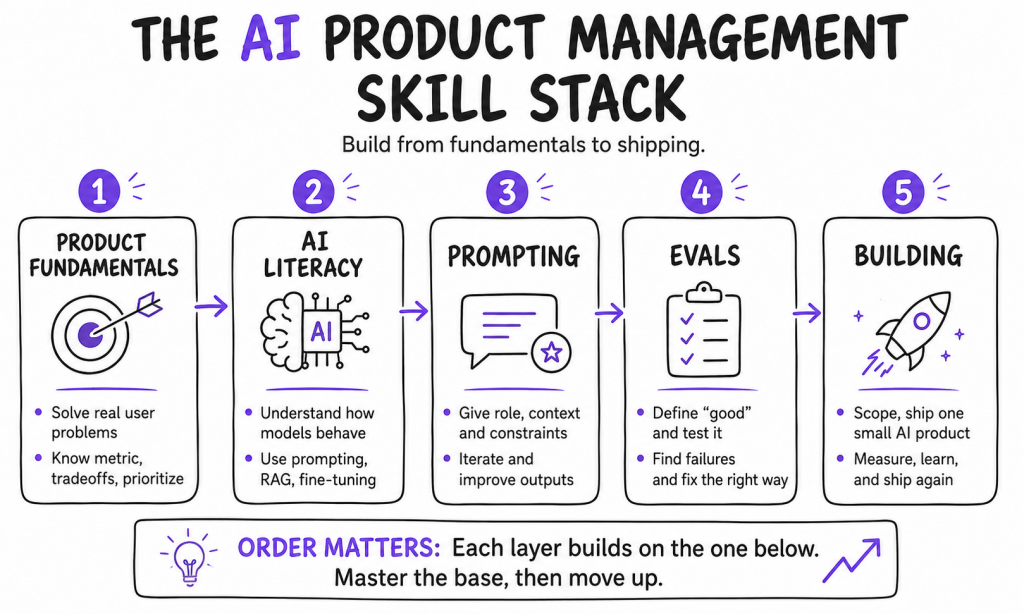
The AI PM skill stack, in the order that actually works: product fundamentals first, then AI literacy, then prompting, then […]
There is a Sequence to Learn
Most “AI PM skills” lists throw 20 things at you with no sequence. That is the fastest way to feel busy and learn nothing.
Skills stack. Each one only makes sense once the one below it is in place. Try to learn evals before you understand that a model is probabilistic, and none of it lands. Learn prompting before you understand product fundamentals, and you will prompt your way to a product nobody needs.
So treat this as a stack you build from the ground up, not a checklist you tick in any order. Each layer below has the same three parts: what it is, what to actually learn, and a plain test for when you’ve got it.
AI Product Management Skill Stack, bottom to top
Layer 1: Product fundamentals
What it is. The base, and the one everyone wants to skip. An AI PM is still a PM. You solve a real user problem, weigh user value against business value and feasibility, prioritize, talk to users, and decide what to build and why.
What to learn. Problem framing (what’s the actual user pain, not the feature request), prioritization, how to write a crisp PRD, and the core product management frameworks for deciding what matters. Pick one product you use and practice on it.
You’ve got this layer when you can take any product and state, in three lines, the real problem it solves, who it’s for, and the one metric that proves it’s working, and say what you’d cut.
If this layer is weak, nothing above it holds. A hiring manager can tell within minutes when someone has learned AI terms but can’t reason about a product.
Layer 2: AI literacy
What it is. The AI part, and its understanding, not engineering. You need to know how a model behaves well enough to make product calls, not enough to build one yourself.
What to learn. How a large language model actually works: it’s probabilistic, not deterministic; it predicts the next likely word rather than reasoning; it has a fixed knowledge cutoff, and it will confidently make things up (hallucinate) when it doesn’t know. Then the three ways a PM gets a model to do useful work: prompting (instructions), retrieval (feeding it your data, often called RAG), and fine-tuning (training it further, rarely your first move). Add a working grasp of what AI agents are, since more products are built on them.
You’ve got this layer when you can explain to a non-technical friend, in two sentences, why an AI tool sometimes invents an answer, and when you’d give it your own data instead of just writing a better prompt.
This is the layer people fear, and it’s the one you can clear in a couple of focused weeks.
Layer 3: Prompting
What it is. Your main lever for steering a model, and a real craft, not a footnote. A strong prompting PM can shape product behavior without writing production code, prototype the experience, test it, and hand-engineer a clean spec.
What to learn. Give the model a clear role and task, give it context and an example or two, constrain the output (format, length, “say I don’t know if unsure”), and design against hallucination directly in the instruction. Then iterate: change one thing, watch what moves. A guide like ChatGPT for product managers is a good place to practice.
You’ve got this layer when you can predict what a change to a prompt will do to the output before you run it, and you know why a prompt works, instead of only that it did.
Layer 4: Evals (how you know an AI feature is any good)
What it is. The layer that separates real AI PMs from people who memorize buzzwords, and the one almost everyone skips. An eval is simply a repeatable way to check whether an AI feature’s output is actually good. Because the output changes every run, you cannot eyeball it once and ship. You need a test.
What to learn. The loop is short, and you can run it on any feature:
- Define “good” in five bullets. For a support bot: accurate, on-tone, admits when it doesn’t know, never invents a policy, answers in under three sentences.
- Build a small test set. Fifteen to twenty real inputs, including the hard and weird ones (empty input, two languages, an angry rant, a trick question).
- Write a simple rubric. One pass/fail check per “good” bullet.
- Run it and find the failures. Document the cases where the feature fails your own rubric. This is the actual skill: breaking your product on purpose before a user does.
- Pick the right fix, in the right order. Try a prompt change first, then retrieval if it’s a knowledge problem, then fine-tuning only if you genuinely must. Reaching for fine-tuning first is a classic waste of months.
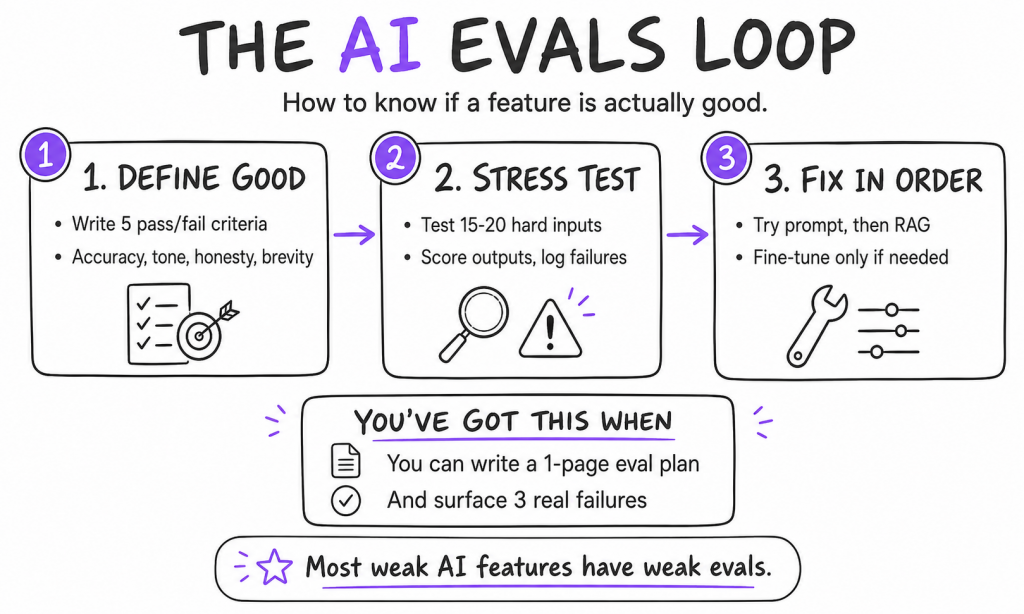
You’ve got this layer when you can take any AI feature and produce a one-page eval plan, then actually surface three real failures in it.
The blunt truth to carry: an AI feature usually fails not because the model is weak, but because no one has evaluated it.
Layer 5: Building
What it is. The top of the stack, and the proof of everything below it. In 2026, you can build a working AI product with no-code and vibe-coding tools, no engineering required.
What to learn. Scope something small and real, ship it with a no-code AI builder, and write up the decisions you made. The AI tools for product managers worth knowing are fewer than the hype suggests; learn a couple well.
You’ve got this layer when you’ve shipped one small AI thing and can walk someone through the decisions: why you scoped it that way, how you stopped it hallucinating, what broke, and what you’d do next.
One small thing you built, with the decisions written up, is worth more than every certificate combined.
The skills that survive AI
Here is the part worth betting your time on. Tools change every quarter. A few skills do not.
Product judgment. Understanding people. Framing the right problem. Deciding what not to build. These are the skills AI cannot do for you, and they are exactly what will still matter when today’s models are three generations old.
Across the 2,800+ of our alumni now working in product roles, the ones who last are not the ones who chased every new tool. They are the ones who got the judgment layer right and treated AI as leverage on top of it. Learn the tools. Bet on the judgment.
What to skip (the traps that waste months)
Just as useful as what to learn is what to leave alone.
- Deep ML math. You are building on top of models, not training them. Skip the linear algebra.
- Chasing every new tool. A new AI tool launches every week. Learn the categories, not all 200 apps.
- Certificate collecting. One more course feels like progress. It usually is not. Build something instead.
- Prompt-hoarding. A folder of 500 saved prompts is not a skill. Understanding why a prompt works is.
The goal is a T-shape: deep enough in the AI stack to make sharp calls, broad enough across product, users, and business to lead.
A 30-day order to learn it in
You do not need a year. You need a sequence and four focused weeks.
- Week 1: shore up product fundamentals. Pick one product, write its problem, users, and one success metric.
- Week 2: AI literacy. Learn how a model behaves, then retrieval, then what an eval is. Explain each to a friend in two sentences.
- Week 3: Prompting. Take a repetitive task, write a strong prompt, improve it three times, and watch what moves.
- Week 4: evals, then build. Write a one-page eval plan for a feature, then ship one small AI thing using a no-code tool, along with the one-page decision note.
Four weeks, five layers, one real build. That is the whole stack. For the full career path around it, see our step-by-step roadmap to becoming an AI PM.
Who learned this stack and switched
You don’t have to take our word for it. Here is what our alumni have to say.
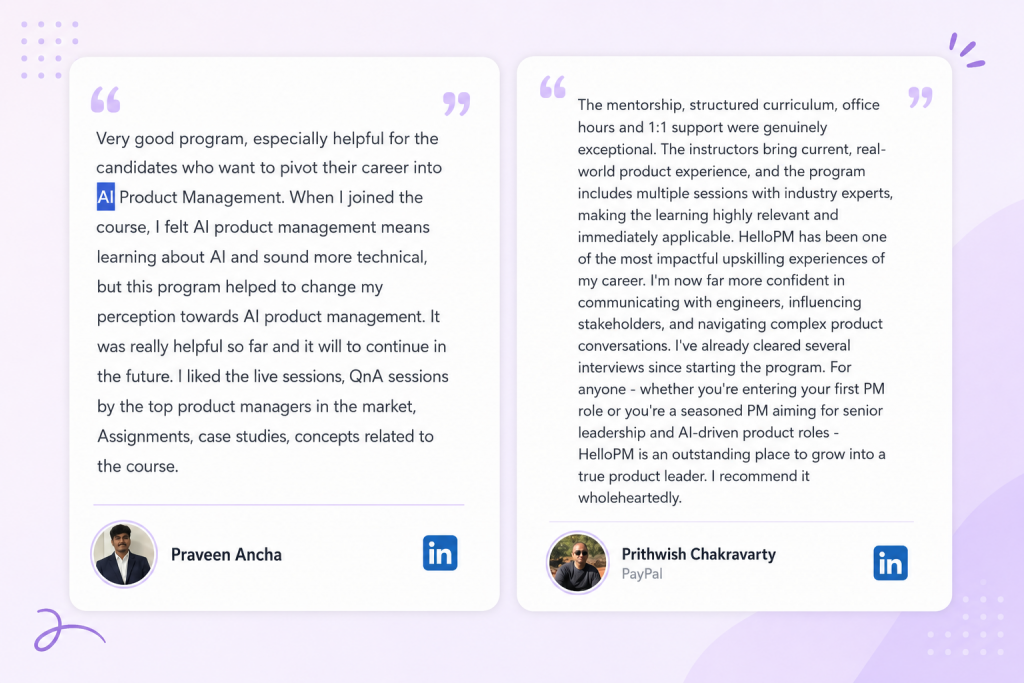
For the full stories, read how a software developer became a product manager and how a sales professional moved into AI product management with no tech background.
Where to start
Don’t try to learn the whole stack this week. Start at the bottom.
This week, take one product you use and write down the real problem it solves, who it’s for, and the one metric that proves it works. That’s Layer 1, and it’s the foundation everything else sits on. Next week, add AI literacy. The stack builds itself once you start at the base.
When you want the structured version, or a second pair of eyes on your first build, take a look at our AI PM curriculum and free AI PM resources. But Layer 1 is yours to start today.
So go write that one problem statement. Layer 1 starts there.
Happy learning 🙂
Frequently asked questions
1. What skills does an AI product manager need?
In order: product fundamentals, AI literacy (how models behave), prompting, evals (how you judge output quality), and the ability to build a small AI product with no-code tools. Product judgment sits underneath all of it and matters most.
2. Do AI PM skills require coding?
No. The stack is about product judgment and AI literacy, not engineering. You should understand prompts, retrieval, and evals well enough to make decisions, not write production code.
3. Which AI PM skill matters most?
Product judgment. Tools and models change constantly; the ability to frame the right problem, understand users, and decide what to build is what lasts. It’s also the hardest to fake in an interview.
4. What exactly is an “eval” and why does it matter so much?
An eval is a repeatable test that scores whether an AI feature’s output is actually good. It matters because AI output changes every run, so you can’t just check it once. Defining “good,” building a test set, and finding real failures before users do are the single skills that most separate a real AI PM from someone who only knows the vocabulary.
5. How long does it take to learn AI PM skills?
If you already have product fundamentals, a few focused weeks. A sensible order is fundamentals, then AI literacy, then prompting, then evals, then one real build, roughly a week each.
6. What AI PM skills should I not bother learning?
Deep ML math, every individual AI tool, and stacks of certificates. Learn the categories and the judgment, build something real, and skip the rest until a job actually needs it.