How to Become an AI Product Manager in 2026: The 7-Step Roadmap (No Experience or Coding Required)
You can become an AI product manager in 2026 without prior PM experience or coding skills. The path is four […]
Is AI even worth betting your career on?
Yes. AI is not a bubble you will regret chasing, because it is already useful, not just promised to be useful.
Here is a ten-second test to prove it to yourself:
Think about NFTs, blockchain, and the metaverse.
Most of us only ever read about them.
Now think about the last time you opened ChatGPT or Gemini.
Probably today. Maybe an hour ago.
Something already sitting inside your daily work is not hype waiting to pop.
Are some valuations silly? Sure. Will a pile of AI startups fold? Also yes.
But the usefulness is real, and it grows every month. That is why these roles keep multiplying while the hype cycles come and go.
What is an AI product manager, and how is it different from a regular PM?
An AI product manager is a PM who builds products powered by AI models and owns the parts unique to AI: the data, the prompts, the retrieval, the evaluations, the guardrails, and the strange fact that the same question can yield two different answers on two different days.
That last part is the real difference. Traditional software is deterministic; the same input gives the same output, every time. AI is probabilistic; the same prompt can yield one result today and another tomorrow. So an AI PM spends real energy on things a normal PM rarely touches: judging quality you cannot take for granted, and making something unpredictable feel trustworthy to a real person. If you want this compared side by side, we wrote a full piece on AI PM vs product manager.
The two kinds of AI PM, and the one you should aim for
There are two flavors of AI PM, and picking the right one saves you months of chasing skills you will never use.
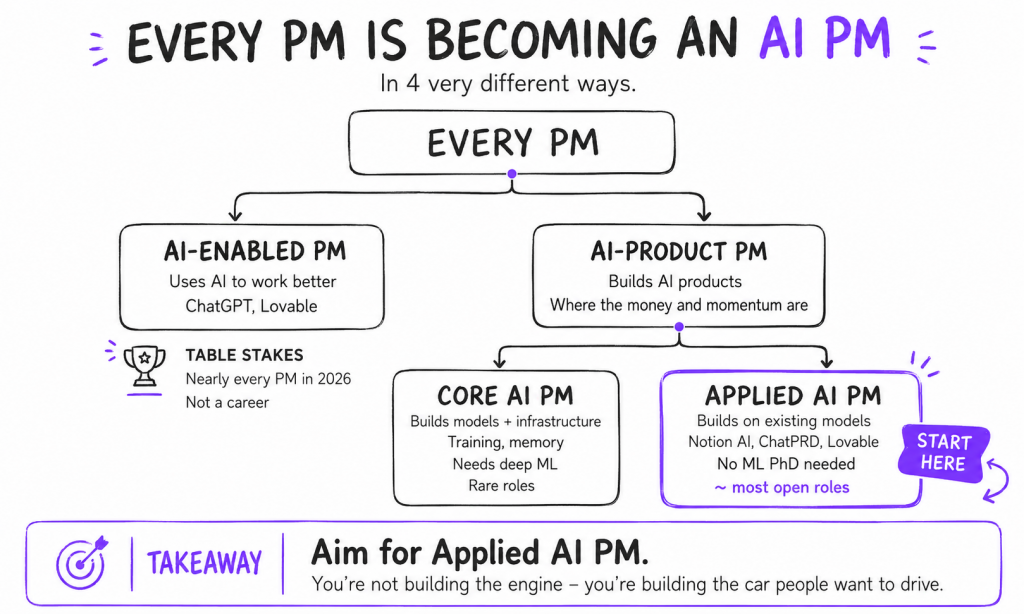
An AI-enabled PM uses AI to do their existing job better: drafting a PRD in ChatGPT, prototyping in Lovable, leaning on the AI features now baked into every tool. In 2026, that is basically every PM alive. It is table stakes, not a career.
An AI-product PM builds AI products, and that is where the money and momentum are. It splits one more time:
- Core AI PM builds the models and infrastructure themselves, training, memory, and efficiency. This needs a deep ML background.
- Applied AI PM builds useful products on top of models that already exist, like Notion AI, Grammarly, ChatPRD, or Lovable.
Aim for applied. That single choice is why coding and an ML PhD are not your entry ticket. You are not building the engine. You are building the car people actually want to drive.
Where do AI product managers actually create value?
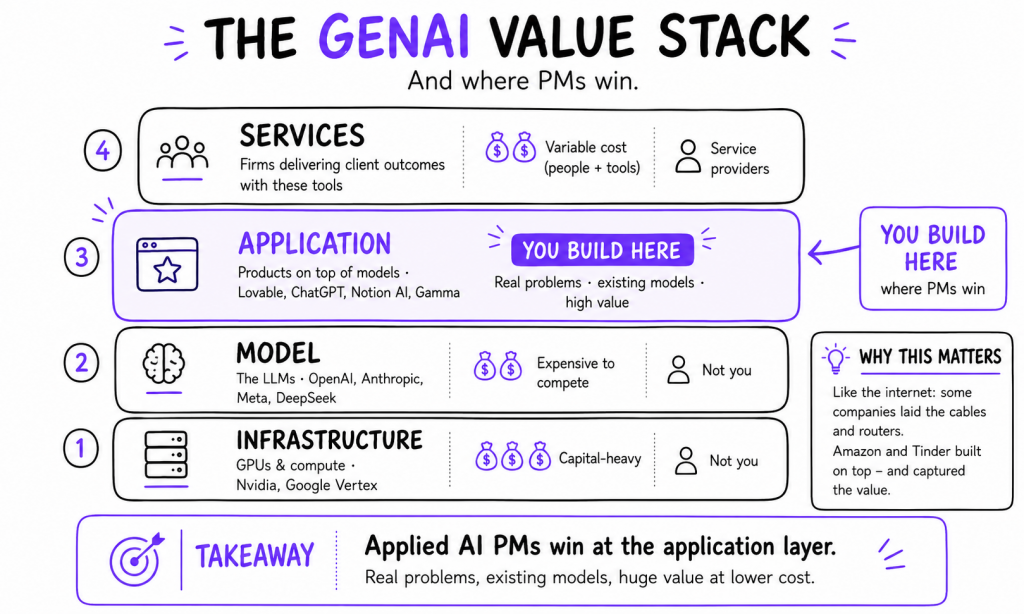
Short answer: at the application layer. You solve a real customer problem on top of a model somebody else already spent a fortune training.
To see why that is the sweet spot, look at how generative AI stacks up:
- Infrastructure: the GPUs and compute, think Nvidia and Google Vertex. Brutally capital-heavy.
- Model: the LLMs themselves, like OpenAI, Anthropic, Meta, and DeepSeek. Expensive to compete in.
- Application: products solving a customer problem on top of those models, like Lovable, Gamma, and ChatGPT.
- Services: firms using these tools to deliver outcomes for clients.
The internet played out the exact same way. A few companies laid the cables and built the routers. Amazon and Tinder did not. They built on top and captured the real value. Your ground as a PM is that top layer.
Here is something we strongly believe: use AI for leverage, not speed.
Doing your old job 20% faster is a small win. The real prize is doing things that were not possible before, like shipping a working prototype on your own in an afternoon.
Aren’t AI products just ChatGPT wrappers?
Some are. Many are not, and telling the two apart is a big part of the job.
You have probably thought it, so let’s say it out loud…
Plenty of AI products really are thin wrappers: a prompt, a clean screen, nothing underneath.
They compete on looks and get cloned in a weekend. The moat is thin. The ones that last are different.
They own a real workflow, a private data source, or a hard problem the model alone cannot crack.
Granola is not “a prompt over a transcript”; it is a meeting workflow people build their week around.
NotebookLM is not “chat with a PDF”; it is grounded retrieval from sources you trust.
Choosing to build the version with a moat instead of the one that gets copied is exactly the judgment you are hired for.
So the honest answer is: some are, and your whole job is to build the kind that isn’t.
Do you need to code or have a degree to become an AI PM?
No. Not coding, not a specific degree, not an MBA, not an ML PhD.
What an applied AI PM needs is literacy: enough understanding of prompts, retrieval, evaluations, latency, and guardrails to make good product calls. Not the ability to write production code. “No coding” does not mean “no technical understanding”; it means you understand the system well enough to make decisions, not to build it yourself. You can build that depth in weeks.
And you do not need prior product experience either. Career-switchers make this jump all the time.
One of our alumni who moved from QA testing into product, with no coding pedigree, gives the sharpest advice I have heard on it:
“Even before you get the tag of a PM, always play that role. Even if you are working as a salesperson, a developer, or a QA, start pretending: if I were a PM, what would I have done extra?”
That mindset, acting like a PM before anyone hands you the title, is how people break in with no experience and no tech background. You can watch his transition story here.
The 7-step roadmap to becoming an AI product manager
Seven steps, in order. Each one leans on the last, so do not skip the early ones to reach the shiny AI parts. That is exactly where people fall over.
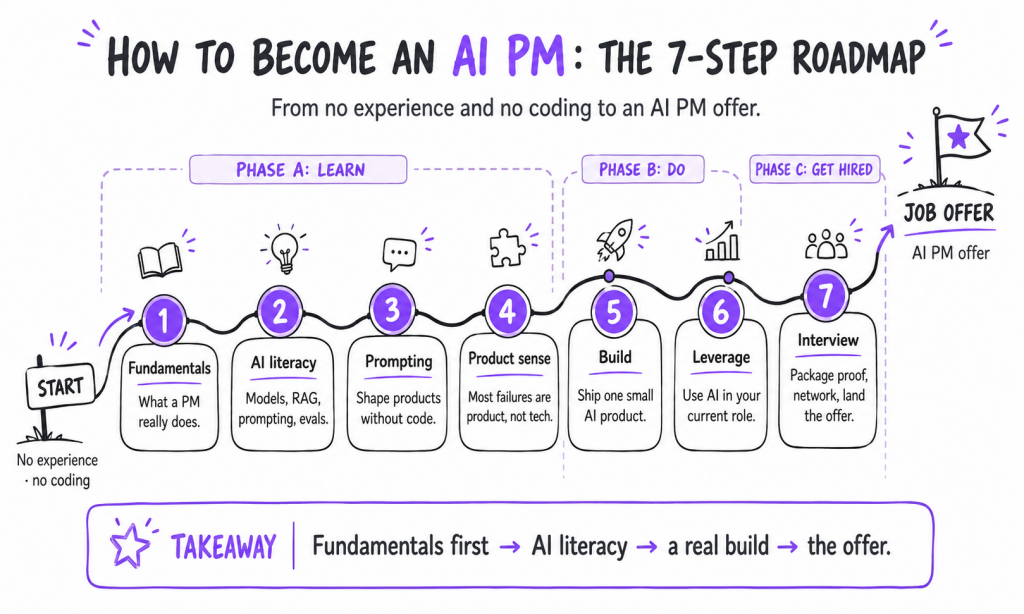
Step 1: Get the product fundamentals right first
Before AI, get honest about what a product manager really does. This is the step everyone wants to skip, and the one that gets them quietly rejected.
An AI PM is still a PM. You are solving a real user problem, weighing user value against business value and feasibility, prioritizing hard, talking to users, and deciding what to build and why. AI is the how. It is never the what. A hiring manager can smell someone who memorized five AI buzzwords but cannot reason about a product fast. That is why, at HelloPM, we spend the first weeks on fundamentals before anyone touches an AI module.
Start with the core frameworks and the PRD.
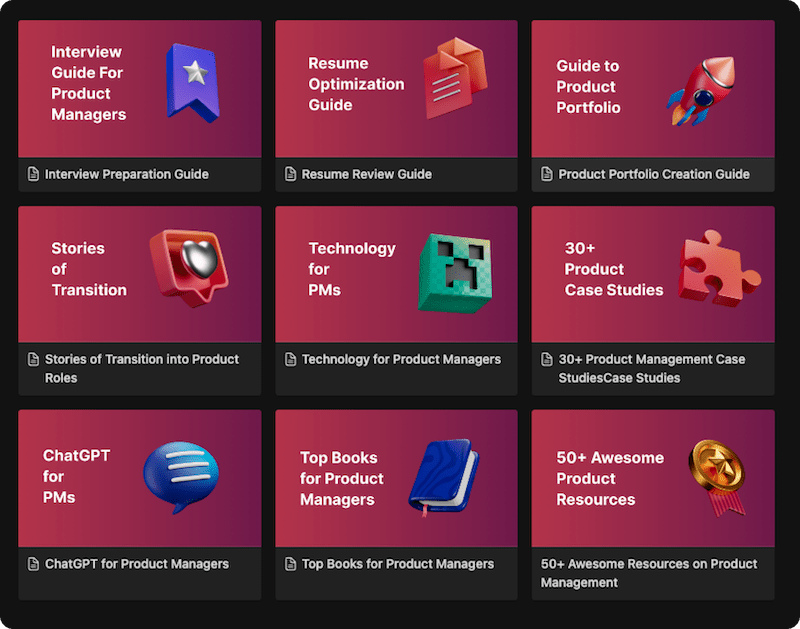
Our guides to product management frameworks and how to create a PRD are a solid base.
Do this week:
Pick one product you use daily and write down the core problem it solves, who it is for, and the one metric that would prove it is working. That is the muscle.
Step 2: Build AI literacy without becoming an engineer
You need to understand how AI works, not how to build it. Here is the literacy that actually matters, in plain language, no math.
A language model is a next-token predictor: give it part of a sentence, and it guesses the next piece, until it has an answer. It is probabilistic, not deterministic, which is why answers vary and why evaluation exists at all.
Then learn how a PM steers it: the umbrella is context engineering, giving a model the right context, and it has three levers: prompting (how you instruct it), RAG (giving it a trusted knowledge base to pull from, which cuts hallucination), and fine-tuning (changing its base behavior).
And agents are models that take action through tools, not ones that only answer.
Step 3: Make prompt engineering your edge
Prompting is a craft, not a footnote. Treat it like one, and it becomes your visible edge in interviews and on the job.
The lazy take is that prompting is “just typing into ChatGPT.” It is not. It is the main way you steer these models, and whole products lean on it. A sharp prompt PM can shape real product behavior without writing a line of production code: prototype the experience, test it, hand engineering a clean spec.
Do this: take one repetitive task, write a detailed prompt that nails it, then improve it three times and watch what moves the output.
Step 4: Develop AI product sense by studying why AI products fail
The best AI PMs are students of failure, because most AI products fail, and almost always for product reasons, not technical ones. Roughly 95% of enterprise GenAI pilots stall on adoption and integration, not model quality (MIT NANDA report, 2025). The model usually works. The product around it does not. That is a PM problem, every time.
Two habits build this sense.
First, evaluations: a way to judge quality when output varies; the blunt version to remember is that an AI feature fails not because the model is weak, but because you never evaluated it.
Second, knowing which tool fits which problem: prompt first, RAG for a knowledge gap, fine-tuning only as a last resort.
Read More: How to measure the success of an AI feature.
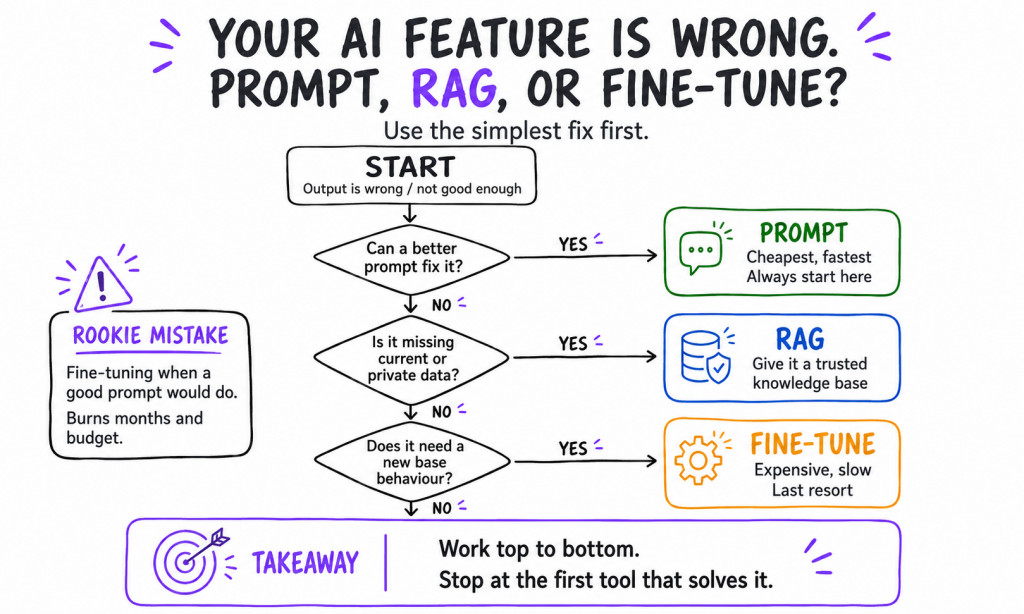
Step 5: Build something real this weekend
Proof of work beats credentials, every time. One real AI product you built will out-argue a stack of certificates in any interview. And in 2026 you can build without being an engineer, using no-code and vibe-coding tools.
Small Exercise for You:
Build one small AI thing that fixes an annoyance in your own week, then write a one-page note on the problem, your decision (prompt or RAG), and what you would change. That note is your proof of work, and it feeds your whole AI PM portfolio.
Step 6: Use AI for leverage in the job you already have
You do not need a new title to start being an AI PM.
Become an AI-enabled PM today, inside your current role. Use AI for things that were out of reach: synthesize 50 user interviews in an hour, draft and stress-test PRDs, and stand up a prototype before an engineer is pulled in.
The point is not to go faster on the same small work; it is to take on bigger problems.
This also generates real interview stories. “I shipped an internal AI tool that cut our reporting time in half,” beats “I completed a course” every time.
Read Now: ChatGPT for product managers.
Step 7: Package the work, network, and interview
Now you turn the work into an offer. Most people build real skill and then lose momentum at the last mile, the job search itself. Do not.
If you are pivoting in from another function, lead with proof that you think like a PM, then show your AI build; your old field is an asset, not baggage. Build a portfolio around one or two builds, sharpen your resume, and prepare for the PM interview. Prepare for the three questions that always show up: when you would use RAG versus fine-tuning, how you would evaluate an AI feature, and how you would lift adoption of one.
After Steps 1 to 6, you have real answers to all three.
How much do AI product managers earn (India and the US, 2026)?
Let’s talk money, because it’s fair to want to know.
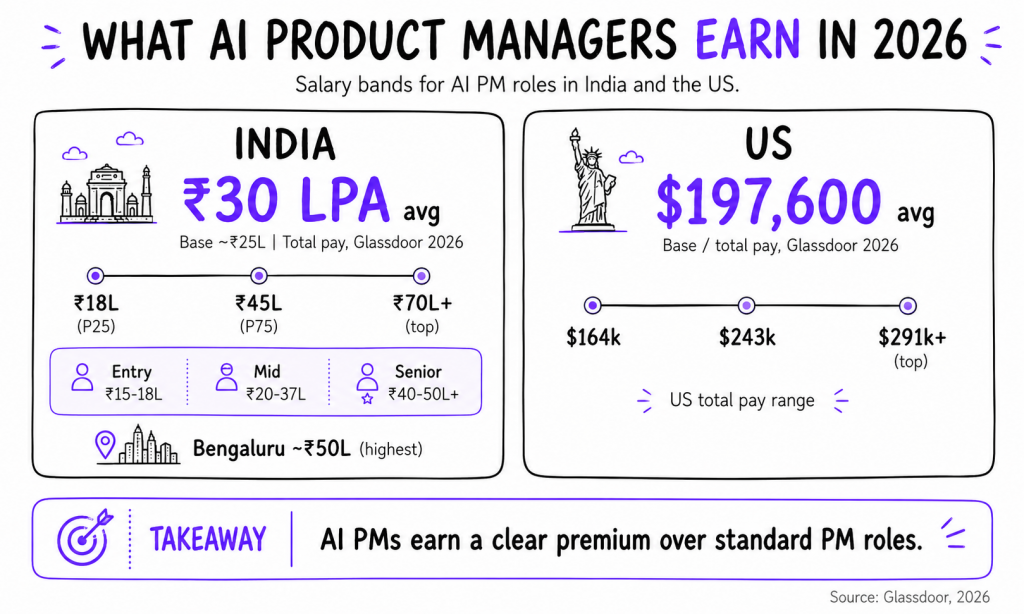
AI PM pay is strong; it rises quickly with seniority, and in top tech hubs, AI PMs command a clear premium over standard PM roles at the same level. Here are the current as per Glassdoor:
| Market | Average | Typical range (P25–P75) | Top earners |
| India (national) | ~₹30 LPA total (~₹25L base) | ₹18–45 LPA | ~₹70 LPA+ |
| India, Bengaluru | ~₹50 LPA | · | ~₹1 Cr+ |
| US (national) | ~$197,600 | $164k–$243k | ~$291k |
Two things worth noticing….
Experience moves the number a lot: entry-level sits toward the lower end (~₹15–18 LPA), mid-level around ₹20–37 LPA, and senior AI PMs ₹40–50 LPA and up.
And location matters as much as title: Bengaluru pays a steep premium over the national average.
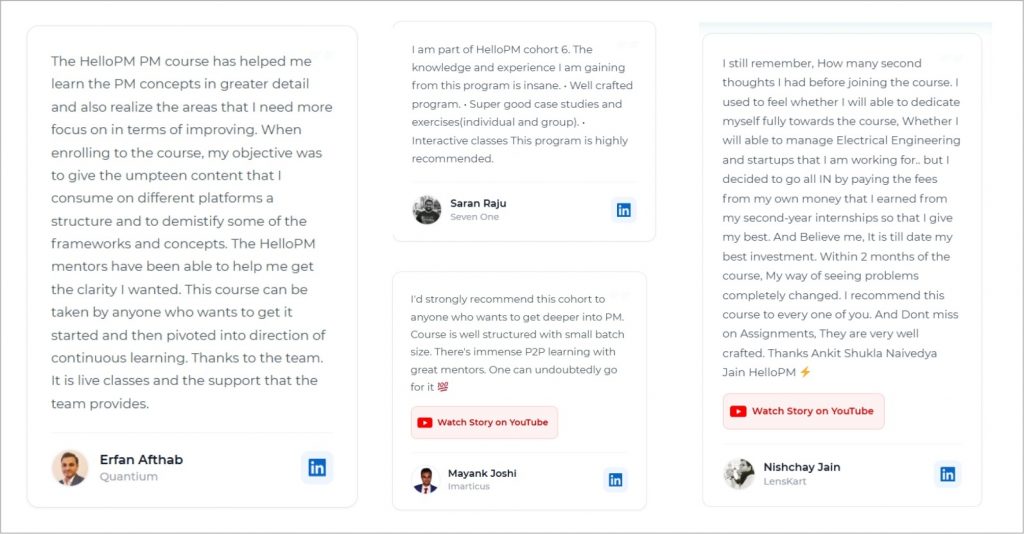
Real people who made this switch
You do not have to take my word for any of this. These are real HelloPM alumni who started where you are.
Some came from non-tech backgrounds, but they had left it too late. Some were engineers who told it was “too early.” Some were in sales, in QA, or at a service company with no PM title and no degree. They made it into a product anyway.
Read More:
- How a software developer became a product manager,
- A sales professional’s journey into AI product management without a tech background,
- A TCS Functional consultant broke into AIPM without an IIT tag or an MBA.
Kickstart your AI Product Management Journey
You do not need permission, a degree, or a coding bootcamp. You need a sequence and the discipline to follow it.
So start today, small. Pick a product you love and write down the real problem it solves. Then this weekend, build one tiny AI thing and write the one-page note. That single move puts you ahead of almost everyone still stuck in tutorial mode.
You can also start with: HelloPM free AI PM course and the masterclass on YouTube.
And when you want to build the full portfolio with real feedback, that is exactly what we do inside the HelloPM AI Product Management cohort.
Either way, the next move is the same, and it is yours to make. Go build something this weekend.
Frequently asked questions
1. Can you become an AI PM with no experience and no coding?
Yes. Most applied AI PM roles are about product judgment on top of existing models, not engineering, so coding is not required. And people switch in from non-tech backgrounds in sales, QA, and engineering all the time. What you need is product thinking, AI literacy, and one real AI thing you built as proof, not prior PM experience or a CS degree.
2. Do you need a degree or an MBA to become an AI PM?
No. There is no formal degree requirement, and an MBA is not required. HelloPM alumni have switched in without either. Proof of work and product thinking win over a credential.
3. How long does it take to become an AI product manager?
It depends on where you start. An existing PM adding AI literacy moves faster than someone learning product fundamentals and AI simultaneously, so there is no single honest timeline to promise. What is always true: order matters more than speed. Fundamentals first, then AI literacy, then a real build. For more information, check this
4. How is an AI PM different from a traditional product manager?
The core job is identical: solve a real user problem with good judgment. The difference is that AI products are probabilistic, so an AI PM also owns evaluations, prompts, and data quality, hallucination, and adoption risk in a way traditional PMs usually do not. Full comparison: AI PM vs product manager.
5. What is the AI product manager salary in India versus the US?
As of 2026, per Glassdoor, the average AI PM salary in India is around ₹30 LPA total pay (base closer to ₹25 LPA), with a typical range of ₹18–45 LPA and top earners at ₹70 LPA and above; Bengaluru averages higher, around ₹50 LPA.
In the US, the average is around $197,600. AI PM roles also command a clear premium over standard PM roles at the same level.
6. What skills do you need to become an AI PM?
Product fundamentals first, then AI literacy (how models behave, RAG, prompting, evaluations), then the ability to build a small AI product with no-code tools. Product judgment sits at the heart of it. The full ordered list is in the AI PM skill stack.
7. Will AI replace product managers?
No, it reshapes the job. AI automates the mechanical parts; it cannot do the core: understanding people and deciding what to build. The PMs at risk are the ones who refuse to use AI.