How to Crack a Senior Product Manager Interview: Uma’s 15-Step Plan That Landed 3 Offers
To crack a senior product manager interview, stop rehearsing in your head and start getting graded. Build a question bank […]

Can you crack a senior PM interview while working as a contractor?
Yes. Uma did it while working as a contractor, after she fixed what she was sending and how she was answering. She was not chasing a title. She wanted stability, a role she could stay in for the long term, at a point when layoffs were everywhere, and most teams around her were not hiring. In her words: “At the end of the week, when I gave the GEICO interview, I had three offers in my hand.”
Her problem was never her experience. She had already been a PM for 7 years. The problem was that her preparation had no structure, so the results were random. Once the structure went in, the calls started.
How did Uma start getting interview calls when she’d barely gotten any?
She stopped sending a single resume to dozens of companies and started tailoring it to each job description. That single change is what turned the calls on. For years, she had done the opposite, mass-applying with one generic resume on the assumption that volume alone would produce a call. She calls that her biggest mistake. Now she rewrites the resume for the specific role first: “Even if I’m applying to five companies, I should feel that I’m confident to give the interview.”
She also had to fit all of this around a full life. Two kids, a contract job, and HelloPM classes on weekends. So she split her week. Friday, Saturday, and Sunday were spent in classes and sending applications. Monday through Thursday, I did homework, consumed the content, and wrote answers. Structure first, volume second.
Before applying anywhere, she tweaked the resume to the specific role, kept a rough problem statement ready in case a recruiter asked, and prepared two or three assignments so she was never starting cold on a call.
The 6 rounds of a senior PM interview: what GEICO actually asked
A senior PM interview is not one conversation. For Uma at GEICO, it ran to six rounds, and knowing the shape of it in advance is half the battle.
- Hiring manager screen (30–45 min): introduction and basic fit for the role.
- Design panel (1 hr): one of three cross-functional rounds run back to back.
- Engineering panel (1 hr): the second compulsory cross-functional round.
- Product panel (1 hr): the third compulsory round. These three ran across three continuous days.
- VP of Engineering round: an extra round because the role sits on the engineering side, focused on developer experience, tooling, and processes.
- VP + hiring manager close: expectations, time zone, team size, culture, and space for her questions.
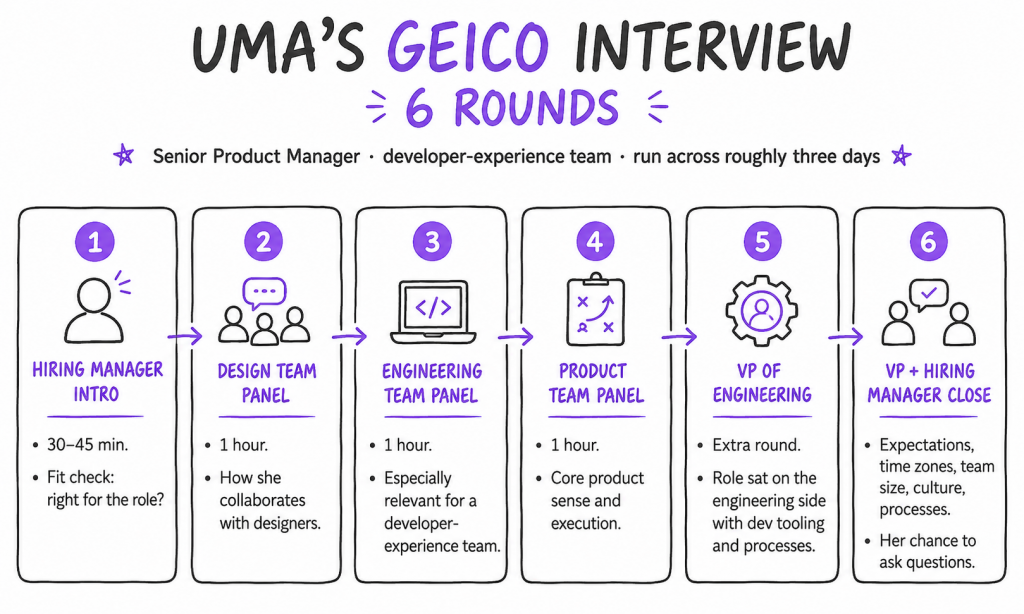
As per Uma: for most PM roles, the loop is four to five rounds, and the three cross-functional panels are the compulsory core. Her sixth round was due to the engineering focus of her team.
The one habit that changed her interviews: stop jumping to the solution
The single behavior change that moved Uma from misses to offers was learning to pause instead of racing to an answer. Early on, the moment an interviewer asked a question, her brain jumped straight to a solution. It cost her. She could not get past the next round at Walmart, and she called it, plain and simple, a place she needed to improve.
So she took the rule her mentor Ankit gave her, do not jump to the solutions, and made it her own. Open by mapping the problem instead. Who are the users, what are their needs, and where are the pain points? Follow the structure, talk through the problem space, and the solution surfaces while you speak, which is exactly what interviewers are watching for. In her words, “taking a pause worked for me very well.”
Feedback made this concrete. After her Walmart round, she was told she sounded too technical and needed to lead with impact, so she reworked her stories around outcomes rather than architecture.
Uma’s 15-step senior PM interview prep plan
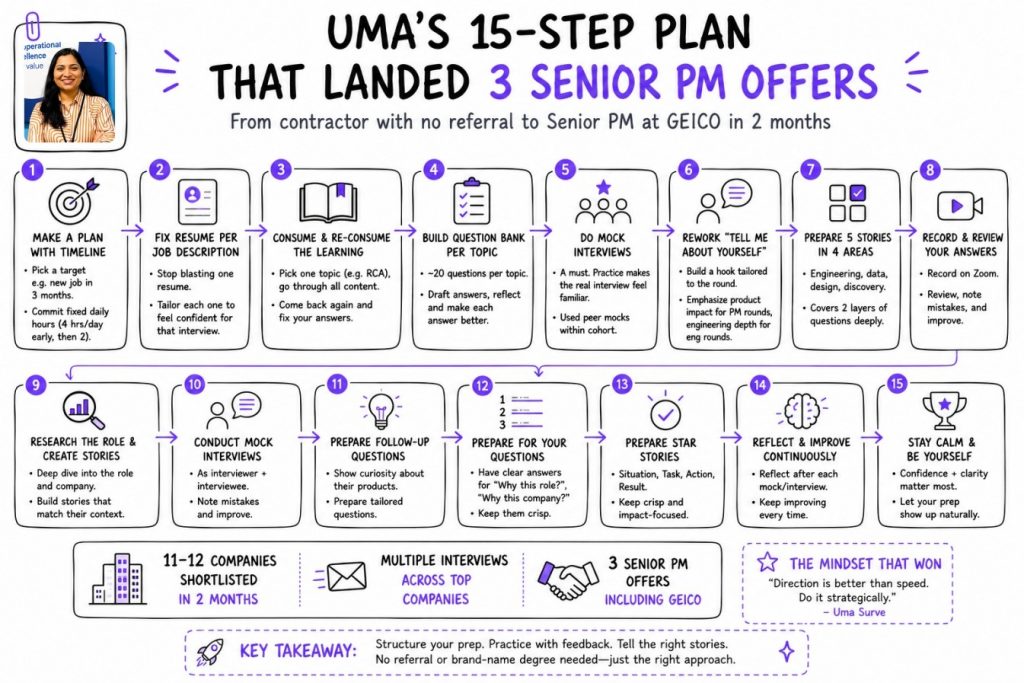
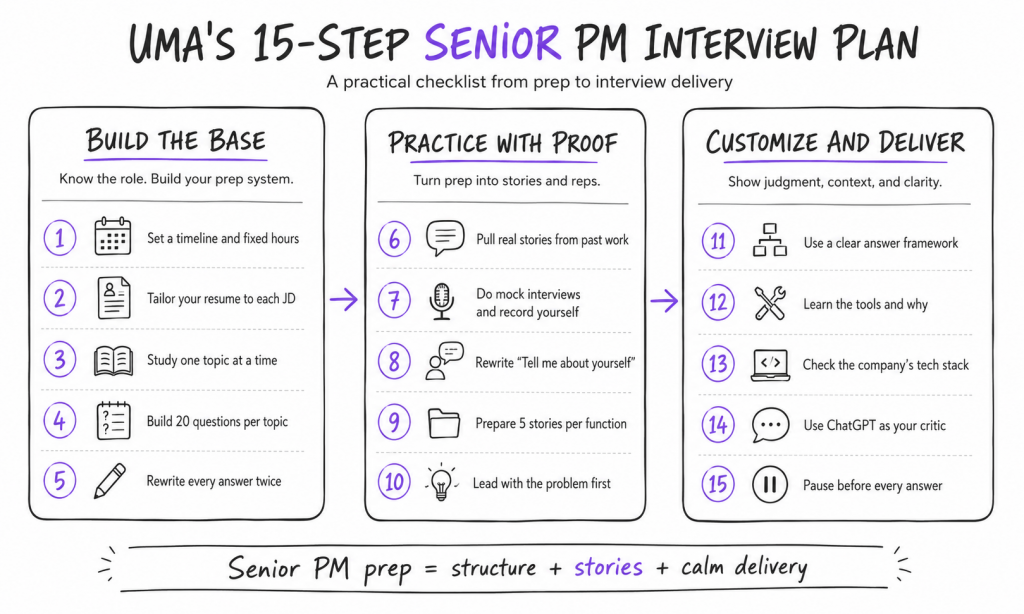
Here is Uma’s 15-step checklist to help you determine whether you are interviewing for an associate, mid-level, or senior PM role. Each step below is drawn from her own account of what she did.
- Make a plan with a real timeline. Pick a target (Uma worked toward a three-month goal) and commit fixed hours. She gave it about 4 hours a day in the first month, then dropped to roughly 2 hours a day once the foundation was in place.
- Tailor your resume to every job description. Stop mass-applying one resume. Rework it for each role until you feel confident enough to interview for that specific job, even if you only apply to 5 companies.
- Consume and reconsume the content, topic by topic. Take one topic at a time, for example, root cause analysis, and go through every related video and link before moving on.
- Build a bank of about 20 questions per topic. For each topic, collect around 20 likely questions and draft your answers to all of them.
- Reflect, then refine each answer a second time. After a first pass, ask how each answer could be improved, then go back to the material and rewrite it. She corrected every answer at least twice.
- Mine the referral links for your own real stories. The examples in the content jogged real experiences she had forgotten under interview pressure, which she then turned into her own examples.
- Do mock interviews, and make them a must. Record yourself, and run peer mocks. Uma and her cohort friends committed to taking each other’s mock interviews so mistakes happened in practice, not in the real room.
- Rewrite “Tell me about yourself” as a hook. Tailor it to each round. For an engineering round, she led with her development background; for a product round, she led with impact, for example, moving a conversion rate from 23% to 55%.
- Prepare at least five stories each for engineering, data, design, and discovery. With five stories per area, you can switch examples on the fly, even if two questions probe the same function.
- Lead with the problem, not the solution. Open every product answer by defining users, needs, and pain points before you go near an answer.
- Follow a structured framework. Uma used the hook framework, so the solution emerged while she talked through the problem, which is what interviewers score.
- Learn the tools in play, and why. Know why a company uses a given PM or engineering tool. Read the job description and be ready to speak to the tools it names.
- Check the company’s tech stack before you interview. Ankit’s tip: if you do not know the stack, read the engineering job description. Uma put it plainly: “Before applying to GEICO, I did not know what technology they were using. I just simply went on LinkedIn, I checked for the product engineering job description, and I came to know Flutter is something they are using.” She asked her cohort, caught up with someone who knew Flutter, and prepped enough to follow the interview.
- Use ChatGPT as your critic. Feed it the job description, ask for likely questions, and have it grade your answers. Uma framed the prompt directly: “I asked ChatGPT, you are the critic for the interviewer.” The result was a reality check in her words: “When I was feeling in my head that this answer is four out of five, ChatGPT graded me 2.5, then it was a wake-up call for me.” After she refined the answers, ChatGPT moved them to 4 to 4.5.
- Take a pause before every answer. The habit she credits most. Slow down, breathe, then structure your response.
Frequently asked questions
1. How do you crack a senior product manager interview?
Treat it as a system, not a single conversation. Tailor your resume per job description, build a question bank of roughly 20 questions per topic, record and grade your answers against the job description, prepare five behavioral stories per function, and pause to frame the problem before you solve it.
2. How many rounds is a senior PM interview?
It varies by company. Uma’s GEICO loop ran six rounds: a hiring-manager screen, three compulsory cross-functional panels (design, engineering, product) across three days, a VP of Engineering round for her engineering-heavy team, and a closing round with the VP and hiring manager. She estimates most PM loops run four to five rounds.
3. Can you get a senior PM role while working as a contractor?
Yes. Uma moved from a contractor role to a full-time senior PM offer at GEICO through tailored applications, after she restructured her preparation. The calls started once she stopped sending one generic resume and began tailoring it to each job description.
4. How long should you prepare for a PM interview?
Uma worked on a three-month plan. She spent about four hours a day in the first month while building her foundation, then dropped to roughly two hours a day. The point is a fixed, committed schedule, not a fixed number that fits everyone.
5. How do you use ChatGPT to prepare for a PM interview?
Paste the job description in, ask it to generate the questions that description would produce, then answer out loud and ask ChatGPT to grade you as an interview critic. The gap between your self-rating and its rating is the signal. Uma closed a 4-versus-2.5 gap this way, then reached 4 to 4.5.
6. How many mock interviews should you do?
Enough that the real interview feels like it has happened before. Uma treated mocks as non-negotiable and ran them with cohort peers who committed to interviewing each other, so mistakes and corrections happened in practice.
7. What is the biggest mistake PMs make in interviews?
Jumping straight to a solution. Product interviews rarely have one right answer; interviewers watch how you approach the problem. Define the users, needs, and pain points first, and the solution tends to surface while you talk.
8. Do you need to know the company’s tech stack for a PM interview?
You do not need to code it, but you should understand it. Read the engineering job description to find the tools and technologies in use. Uma learned that GEICO used Flutter before her interview and was prepared enough to follow and contribute to the conversation.
9. Want the structure Uma used to crack a senior PM interview?
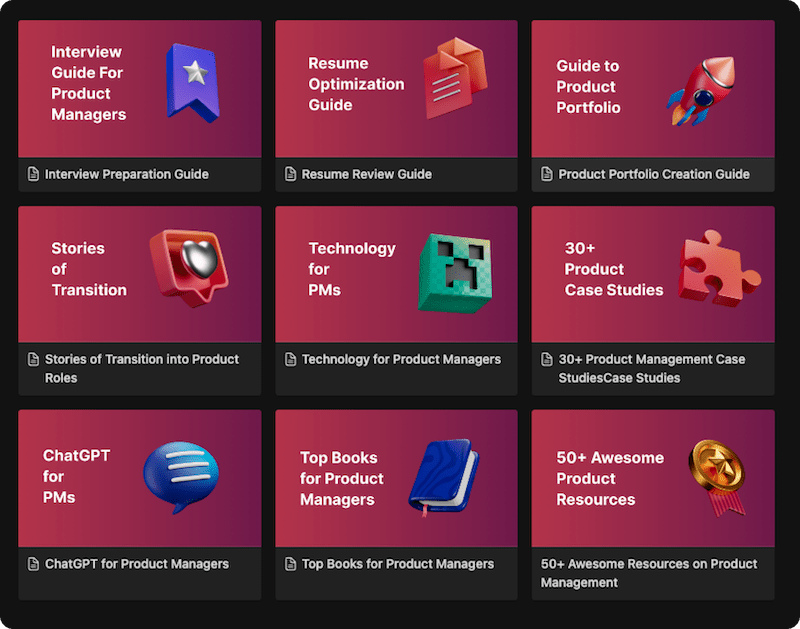
You can watch Uma’s full interview breakdown, or start with our PM interview resources. If you want to talk through your own prep plan and see whether the program fits where you are, book a counseling call, or browse the free PM resources first.