How to Crack a Senior Product Manager Interview: Uma’s 15-Step Plan That Landed 3 Offers
SHORT ANSWERTo crack a senior product manager interview, stop preparing in your head and start getting graded. Build a question […]

To crack a senior product manager interview, stop preparing in your head and start getting graded. Build a question bank, record your answers out loud, and rate every one against the job description until it actually holds up. Uma Surve did this as a contractor with no referral. She was barely getting interview calls. After rebuilding her resume per job description and drilling around 10 behavioral stories, she was shortlisted at 11 to 12 companies in two months and walked away with three senior PM offers, including GEICO. Here is every step she actually followed.
Can you crack a senior PM interview as a contractor with no referral?
Yes. Uma did it from a standing start. No internal referral, no warm intro, just cold applications that finally started converting once she fixed what she was sending and how she was answering.
Before HelloPM, Uma was working as a contractor, which meant constant worry about the project ending and no certainty about the next one. The tech market was in layoff mode. Every time she applied around the Bay Area, she hardly got a single interview call. The problem was not her experience. She had already been a PM for 7 years. The problem was that her preparation had no structure, and it showed in the results.
Then something clicked in the first lecture of her cohort. Ankit described how earlier participants kept getting rejected, then started clearing the first round, then the second, then finally landing offers. That exact arc played out for her. By the end of the first week after her GEICO interview, she had three offers in hand.
| The same journey happened with me. At the end of the week, when I gave the GEICO interview, I had three offers in my hand. – Uma Surve, Senior Product Manager at GEICO, HelloPM Cohort 39 |
The takeaway for anyone sitting in a contract role, wondering if a full-time senior jump is realistic: it is. What changed for Uma was not luck and not a referral. It was the system she ran for two months. The rest of this article is about that system.
| 11–12 Companies shortlisted in two months – all senior PM roles – converting to 3 offers. |
How did Uma start getting interview calls when she’d barely gotten any?
She stopped sending a single resume to 50 companies and started tailoring it to each job description. The calls began almost immediately after that single change.
This was the mistake she named openly. For years, her approach was volume: build one resume, fire it at 15 or 50 companies, and assume at least one call would come back. It rarely did. The fix was to read the job description before applying, then rewrite the resume to match what that specific role was asking for. She would not apply to a company unless she felt confident she could walk into that interview.
She paired the resume fix with a problem-space focus. Her interests were e-commerce and insurance, partly because she had worked in healthcare and health insurance before. So she targeted those, reviewed the job descriptions, and prepared a possible problem statement to raise if a recruiter offered her the opening. She built two or three of these assignments in advance. She never actually got to present them, because the conversations went elsewhere, but the prep built what she called her mental muscle for the next interview.
If you want the deeper version of this, the guide to preparing for PM interviews covers the call-generation stage in detail. Uma’s compressed version: tailor the resume, pick a problem space, prep your assignment before the recruiter calls.
The 6 rounds of a senior PM interview, what GEICO actually asked
A senior PM interview is not one conversation. At GEICO, it was six rounds across three days, and three of them were non-negotiable cross-functional panels.
Most prep guides talk about “the interview” as a single event. For senior roles, it is a sequence, and knowing its shape ahead of time is half the battle. Here is exactly how Uma’s GEICO process ran.
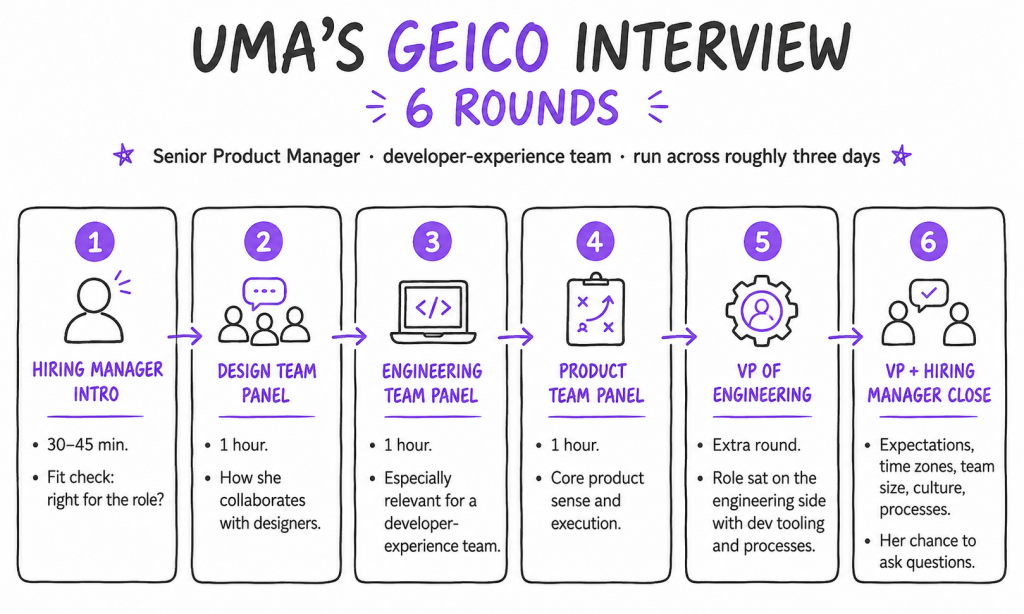
The pattern to notice: for a senior PM role, the three middle panels (design, engineering, product) are the load-bearing ones, and they ran back to back over three continuous days. That is why a generic “tell me about a time” prep is not enough. You need stories ready for each function, which is exactly what step five solves.
The one habit that changed her interviews: stop jumping to the solution
The single behavior change that moved Uma’s interviews from misses to offers was learning to pause instead of jumping straight to a solution. Taking that pause, in her words, worked wonders.
Early on, the moment an interviewer posed a problem, her brain raced to the answer. That is the instinct most experienced PMs have, and in a senior interview, it backfires. Product interviews rarely have one right answer. The interviewer is watching how you approach the problem, not whether you arrive at a clever solution fast.
| Whatever happens, do not jump to the solutions. Taking a pause worked very well for me in the last two to three interviews. – Uma Surve, Senior Product Manager at GEICO |
She learned to do the opposite. When a problem landed, she would pause, then talk about the problem first: who are the users, what are their pain points, what are the needs. By following a structure and talking through the problem space, she would arrive at the solution while speaking with the interviewer, which is exactly what they want to see. If you get stuck and cannot find the solution, talk more about the problem. The structure carries you there.
The other shift came from a specific failure. After an interview with Walmart that she could not move forward, the feedback was that she sounded too technical. She took it as data, not defeat, and reworked her stories to lead with business impact instead of system architecture. That adjustment is part of why the GEICO rounds went differently. Treat every interview that does not convert as feedback you can act on, because it is.
This is the heart of behavioral and product-sense rounds. For the full breakdown of how to structure those answers, the guide to behavioral interview rounds goes into more depth than we can here.
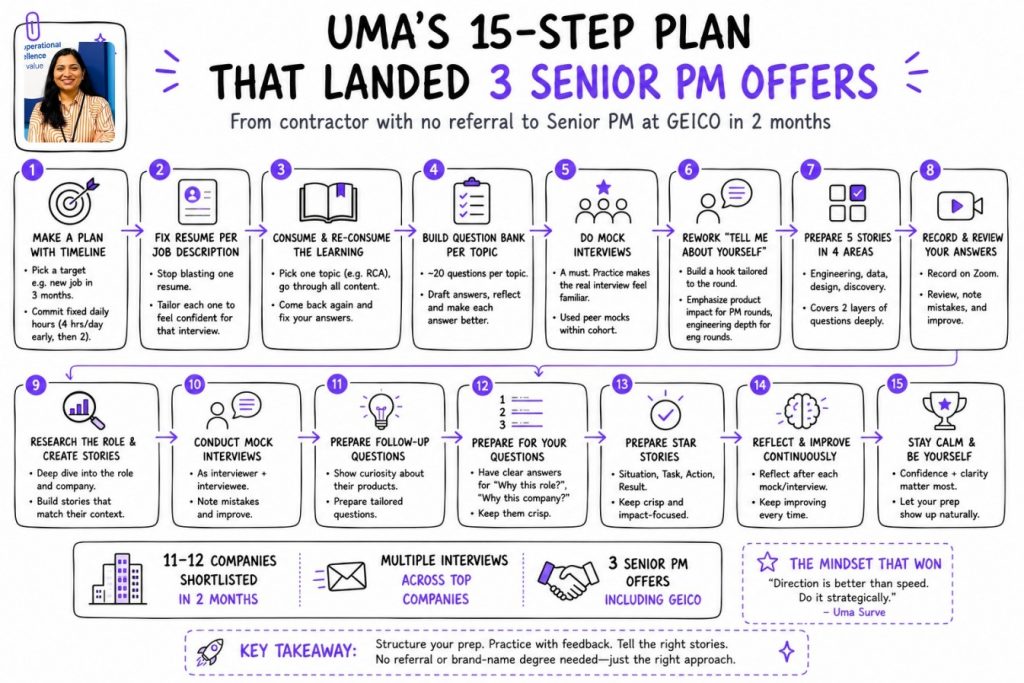
Uma’s 15-step senior PM interview prep plan
Uma followed a clear 15-step checklist she says worked like a miracle, and she believes it holds whether you are interviewing for associate, normal, or senior PM roles. Here is the full plan in her sequence.
She is honest that this is not a 20-minute fix. In her first month, she committed four hours a day. Once she had covered most of the ground, it dropped to about two hours. And she did all of it with two kids at home, which is exactly why the plan is so structured. With that little spare time, she could not afford a scattered approach. She split her week deliberately: Friday, Saturday, and Sunday for HelloPM classes and job applications, Monday through Thursday for homework and answer-building. The plan below is the structure those hours went into.
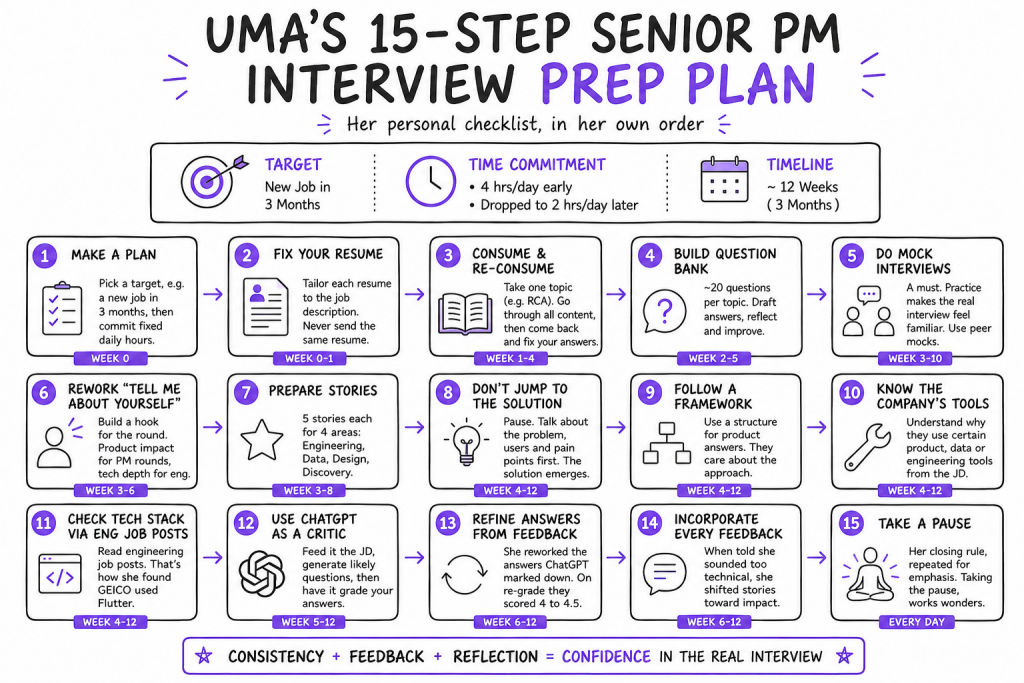
The two steps inside this plan that did the most work, by her own account: tailoring the resume (step two), which got the calls coming, and getting graded honestly (step twelve), which exposed how far her answers actually were from good.
| 2.5/5She rated her own answer 4 out of 5. ChatGPT graded it 2.5. That gap was her wake-up call. Uma’s personal account · She later re-scored 4–4.5 after refining |
That moment is worth sitting with. An experienced PM, in the seventh year of the role, confident her answer was a 4 out of 5, got told by a cold grader it was barely a pass. She did not argue with it. She rebuilt the answers. That willingness to be graded honestly is what separated her prep from the years of applications that went nowhere.
| Curious if this path fits for you? Uma’s plan is the kind of structured prep HelloPM teaches across PM and senior PM transitions. Start with the free resources, or talk it through with the team. Browse Free PM Resources: | Book a Counseling Call |
Frequently asked questions
- How do you crack a senior product manager interview?
Treat it as a system, not a single conversation. Tailor your resume to each job description to get calls, build a question bank of roughly 20 questions per topic, prepare five behavioral stories each for engineering, data, design, and discovery, and get your answers graded honestly before the real thing. Uma Surve ran exactly this and converted 3 of 11 to 12 senior PM shortlists into offers.
- How many rounds is a senior PM interview?
It varies by company, but senior roles often run four to six rounds. Uma’s GEICO process was six: a hiring-manager intro, three compulsory one-hour panels with design, engineering, and product, a VP of engineering round, and a closing round with the VP and hiring manager. The three cross-functional panels are usually the decisive ones.
- Can you get a senior PM role without an internal referral?
Yes. Uma had no referral and moved from a contractor role to a full-time senior PM offer at GEICO through tailored cold applications. The lever was not who she knew. It was matching each resume to the job description and preparing structured answers, which turned a near-zero call rate into 11 to 12 shortlists in two months.
- How long should you prepare for a PM interview?
Plan for focused daily effort over a couple of months rather than a crash session. Uma committed four hours a day in her first month, then dropped to about two hours once she had covered the core topics. She is blunt that there is no 20-minute shortcut for senior-level prep.
- How do you use ChatGPT to prepare for a PM interview?
Paste the job description, ask it to generate the likely questions for that role, then ask it to act as a critic and grade your answers out of five. Uma rated one of her own answers four out of five; ChatGPT gave it 2.5. She refined the weak answers and re-scored 4 to 4.5. For a fuller workflow, see HelloPM’s ChatGPT for Product Managers guide.
- How many mock interviews should you do?
Enough that the real interview feels like a repeat. Uma never did mocks before HelloPM, then made them a non-negotiable, mostly through peer mocks with cohort-mates who interviewed each other. The point is to correct in a low-stakes setting so mistakes do not happen live. See what mock interviews are for more.
- What is the biggest mistake PMs make in interviews?
Jumping straight to a solution. Product interviews are rarely about one correct answer; interviewers watch your approach. Uma’s fix was to pause, then talk through users, pain points, and needs first, letting the solution emerge from the structure. She credits that single habit with her recent conversions.
- Do you need to know the company’s tech stack for a PM interview?
It helps, and you can find it without insider access. Uma read the company’s engineering job descriptions to learn their stack, which is how she discovered GEICO used Flutter and prepared accordingly. You do not need great technical skill, just enough to follow the conversation and respond credibly.