Can You Become a Product Manager Without IIT or IIM? One Sales Professional Story
Yes, you can become a product manager without an IIT or IIM degree. The path exists, and people are walking […]
Who is Mayank Joshi?
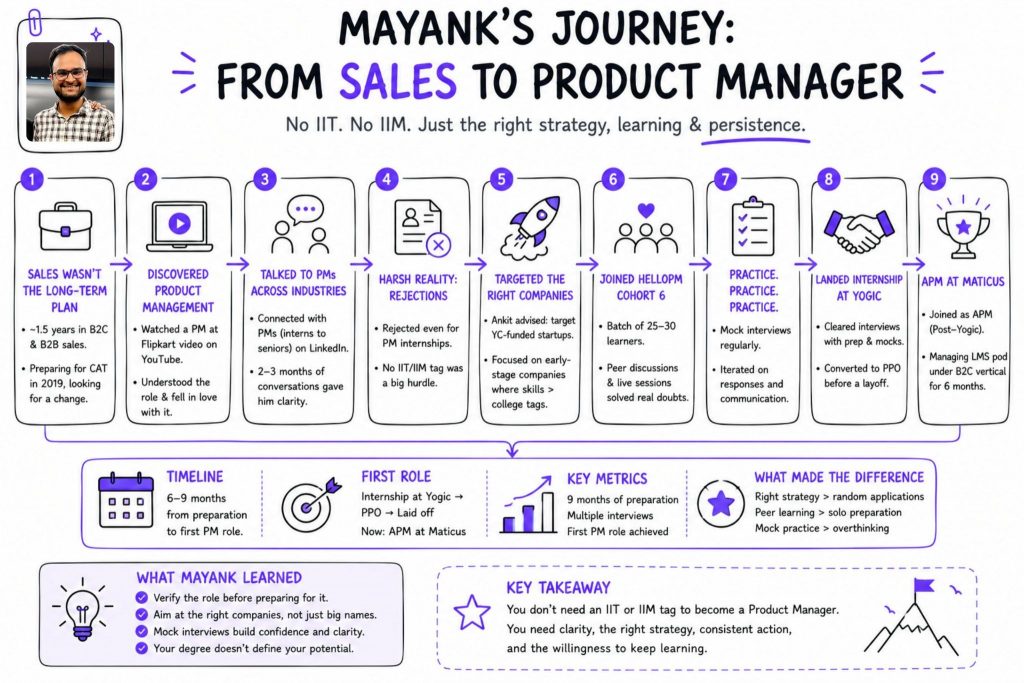
Mayank is a sales professional who spent roughly 1.5 years in B2C and B2B sales roles before deciding the field was not where he wanted to spend the next decade. He has no IIT or IIM tag. He started his PM preparation in January and got his first product role – an internship – within 6 to 9 months. That internship was at Yogic, an e-commerce B2B company, where he converted to a PPO before being laid off. After Yogic, he joined Imarticus as an APM. At the time of this interview, he had been at Imarticus for 6 months, managing the LMS pod under the B2C vertical.
He was part of HelloPM Cohort 6, a batch of 25-30 people.
Most transition stories start with a dramatic quit or a moment of obvious clarity. Mayank doesn’t. He was preparing for the CAT exam in 2019, looking for a way out of sales, not yet sure what he was moving toward. The direction came from a single YouTube video about a day in the life of a PM at Flipkart.
How Did a Salesperson Figure Out Product Management Was the Right Move?
Mayank was preparing for the CAT back in 2019 – not because he wanted an MBA specifically, but because he knew sales wasn’t working for him long-term. He describes the job as “quite monotonous” and says he can’t do it much longer.
Then, while scrolling through YouTube, he came across a video on the Inside IIM channel. A PM at Flipkart was explaining what the role actually involved, day to day.
| “That was the turning point when I closely understood what a product manager does, what the responsibilities are, and what the life of a PM looks like, and that is the one turning point.” – Mayank Joshi, Imarticus |
He did not immediately enroll in a course. He started sending LinkedIn connection requests to PMs at every stage – interns, junior PMs, senior PMs, across fintech, edtech, social commerce, and consumer apps. Two to three months of those conversations gave him enough information to commit: this is the role I want to do for a decade, not just the next job.
That sequencing matters. He validated the role before he prepared for it. Most people skip this step. They see salary figures on LinkedIn and start prepping without checking if the day-to-day actually suits them.
What Made Getting Shortlisted So Hard Without a Brand-Name Degree?
Mayank is direct about this. Getting rejections even for PM internships was one of the three biggest challenges he faced – and the most demoralizing because it came last, when he felt ready.
| “The percentage of people who are product managers is very low, especially the people like me who don’t have a tag name or a brand name of IIT or IIM, so that’s a very big hurdle.” – Mayank Joshi, Imarticus |
6–9 months from sales to a first PM role & the first offer Mayank received was an internship, not a full-time position. Mayank was still being rejected for PM intern roles while actively preparing.
The solution Ankit gave him was to not apply to tier-1 companies and to grind harder. It was to target a completely different pool: startups recently funded by Y Combinator. Early-stage companies with fresh funding are not filtering on college pedigree. They filter on ability and energy. That targeting strategy is what finally got Mayank’s foot in the door.
This is the advice most PM prep programs do not give. They teach you how to answer product-sense questions, but they don’t tell you which companies will actually give you a chance based on your profile.
Can someone without an IIT or IIM Actually Become a Product Manager?
Yes. The honest answer is that the college pedigree filter exists, but it exists mostly at
established mid-to-large companies that use educational background as a first-pass filter. That layer isn’t where most first PM roles come from, anyway.
Mayank puts it simply: ” Anyone can become a PM, “unless you are curious enough to be one.” PM interviews test how you think through problems, not where you got your degree. If you can break down a problem into user needs, prioritize by impact, and communicate your reasoning clearly, the degree becomes less relevant, especially at early-stage companies.
Once you have one product role on your resume, even an internship at a small startup, the credential question largely disappears. The track record replaces the pedigree.
How Did HelloPM Help Someone Without a Tier-1 Degree Get Their First PM Role?
Mayank came across Ankit on Twitter. Not through a course advertisement. Ankit had posted something product-related, and his profile said he was available to help people with products. Mayank sent him a five-minute voice note on LinkedIn.
| “I sent him a five long minute voice message on LinkedIn right. This is the problem which I’m facing, I came from this background, I don’t have a tag of IIT or IIM, I am very confident that this is what I wanted to do but I still am very confused and not confident whether I’ll be able to do it or not.” – Mayank Joshi, Imarticus |
Ankit called back. They had a meeting. Then two to three more conversations before Mayank ever heard the word “HelloPM.” And Ankit told him something most course founders would never say
before a sale:
| “Hey Mayank, you don’t need a course actually to become a product manager right. You can find whatever the curriculum is mentioned in the HelloPM if you have time enough to find those resources on the internet and you can accumulate those resources and go on your own.” – Mayank Joshi, quoting Ankit Shukla |
Mayank enrolled anyway. The curriculum was not the product. The accountability and
Personalization was the product.
Three things HelloPM specifically did for his profile:
1. Personalized path from day one
Ankit built Mayank’s plan around his specific situation: sales background, no IIT/IIM, needs to target early-stage startups. The advice on applying to recently Combinator-funded companies came from this personalization. That single targeting strategy changed the shortlisting rate.
2. Small cohort size with real peer-to-peer learning
HelloPM C6 had 25 to 30 people. Mayank says sessions regularly ran over – more than one hour of the two-to-three-hour session went into cross-questioning. That density of discussion per person is not replicable in a 200-person cohort.
3. Interview prep module added based on student feedback
When Mayank was in C6, there was no structured interview prep module. He gave that feedback directly to Ankit. By the time of this interview, HelloPM had added a two-week interview preparation module.
How Do Mock Interviews Change the Way You Think in PM Interviews?
Mayank is specific about this. Mocks didn’t just prepare him for interview content. They changed his cognitive state before he went in.
| “MOX has definitely helped me. It shifts your mind from a certain state to a state which is required in a product interview.” – Mayank Joshi, Imarticus Learning |
PM interviews test how you think, not what you know. The interviewer is watching how you break down a problem – not whether your solution is objectively correct. That kind of thinking is a skill, not knowledge. Skills require practice, not study.
Mayank and a peer from HelloPM did mock sessions day and night: guesstimate questions, RCA questions, product design questions. The goal was not to memorise frameworks. It was to build the reflexes. If you are preparing for PM interviews and not doing mocks, you are studying for a driving test by reading the manual.
What Do Aspiring PMs Without Top College Degrees Actually Need to Do?
Mayank gave four things. Not five. Not ten. Four, and he was specific about each.
1. Understand the role before you prepare for it
There is a lot of hype around PM right now – the salary, the visibility, the idea of being the “CEO of a product.” Most people start preparing without checking whether the day-to-day job is something they actually want to do. Mayank spent 2 to 3 months just talking to PMs across industries, fintech, edtech, social commerce – before he committed. Do this first, not last.
2. Be genuinely curious, not just interview-curious
Use Swiggy, use WhatsApp. Ask why that button is positioned there. Ask what the intent of that push notification is. You can be a PM without curiosity. You cannot be a good one.
3. Do a lot of mocks, with real feedback
Not reading about frameworks. Not watching videos. Sitting with another person, answering a question out loud, and getting corrected. Mayank and a peer from HelloPM did guesstimate, RCA, and product design mocks. Day and night.
3. Get a mentor, and run your job search like a funnel
You don’t need a hand-holding, but you need to figure out where you’re going wrong, The mentor’s job is to identify the gap between how you’re thinking and how PM interviewers expect you to think. Mayank also ran his job search like a funnel, not a prayer: cold outreach to APMs and senior PMs to understand their domains before applying; targeting early-stage, recently funded startups over broad job boards; continuous mocks with a peer on guesstimates, RCA, and product design; iterating on his approach after every rejection, including after the Yogic layoff.
| BEFORE YOU ACCEPT ANY OFFER Many PM job listings are actually project management or operations roles with trendy titles. Mayank mentions this directly: companies hire you as a “Product Manager,” but you are not doing PM work. Before signing anything, talk to people already on the team, ask how the roadmap gets built, ask who owns feature prioritization, and ask what the relationship with engineering looks like. That 10-minute check saves you months of wasted time. |
| “Don’t just lose the hope right. It will take time. For me, it took around six to nine months to get my first product role, and that too was an intern role. I still didn’t get the full-time role right. So keep hustling.” – Mayank Joshi, Imarticus |
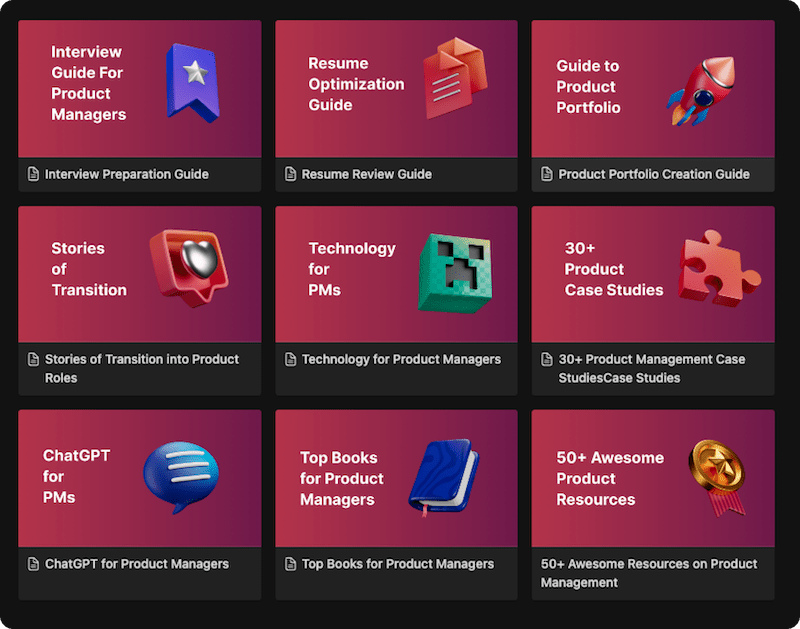
Resources for You
Preparing for Product Management interviews, first check out these resources-
- If you are at the resume stage, read the PM resume guide before applying.
- For a first portfolio artifact, the product teardown guide is the fastest place to start.
- The complete Interview prep resources are live at HelloPM Resources
| Curious if this path is right for you? Mayank’s story is one of 2,800+ HelloPM alumni who came from non-IIT, non-IIM backgrounds and broke into product management. Browse the free resources or book a call to talk through where you are and what makes sense next. Browse Free PM Resources: | Book a Counseling Call |
Frequently Asked Questions
1. Can you become a product manager without an IIT or an IIM?
Yes. Mayank Joshi did this after 1.5 years in sales with no tier-1 college tag, landing an APM role at Imarticus within 9 months. The IIT/IIM filter largely disappears at early-stage startups where hiring decisions are based on demonstrated thinking and energy, not college name. Getting one product role on your resume, even an internship, largely removes the credential question for subsequent applications.
2. How long does it take to get a PM job without a top college degree?
Mayank’s timeline was 6 to 9 months from the start of active preparation to his first PM internship. That timeline depends on how much time you spend on mocks, how strategically you target companies, and whether you have a mentor identifying gaps in your thinking. People who apply only to large companies without the right background typically take longer, not because they are less capable, but because they are solving the wrong targeting problem.
3. Do I need to know how to code to become a product manager?
No. You need enough technical understanding to have credible conversations with engineers and make realistic trade-off decisions. Mayank came from sales, not engineering. Curiosity about how products work matters more than the ability to write code.
4. What types of companies should someone without an IIT or IIM apply to for PM roles?
Early-stage startups, particularly those recently funded by Y Combinator or other established accelerators. Ankit gave Mayank this advice directly: the friction in getting hired at an early-age company is significantly lower. Once you have one PM role on your resume, even an internship, you can apply more broadly.
5. What sales skills transfer to product management?
More than most people expect. Handling objections maps to user research. Tracking pipeline metrics maps to funnel analysis. Pitching to multiple stakeholders maps to cross-functional communication. The capability gap between sales and PM is smaller than it looks. The framing gap – how you describe those skills on a resume and in interviews – is what needs work.
6. Do you need an MBA to switch from sales to product management?
No. Mayank’s story is evidence of this. He was initially preparing for the CAT as a way out of sales. Structured PM preparation with a mentor, portfolio building, and targeted applications to early-stage companies is a full alternative path
7. How do mock interviews help in PM interviews?
PM interviews test your thinking process, not your knowledge. The interviewer is watching how you break down a problem – not whether your final answer is correct. Mocks build the reflex through repetition. Mayank describes the effect as shifting your mind to the state required in a PM interview. You cannot get that shift from reading frameworks.
8. What should you check before accepting your first PM offer?
Verify it is actually a product role – not project management or ops with a trendy title. Ask the interviewer how the roadmap gets built, who owns feature prioritization, and what the engineering relationship looks like. Talk to current team members if possible. Mayank specifically warns that many companies hire people as PMs when they are not doing PM work.