Can a TCS Functional Consultant Become a Product Manager Without IIT or an MBA?
Yes, you can move from a service-based IT role like TCS into product management without an IIT degree or an […]
Who is Mohini Prakash, and why did she leave her TCS Job?
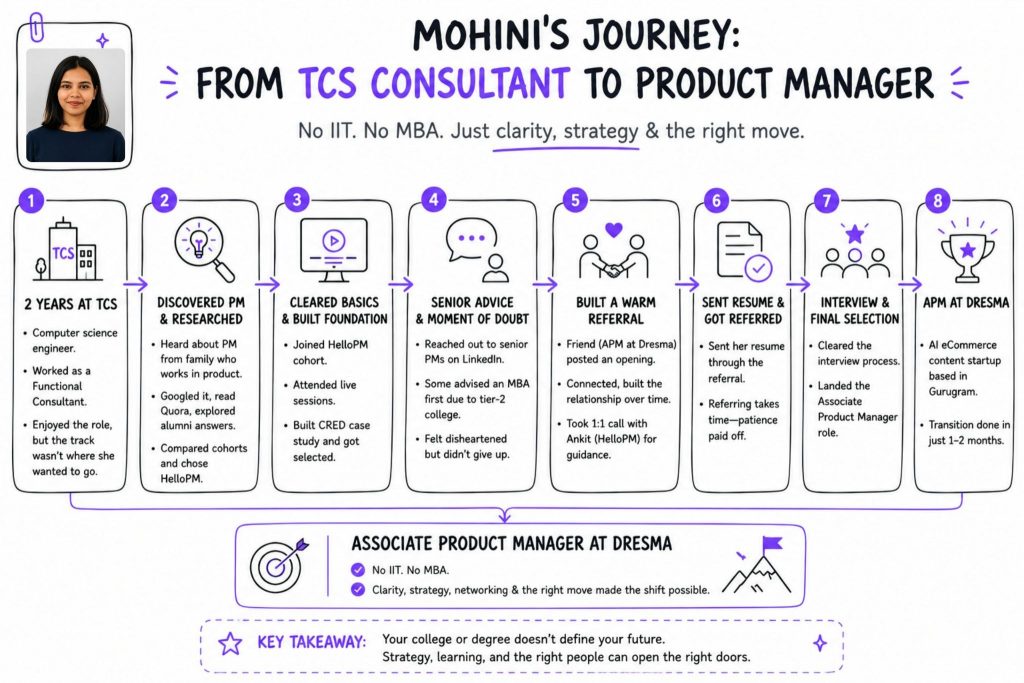
Mohini Prakash is a computer science engineer who spent two years as a Functional Consultant at TCS before moving into product. She is now an Associate Product Manager at Dresma, a Gurugram-based AI startup that builds eCommerce content tools. She made the switch without an MBA, without a prior PM title, and without coming from a top-tier college.
Her TCS role was a mix of tech and functional work, and she didn’t hate it. That’s the part most transition stories skip. She enjoyed the journey. But she could see the track she was on, and it wasn’t pointing where she wanted to go.
She first heard the role even existed from someone in her family who worked in the product. She hadn’t come across product management before that. So she did what a careful person does: Googled it, dug through Quora threads, found answers written by HelloPM alumni, compared cohorts, and picked one. No dramatic quit.Research first.
Can You Become a PM From TCS If You’re Not From an IIT?
Yes. The college you came from does not decide whether you can become a product manager. Mohini came from a tier-2 college, not an IIT, and she landed an APM role anyway. The barrier she was warned about turned out to be smaller than the people warning her believed.
And she was warned. When she started reaching out to senior product managers on LinkedIn, some of them looked at her background and told her the path was blocked without more credentials.
| They advised me that I was from a second-tier college, I was not from IIT or anything, so they advised me I should do the MBA thing or do an internship first. – Mohini Prakash, APM at Dresma |
That moment shook her. Her words: “That time I was like, oh God, how can I do this?” It’s the exact wall most service-company engineers hit. You don’t have the brand-name degree, so someone tells you to go buy one before you’re allowed to apply.
She didn’t buy it. Instead of spending two years and a fortune on an MBA to fix a problem she wasn’t sure she had, she tested the cheaper hypothesis first: clear the PM fundamentals through a focused cohort, build proof, and go straight at the role. It worked. The MBA was advice, not a law.
| Note to reader: “no MBA needed” and “no coding needed” are common questions. They’re answered in the FAQ at the end, with links to the fuller guides. |
How She Landed the Dresma Role Through a Referral, Not Cold Applications
Here’s the move most people get wrong. Mohini didn’t get her APM role by firing resumes into job portals. She got it through one warm referral that she deliberately built over time.
The sequence matters, so here it is exactly. A friend of hers was already working as an APM at Dresma. He posted on LinkedIn that there was an opening. She was not already in his network, so she didn’t just slide into his messages demanding a referral. She connected first. She built the relationship. Then she sent her resume. In between, she took a one-on-one call with Ankit from HelloPM, who gave her specific tips on how to position herself, and her case study got selected.
What she’s clear-eyed about is the patience this takes.
| Referring is not like you ping one day and the next day you get the referral. It will take some time. |
That’s the part the LinkedIn-hustle advice always leaves out. A referral isn’t a transaction you trigger. It’s a relationship you build slightly before you need it, then ask once you’ve earned the standing to. If you want the longer playbook on this, HelloPM has a full guide on how to leverage LinkedIn for exactly this kind of warm approach.
Why does this beat the cold-applying strategy?
Off-campus, applying cold to product roles is brutal, especially without a PM title or a marquee degree on the resume. Mohini said it plainly: networking was her single strongest strategy. A referral skips the resume pile. It puts a human between you and the “reject” button. For someone whose resume gets filtered out on college name alone, that human is the whole game.
“Direction Is Better Than Speed”: Her Job-Search Strategy
The single line Mohini kept coming back to: direction is better than speed. Don’t apply everywhere at once. Pick a direction, build a strategy, then move consistently in that one direction.
| “You don’t have to bang everywhere like everyone. Do it strategically.” |
This sounds soft until you see what it replaced. The default job hunt for a switcher is volume: hundreds of applications, no targeting, and a slow bleed of motivation as the rejections pile up. Mohini did the opposite. She picked product, picked networking as the channel, and stayed pointed at it. Her whole transition took one to two months once she moved with that focus.
The second half of the line is consistency. She watched people apply to two or three roles, get rejected, and quit. Her warning is direct: you’re transitioning, so it will take attempts. Rejection is the cost of entry, not a signal to stop.
| Be consistent, because you are transitioning. It will take some time, and it will take some attempts also. — Mohini Prakash |
What Clicked for Her Inside HelloPM
Two things stood out for Mohini: the live sessions and the case studies.
The live sessions mattered because of a problem she didn’t know she had. As a newcomer, she didn’t know which questions to ask. Hearing other people ask the things she hadn’t thought of, and watching Ankit answer them in real time, filled gaps she couldn’t have filled from pre-recorded content alone.
The case studies were the other half. She did a teardown of CRED during the cohort and received feedback.
Her takeaway on why the practical work mattered: Theoretically, you get something, and you miss something. When you do the case studies practically, you get the whole thing.
The Real Takeaway: It’s Not About Where You Studied
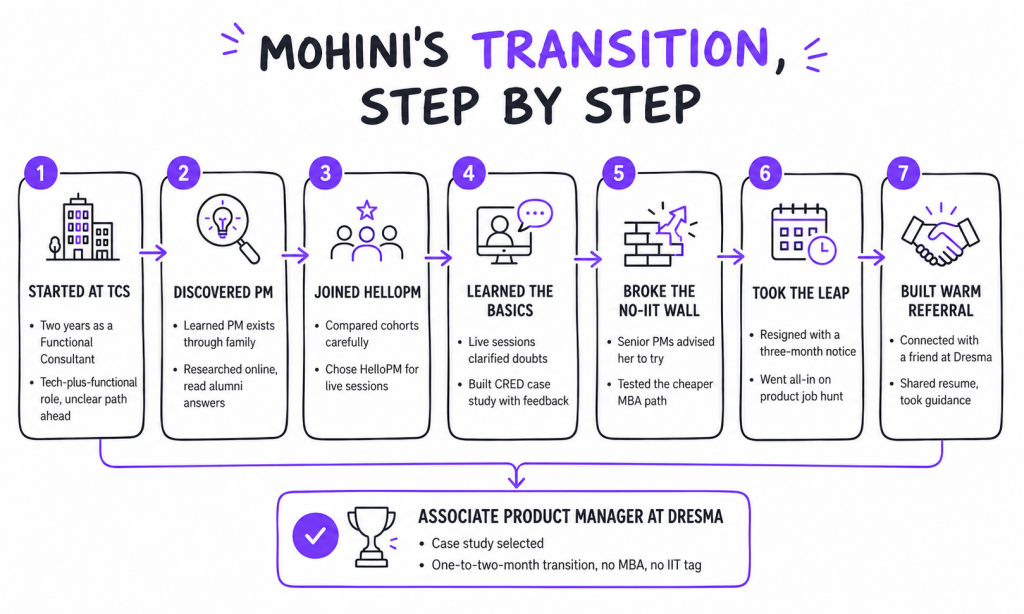
Mohini was told by people already in the industry that her college would close its doors and that an MBA or an internship was the fix. She did neither. She chose a structured cohort, worked through a real CRED case study, built one meaningful LinkedIn connection, prepared properly for the PM interview, and had the offer in one to two months.
| I don’t think it is that much hard, you can do it. Everyone can transition to product. If you get lucky with the right mentorship, you can transition in one or two months. – Mohini Prakash, APM at Dresma |
Notice what’s missing from her story: the volume. There’s no hundreds-of-applications number here, no inbox full of cold emails. Her count is one conversation with family that pointed her at the role, one Quora thread that led her to a cohort, one LinkedIn connection inside the company, and one case study that got selected. Direction, not volume.
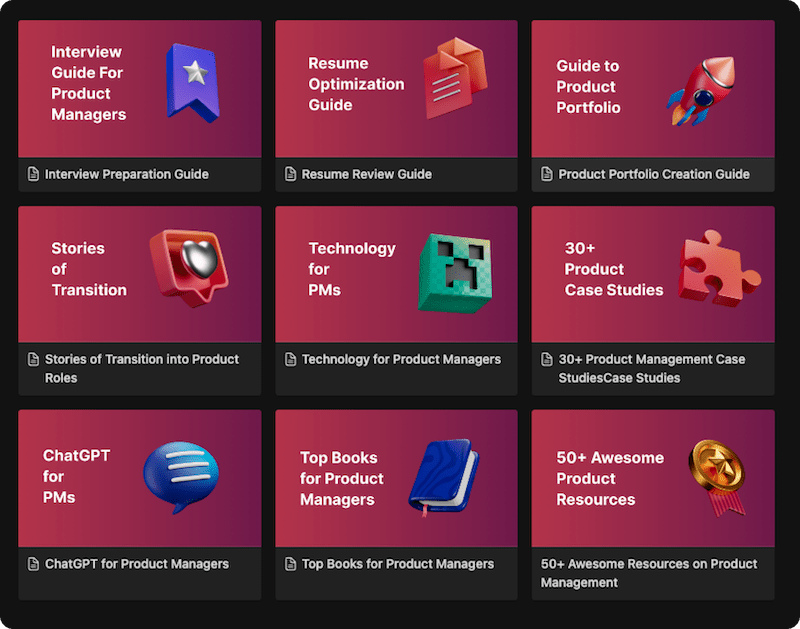
| Curious if this path fits for you?Mohini’s route, clearing the basics, building proof, and networking to a referral, is what HelloPM teaches switchers from TCS, services, and non-tech backgrounds. Browse Free PM Resources: | Book a Counseling Call More alumni paths: HelloPM Alumni Stories |
Frequently Asked Questions
- Can you become a product manager from a service-based company like TCS or Infosys?
Yes. A service or consulting role gives you cross-functional exposure, delivery experience, and client problem-solving, all of which map to PM work. Mohini Prakash moved from a Functional Consultant role at TCS to an APM at Dresma in one to two months by clearing PM fundamentals and networking through a referral, rather than waiting for a title. - Do you need an IIT or top-tier college degree to become a PM?
No. Mohini came from a non-IIT, tier-2 college and was told she’d need an MBA to make up for it. She landed the role without one. Companies hiring for product care about demonstrated product thinking and proof of work far more than your college name.
- Do you need an MBA to switch into product management?
No, an MBA is not required. It can help in some cases, but it is not a gate. Mohini got in through focused upskilling, a built case study, and networking, rather than a degree, after being told an MBA was the way in. You can read more on resume positioning in the PM resume guide.
- Do you need to know how to code to be a PM?
No. You need enough technical understanding to work with engineers and make sensible trade-offs, not the ability to write production code. A computer science background like Mohini’s helps, but plenty of PMs come from non-coding roles.
- How long does a tech-to-PM transition take?
It varies with how much groundwork you do before applying. Mohini’s active transition took one to two months, but that followed a cohort study, a built case study, and deliberate networking. The more proof and direction you have before you start applying, the shorter the active hunt tends to be.
- Is a referral really better than applying to PM jobs online?
For career-switchers, usually yes. A referral puts a person between your resume and the automatic filter that screens out non-traditional backgrounds. Mohini’s APM role came through a warm referral she built over time, not a cold application. Build the relationship before you need it.
- How do you network for a PM role on LinkedIn without being pushy?
Connect and build a genuine relationship before you ask for anything. Mohini wasn’t already in her contact’s network, so she connected first and let it develop before sending her resume. A referral is earned over time, not triggered with a single message.
- Is it harder to switch into product management from a non-tech or non-IIT background?
It can feel harder because of the noise telling you that you need more credentials first. In practice, the switchers who get in the lead with proof and a clear story instead of apologizing for their background. Mohini’s view, after doing it: it was not that hard once she had direction and a mentor.