Can a Software Developer Become a Product Manager? Prabhav’s Cold Outreach Playbook
Yes. A software developer can become a product manager. Prabhav Gupta did it with no prior product title and no […]
Who Is Prabhav Gupta?
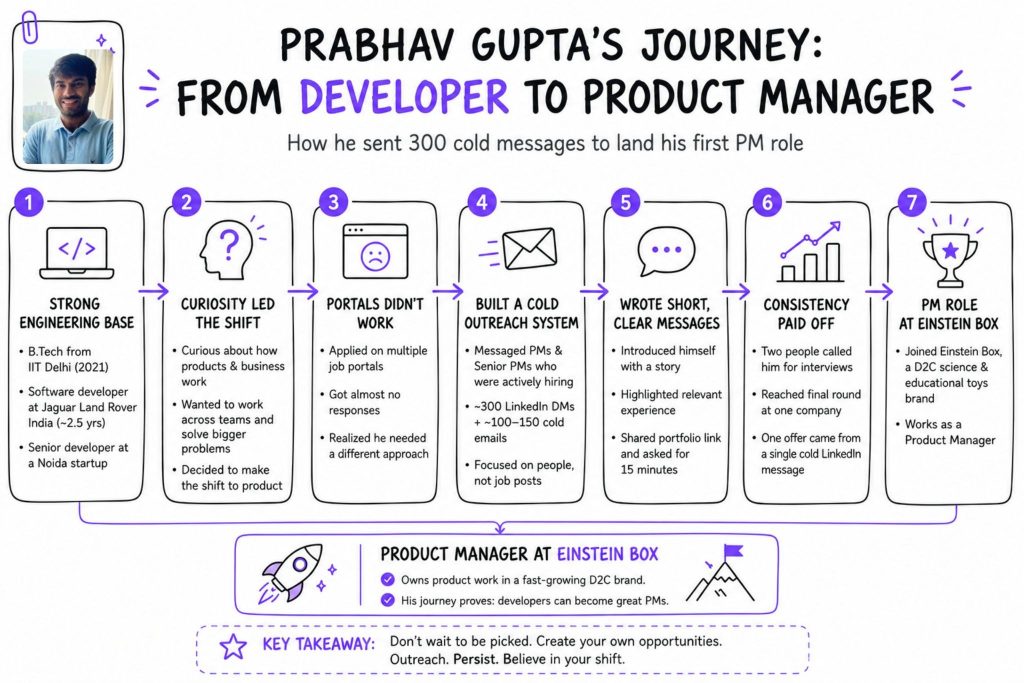
Prabhav Gupta is a software engineer who became a product manager at Einstein Box, a D2C brand that makes science and educational toys for children aged 6 to 14 and sells across India, the US, Australia, the UAE, and Europe, mostly through Amazon. He made the switch without a prior PM title and without prior product experience.
His engineering pedigree is real. He completed a B.Tech in Mechanical Engineering from IIT Delhi in 2021, then spent around 2.5 years as a software developer at Jaguar Land Rover India, developing software to improve the car-testing process. After that, he worked as a senior developer at a NOIDA startup building products at the intersection of data networking and AI.
So this is not a story about someone who struggled to get a job. It is a story about a capable engineer who decided he wanted a different seat and had to prove he belonged there, despite having zero product experience on paper.
Can a Software Developer Become a Product Manager?
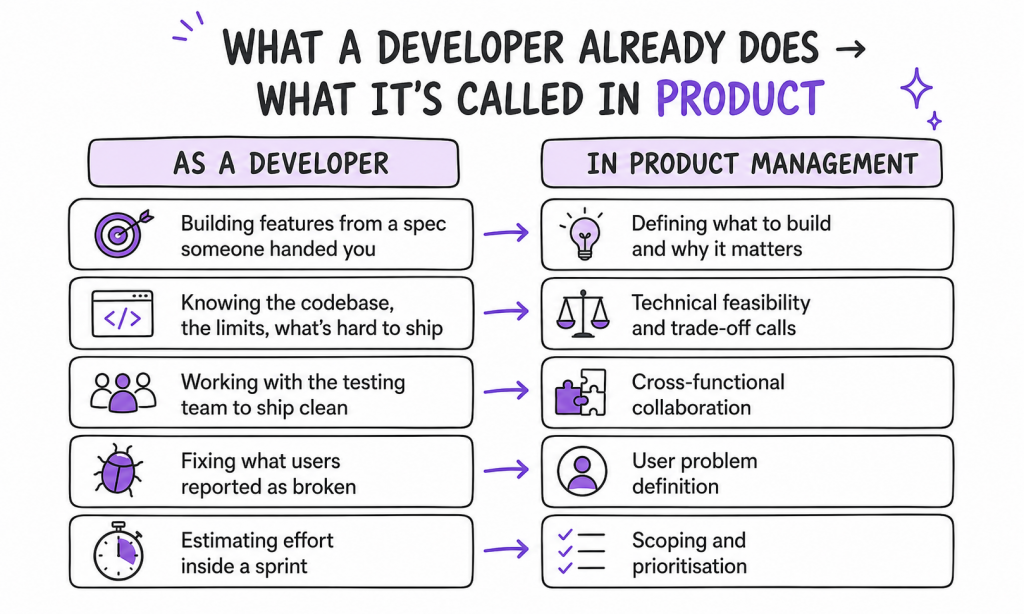
Yes. A software developer already understands how products get built, which is half of what a PM does. The gap is not in capability. It is that a developer thinks about how to build something, and a PM has to think about why, for whom, and what to trade off. Prabhav’s whole transition was learning to ask the second set of questions about the work he was already doing.
He puts it plainly. A developer builds what the product person decided to build. The product person asked why we are building this, who it is for, what the challenges are, and what the trade-offs are. His advice to any engineer is to go back through their own projects and answer those five or six questions themselves. That is the reframe that turns engineering experience into product experience.
One honest caveat from Prabhav: the belief has to come first. He only started seeing results once he was convinced that a developer could do this. If you are not convinced, even a callback is hard to convert, because you cannot persuade an interviewer of something you do not believe.
Why He Left a Developer Career for Product Management?
It was a gradual pull, not a single dramatic moment. While he was writing code, Prabhav grew curious about how the rest of the company and the product worked. Being an individual contributor had its upsides, but he wanted to work across the business, at the intersection of many teams and with many people.
He’s the first to admit none of it was as planned as it looks in hindsight.
| “Just a disclaimer that even though what I might say next would sound like a very solid proof plan and a very solid execution model, it was nothing like that. It was just navigating through the seas, and now it just seems like it was all coordinated.” – Prabhav Gupta, Einstein Box |
He read about the role, talked to friends who had moved into product, and the curiosity kept building until he decided to make it a full-time career shift. This “why” matters more than it looks. When he got into interviews, it was the question interviewers focused on most: not which language he used, but why he wanted to move to product at all.
| “They replied to me because I was just there.” – Prabhav Gupta, on why people responded to his outreach |
How to Get PM Interview Calls When the Portals Ignore You
Cold outreach, not job portals. Prabhav applied through LinkedIn, Instahyre, and four or five other major portals and got almost no response, because his resume did not look like a product resume someone would pull out of a thousand applications. So he switched to directly messaging the people doing the hiring.
Here is the mechanic. He filtered LinkedIn for product managers, senior PMs, and group PMs, then layered on the “actively hiring” filter. That gave him a list of people who owned teams and were looking. He reached out to them directly, not to job posts. The numbers tell the story of how much volume this took.
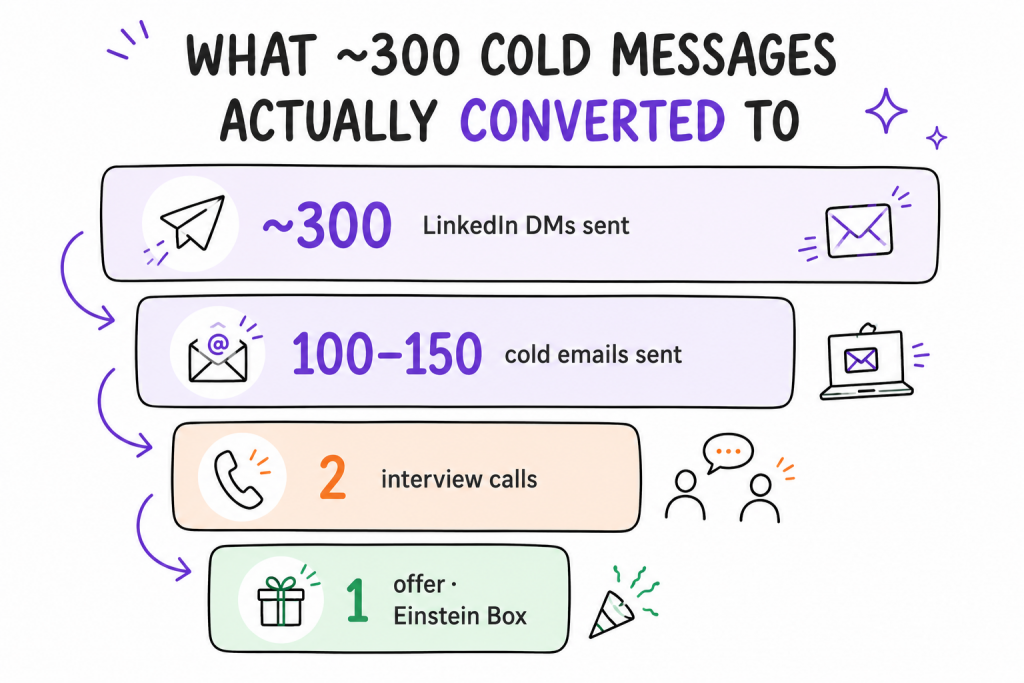
Two people called him in. He reached the final round at one company he badly wanted and lost it, which stung. The other came from the Einstein Box. The job he holds today came from a single cold LinkedIn message to someone who was hiring for their team.
The lesson he repeats: most people queue at the one door everyone else is knocking on, the job portal. He went looking for less competitive doors. As he says, if you don’t ask, the answer is always no, and if even one percent of a thousand people reply, that is ten conversations you would not have had. (That thousand-person figure is the illustrative point he makes to others, not his own count. His own count was roughly 300 DMs.)
The Cold Mailing Playbook
Write short, clear, confident messages and frame them as a story, not a job application. Because a LinkedIn connection request caps around 300 characters, Prabhav had to make every word work: a quick intro, his background, and a clear line that he was looking to move into product and would love to know if they were hiring.
The detail that made the difference was how he framed his past work. He did not write “I was a developer at Jaguar.” He wrote that he had helped curate luxury experiences at Jaguar. Same fact. Completely different signal to the person reading it.
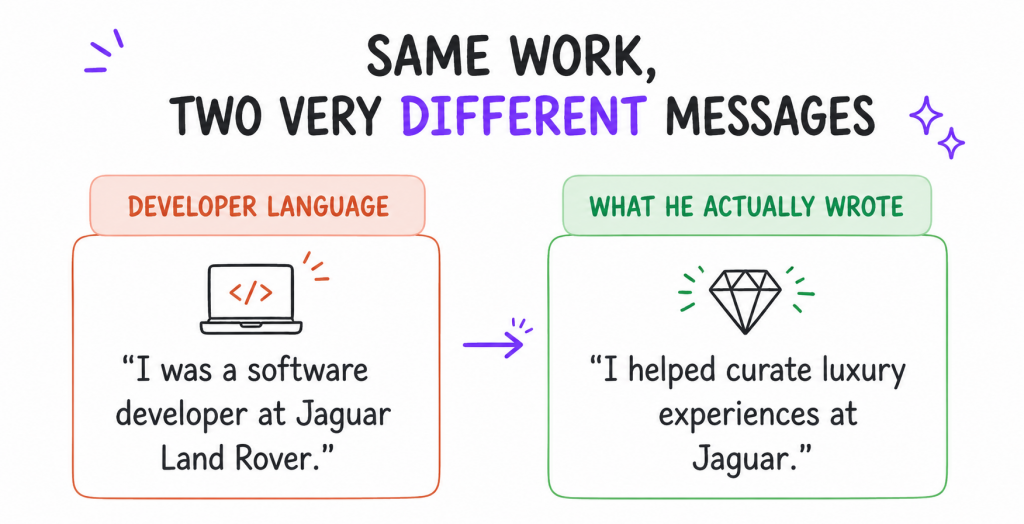
He didn’t start with eight perfect templates. He started with one short message and kept a running document. By day 20, it had grown to eight variants, sorted by who he was writing to: one for a PM, one for a hiring manager, one for an HR contact. Each new person he messaged, he copied the closest version and changed maybe ten percent. The system grew because he kept adding to it, not because he planned it on day one.
| ~300 DMs + 100–150 cold emails → 2 interview calls → 1 PM offer Prabhav Gupta’s personal outreach numbers, in his own approximate words. Einstein Box came from one cold LinkedIn message. |
How to Stay Consistent Through a Long PM Job Hunt?
Set a daily quota you can actually hit, and judge each day by the quota, not by whether you got a job. Prabhav had left his job and was on his notice period, which made the uncertainty sharper. For the first month, he expected fast results and spiralled when they didn’t come.
The shift came when he accepted it would take at least two months, and built a system around that reality: 20 LinkedIn messages and 10 emails, every single day. He would not feel great going to bed jobless, but he could go to bed knowing he had reached 30 more people than yesterday.
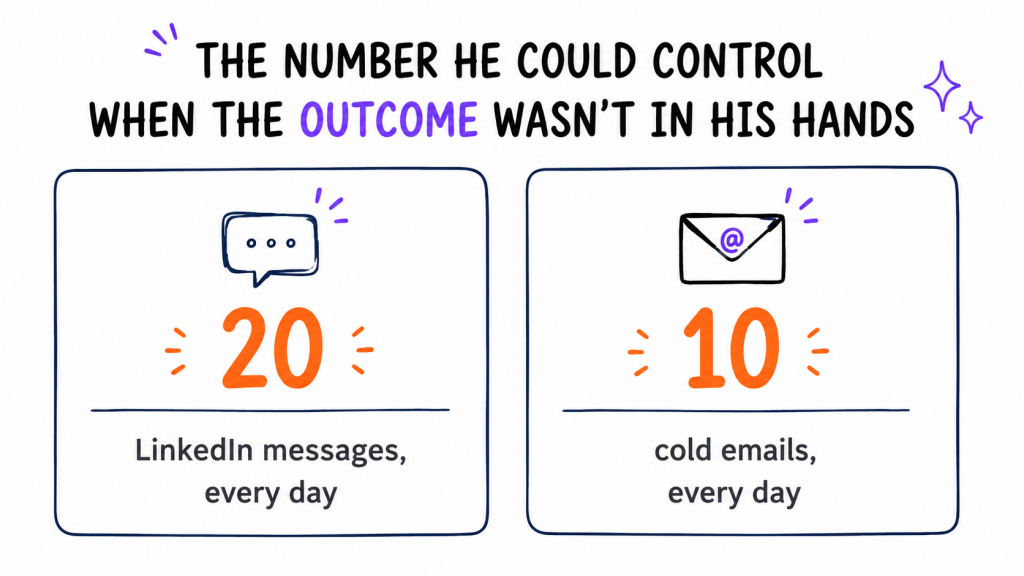
| “In an uncertain phase, grabbing onto some certainty keeps you going.” – Prabhav Gupta, Einstein Box |
One mistake he flags so you can skip it: he delayed reaching out for the first 20 to 30 days because he thought his CV had to be perfect first. It was the wrong order. People didn’t reply because of his CV. They replied because he showed up in their inbox, and then asked for the CV. Keep improving the resume, but never let it block the outreach.
How to Communicate Your Engineering Work in a PM Interview?
Tell the story of your work, don’t list the tech. Prabhav says the content of his experience was already there; how he told it mattered around 90 to 95 percent. Interviewers did not care which language he used to build a feature. They wanted to know what he built, why it was needed, who it was for, the challenges, and the trade-offs he made.
Getting there took real preparation. He read HelloPM’s interview material repeatedly, wrote out his experiences and the likely questions, watched how a typical product interview flows, and rehearsed framing his answers against the job description. A mock interview with the HelloPM team before one of his interviews gave him a reality check on what he was doing wrong, with only two days to fix it. He also leaned on his brother, who works in a product role, for blunt feedback over dinner.
| “How to say that content, I realised, mattered around 90 if not 95 percent.” – Prabhav Gupta, on storytelling in PM interviews |
What do interviewers usually ask about your tech work in a PM Interview?
- What did you build? | The feature or system is described functionally, not technically.
- Why did you build it? | The business or user need that drove it. What problem was being solved?
- For whom? | Who the user or stakeholder was. What they cared about.
- What were the challenges? | Constraints, trade-offs, things that didn’t go as planned.
- What were the trade-offs? | What you chose not to do and why. What you optimized for.
His practical method: re-read the interview material before each round, write out the likely questions and how he wanted to frame each answer, and read the job description carefully first so his framing matched what that specific role wanted.
How did HelloPM help Prabhav Gupta in his PM Transition Journey?
Two things, mostly: a support system and a cold-outreach playbook he could just execute. Before joining, Prabhav was, in his words, in the middle of nowhere on how to actually run the transition. He’d seen the free resources, was struck by how clearly the problems were broken down, and wanted to be around people who thought like that.
What helped most once he was in: the program was built around a tangible outcome, a PM role, not just stacking up knowledge. The cold-outreach strategy gave him a clear intensity to aim for, a follow-up cadence, and a heads-up to expect about two months of uncertainty, which turned his self-doubt into something his mentors had already warned him was normal. The mock interview and the community feedback did the rest.
| 2,800+ HelloPM alumni – career switchers from engineering, QA, sales, marketing, and non-tech backgrounds, many of whom started exactly where Prabhav did. |
He puts a number on what the community alone did for him: it moved his own estimate of his odds from roughly 20 percent to 70 percent. For someone deciding whether even to attempt the switch, that swing in self-belief was the unlock before any tactic mattered.
Key Takeaways from Prabhav’s Journey
- A developer is already half a PM. You know how products get built. The work is learning to ask why, for whom, and what trade-off, about projects you already shipped
- Cold outreach beats the portal queue. ~300 DMs to hiring PMs got him two calls. Job portals got him almost nothing. His offer came from one direct message.
- Don’t wait for a perfect CV. He lost 20–30 days to that. People replied because he showed up, then asked for the resume. Outreach first.
- Build a daily quota you control. 20 DMs and 10 emails a day gave him a win every night, even when the outcome wasn’t in his hands.
- Storytelling is the interview. Reframe “I was a developer at Jaguar” into the product impact you owned. How you tell it mattered ~90% to him.
| Curious if this path is right for you? Prabhav’s outreach-first sequence is what HelloPM teaches across engineering, QA, sales, and non-tech backgrounds. Explore the free resources, or talk it through with someone first. Browse Free PM Resources: | Book a Counseling Call |
Frequently Asked Questions
- Can a software developer become a product manager?
Yes. Developers already understand how products are built, which is a large part of the PM job. The gap is learning to think about why a feature matters, who it’s for, and what trade-offs it entails, rather than only how to build it. Prabhav Gupta moved from software development into a PM role at Einstein Box, making exactly that shift.
- Do you need an MBA to switch from engineering to product management?
No. An MBA can help, but it is not required. Companies care more about demonstrated product thinking, a resume written in product language, and the ability to explain your decisions in user and business terms during interviews. Many PMs come from engineering and non-MBA backgrounds.
- How do you get PM interview calls without product experience?
Cold outreach to people who are hiring, not job-portal applications. Filter LinkedIn for PMs and senior PMs who are actively hiring and message them directly with a short, confident note about your background and intent. Prabhav sent roughly 300 LinkedIn messages and 100-150 cold emails, resulting in 2 PM interview calls and 1 offer. Job portals barely responded.
- How do you rewrite a developer’s resume for a PM role?
Go back through each project and answer four questions: what problem was being solved, who was the user, what did success look like, and what trade-offs were made. Write each bullet in that language instead of listing the tech you used. It takes several iterations and outside feedback. For a full walkthrough, see HelloPM’s guide to building a strong product manager resume.
- What should you write in a cold message to a hiring PM?
Keep it under the LinkedIn 300-character connection limit: a quick intro, your background framed as a story rather than a job title, and a clear line that you’re moving into product and would value knowing if they’re hiring. Prabhav reframed “developer at Jaguar” as “helped curate luxury experiences at Jaguar.” Same fact, stronger signal. Build a small library of variants for PMs, hiring managers, and HR over time.
- How long does a developer-to-PM transition take?
It varies with how much groundwork you do. Prabhav planned for at least 2 months of active outreach once he started, and treated a daily quota as something he could control. Doing the resume work, the outreach, and the interview prep in parallel rather than in sequence tends to shorten the active job-hunting phase.
- How do you stay motivated during a long PM job search?
Set a daily action target you can hit regardless of results, and measure each day by that, not by offers. Prabhav committed to 20 LinkedIn messages and 10 emails a day for at least a month. It gave him a sense of progress on days with no replies, which is what kept him consistent through the uncertainty.