From Sales to AI Product Manager Without a Tech Background: 300+Applications, 4 Interviews, 1 Offer
Samarjeet Sharma moved from a non-tech sales job into AI product management with a mechanical engineering degree and no coding […]
Can a non-tech salesperson really become an AI product manager?
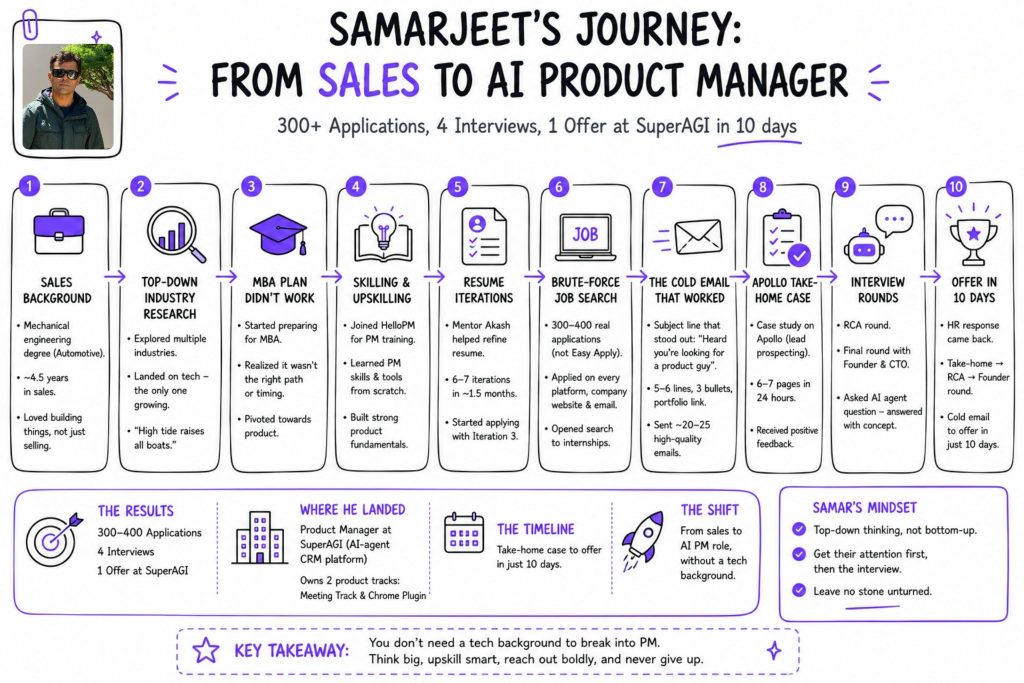
Yes, and Samar is proof. He has a mechanical engineering degree specialising in automotive, spent around 4.5 years in sales, and openly says he did not know tech going in. Today, he is a product manager at SuperAGI, an AI-agent-enabled CRM built to compete with Salesforce, where he owns two product tracks: a meeting track and a Chrome plugin.
What carried him was not a technical background. It was a way of thinking. Stuck at home job-hunting, he refused to limit himself to roles that obviously matched his sales CV. Instead, he went the other way.
| My approach to getting into product was not bottom-up; it was top-down. Instead of seeing where I’d match, I started going over industries. – Samarjeet Sharma, Product Manager at SuperAGI |
He walked through sectors one by one: insurance, pharma, retail, FMCG, and kept landing on tech because it was the one still growing. A friend gave him the line that settled it: a high tide raises all boats, so go where the tide is; you don’t have to be the biggest boat. That reframing is the whole non-tech transition in one sentence. You don’t need to be the strongest candidate in tech. You need to be standing in the part of the market that is rising.
Why leave a stable Sales career for Product Management?
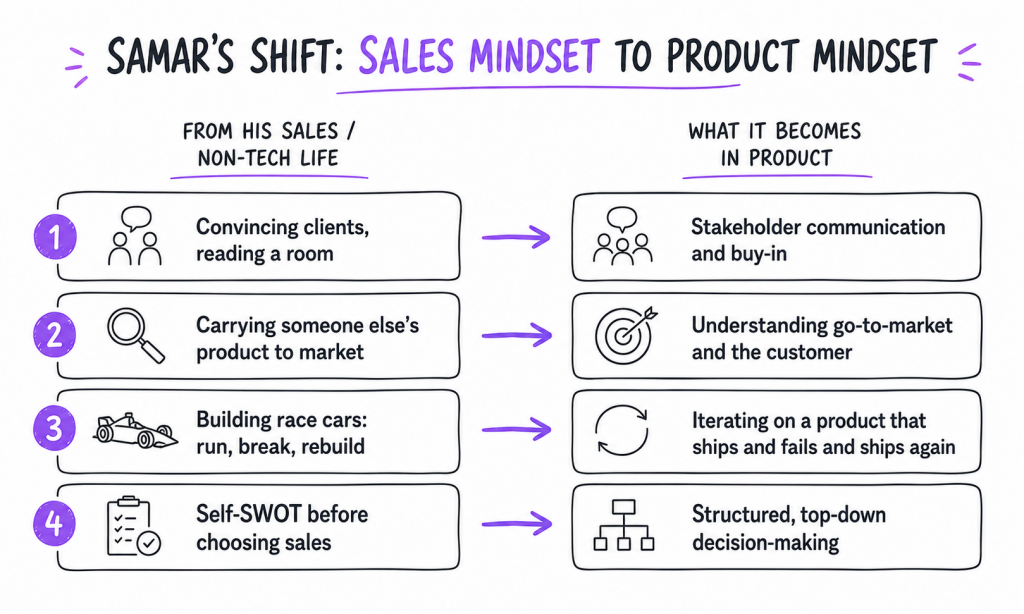
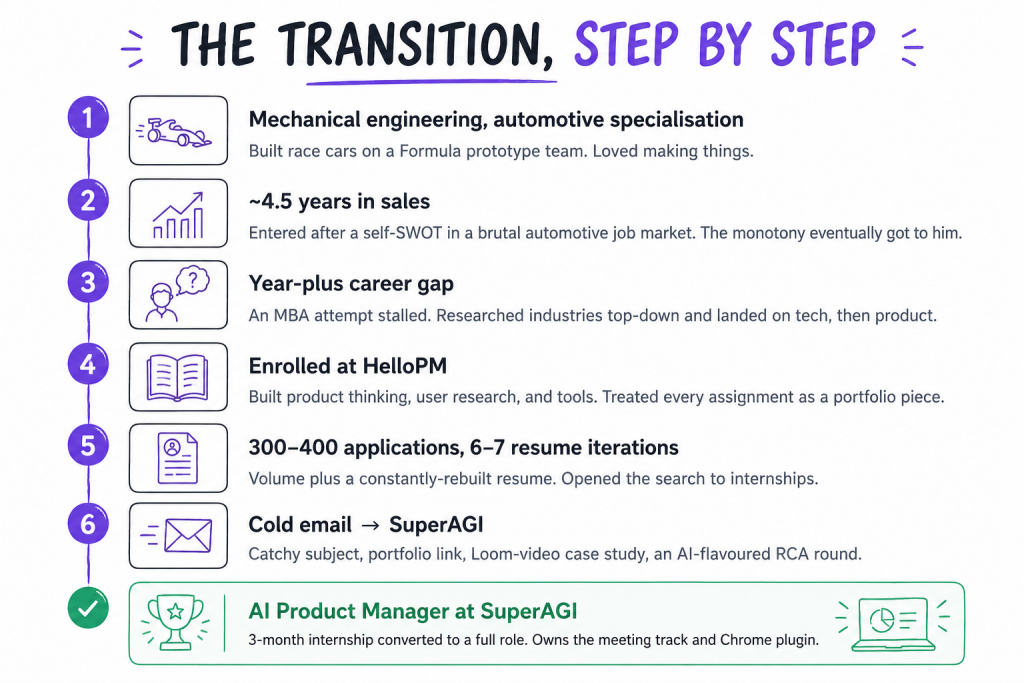
Because the monotony broke him, and building did not. Samar had spent years taking a finished product from one client to the next under constant pressure for numbers. The work that actually lit him up was making things, going back to his college days on a Formula prototype team building race cars, watching something run, brake, and get rebuilt.
Sales was a calculated entry, not a calling. He picked it after a quick SWOT on himself: he could talk to people, he’d get to travel, and the automotive job market was brutal the year he graduated. By his own count, thousands of people were laid off from the automotive sector in a single month that year. So sales was the safe boat. The product was the one he actually wanted to row.
His first instinct, like many switchers, was an MBA. He started studying for it. It didn’t go well; he’d been out of study mode for years, and the overseas job market for foreign students was poor. That dead end is what pushed him toward the top-down industry research that eventually pointed to the product.
How many jobs do you apply to before landing a PM offer?
For Samar, it was 300 to 400 real applications to get four interviews and one offer. And he is specific that this number does not include LinkedIn Easy Apply, which he found close to useless. It counts only the applications where he went to a company’s website, sent an email, or properly applied, the ones he could actually track.
| The only strategy was one: leave no stone unturned. If there is a platform that posts jobs, I am applying to it. – Samarjeet Sharma, Product Manager at SuperAGI |
He is honest about starting with no edge. Bad market, a year-plus out of work, no prior tech experience. So volume was the strategy, but volume on top of a resume he kept rebuilding. With help from his HelloPM mentor, Akash, the resume went through six to seven iterations over about a month and a half. The first versions leaned on ChatGPT edits and weren’t ready. He kept applying, and at some point in that stretch he realised the resume still needed work and that he should open the search to internships too.
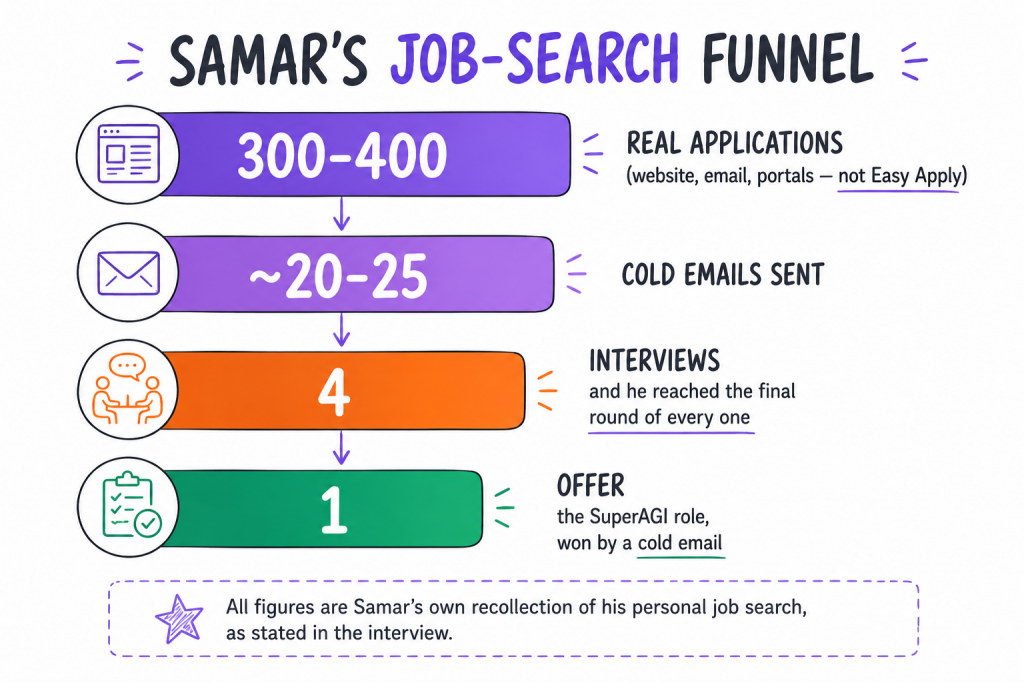
One mindset shift unlocked more doors than any platform: he stopped searching only for “product manager” and started including internships. The moment he accepted that an APM or PM title wouldn’t be handed to a non-tech switcher overnight, his LinkedIn search opened up to a flood of internship posts – and that is the search that eventually paid off.
How do you actually get a PM job through cold email?
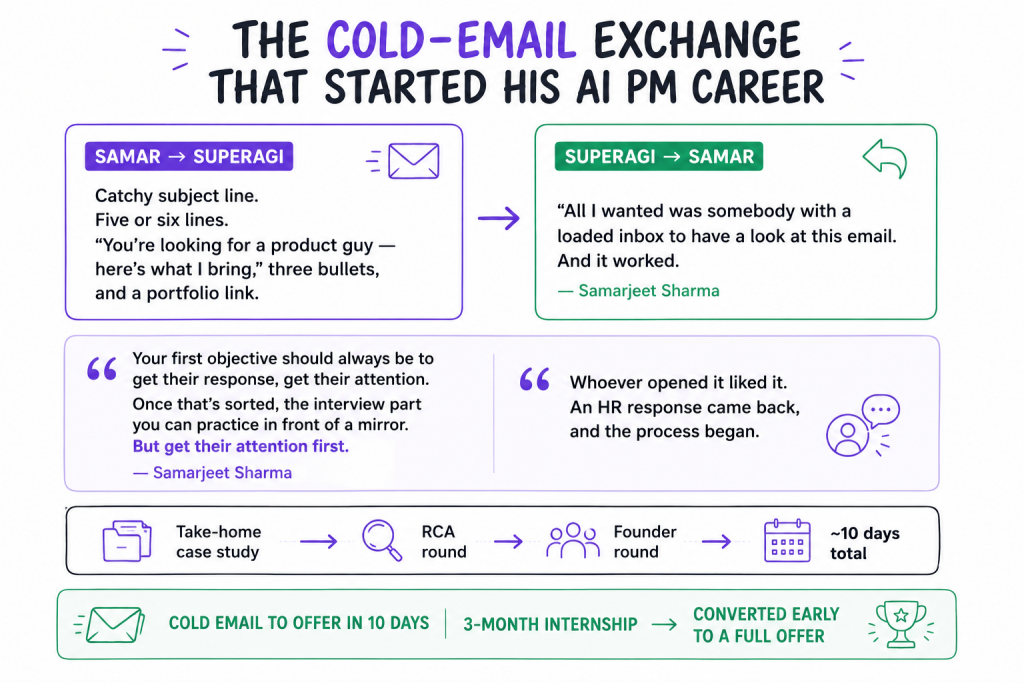
You make a busy person with a full inbox want to open one more email. Samar’s current job came from a single cold email, and he is clear about why the earlier ones failed: his subject lines were boring. “Product – Samar – application” got ignored. The version that worked read like an advertisement, something close to “heard you’re looking for a product guy.”
| All I wanted was somebody with a loaded inbox to have a look at this email. And it worked. – Samarjeet Sharma, Product Manager at SuperAGI |
The body was just as tight: five or six lines, three short bullets on what he brought to the table, and a link to his portfolio. Nothing more. He found contacts using LinkedIn Premium and the Apollo extension to dig out email IDs, and he sent only around 20 to 25 of these quality over spray. To send more would have meant finding more emails, which is genuinely hard.
| Your first objective should always be to get their response, get their attention. Once that’s sorted, the interview part you can practice in front of a mirror. But get their attention first. – Samarjeet Sharma |
The interview: a take-home case and an AI curveball
The first real test was a take-home case study on Apollo, a lead-prospecting database, chosen because it’s a competitor to SuperAGI. Samar didn’t just send a report. He recorded an eight-to-ten-minute Loom video walking through the product screen by screen, explaining each function. Going above and beyond a boring document is exactly what made him stand out.
Then came the curveball. In the RCA round, he was asked why ChatGPT had been getting a wave of downvotes recently. Most online RCA prep doesn’t touch live AI products, so this caught him off guard. He kept pressing – “play doctor, press where it hurts”- narrowing from geography to action type until he reasoned his way to a plausible cause around file uploads failing. He admits he stuttered. He also kept thinking on his feet, which is the actual skill being tested.
Do you need to be technical to be an AI product manager?
No, but you do need relentless curiosity to close the gap fast. Samar walked into SuperAGI as, in his words, a small fish: a roughly 85-person team, most of them from IITs, including a manager from IIT Bombay computer science. His honest answer to feeling outmatched wasn’t to fake it. It was to do the homework before asking.
| “ You can’t ask stupid questions. You’ve got to have your first few questions with ChatGPT, get a basic understanding, and then ask. In this process, you learn even better, even faster. ” – Samarjeet Sharma, Product Manager at SuperAGI |
One example shows how this compounds. During his course, he once built a service for handling DNS records, never imagining it would matter. Months later, he was working on DNS records in his actual job – CNAME, TXT – and it was suddenly familiar. The lesson he draws: stay curious about all things tech, because you cannot predict which scrap of knowledge becomes the thing you need. If you’re working through this yourself, using ChatGPT well as a PM is one of the fastest ways to close that gap.
How do you survive a year-long gap without breaking?
You pick one boring thing and do it every single day. This is the part of Samar’s story that has nothing to do with PM skills and may matter more than all of them. While friends were getting married, moving abroad, and building careers, he was at home wondering whether to even renew his medical insurance. It took a real toll.
| I started running daily. That changed everything. Just go do the most boring thing, over and over again. – Samarjeet Sharma, Product Manager at SuperAGI |
He didn’t like running, yet ran anyway, a daily 5k, the endorphins, the small proof he’d done one thing right that day. The numbers became their own milestone: he started around 86 kg, lost close to 20 kg, and went on to run a half-marathon. A side hobby meant only to keep him sane became evidence of his own persistence. When interviews crushed his hopes, the habit is what got him to apply one more day. He also leaned on Spotify product podcasts, where many of the hosts come from arts backgrounds, a daily reminder that a non-traditional path into product was not just possible but common.
| ~20 KG lost over the job-search gap through daily running, the habit Samar credits with keeping him applying when interviews fell through. He later ran a half-marathon. |
What does an AI product manager actually do today?
At SuperAGI, Samar’s day runs on an agile rhythm from morning standups to a late scrum on blockers. SuperAGI is building a single AI-agent-enabled platform: super sales, super marketer, super coder, super support, aimed at being one solution where HubSpot leans marketer, and Salesforce leans sales. He owns two tracks: a meeting track and a Chrome plugin.
A rough shape of his day: meetings from around 9 am to 1 pm, then wireframing with the design team, then research in the afternoon, then testing alongside QA from roughly 6:30 to 8 pm, and finally a scrum call on blockers. The monotony that drove him out of sales is gone when his product feels stable, a competitor ships something, and he’s reading and rebuilding. For the AI-agent products he works on, HelloPM’s primer on what AI agents are covers the foundation.
What did HelloPM actually change for Samar?
Three things, in his telling: a foundation, the right tools, and people who’d sit with him in the cohort.
The first product-thinking module, the introduction to PM and product thinking, set the gear. The user research module taught him the core PM habit of actually listening to the customer, even for a product you’ve never used yourself.
Then the tools became muscle memory. Instead of building an assignment in Google Slides, he’d do it in Figma, instead of a Word doc, Notion. Small choices, but they made real interviews far less intimidating. The sessions that left the biggest mark were with a mentor who broke down AI in a way a complete non-tech beginner could follow — and who once spent over an hour on a call with Samar even after he’d already landed the job, sitting with him to explain a domain like fintech from the ground up. That kind of access, not a class recording, is what he keeps coming back to.
His sharpest piece of advice on the course itself: treat assignments as your own skill- building playfield, not a graded school task. When a group’s collective focus dropped, he’d happily go solo and build to his own standard, because the assignment was going straight into the portfolio that got him interviews. If you’re building that proof now, start with a product portfolio and a strong PM resume.
Before vs After HelloPM
| Dimension | Before | After |
| Tech | Intimidated by engineering talk | Learns AI module by module; asks ChatGPT first, then colleagues |
| Tools | Google Docs and Slides | Figma and Notion from day one of assignments |
| Applications | LinkedIn Easy Apply, generic subject lines | Targeted portals plus cold emails with a portfolio link |
| Resume | One pass, assumed done | 6–7 iterations; treated as a process, not a document |
| Role | Carrying someone else’s product, client to client | AI PM at SuperAGI, owning two product tracks |
Samar’s advice for aspiring product managers
Respect the decision you made and don’t crawl back. Samar’s first rule is mental: many switchers feel the pull to return to their old job because it’s easier. Don’t. Honour the choice, even when it bruises your ego, because comfort is only temporary.
Second, find a boring daily habit that makes you feel good after you do it. He’s blunt that this process takes a toll, and you need a separate source of small wins. Third, keep your curiosity at the peak for everything tech – the DNS story is his proof that nothing you learn is wasted. And finally, manage time ruthlessly, because in a real PM role, deadlines and other people’s speed beat you up if you can’t.
| Thinking about your own switch into a product?
Samar’s path- top-down industry research, real assignments, and a portfolio that does the talking – is what HelloPM teaches across sales, non-tech, and engineering backgrounds. Start by exploring, not buying. |
Frequently asked questions
1. Can you become a product manager from a sales background?
Yes. A sales background gives you customer empathy, communication, and the ability to read and persuade people, all of which map directly to product management. The gap is usually product thinking, technical fluency, and prioritisation. For a full walkthrough, see HelloPM’s guide on transitioning from sales or business development to product management, and another alumni route in the sales-and-data-to-PM story.
2. How many job applications does it take to get a product manager offer?
It varies hugely, but it can be in the hundreds for a career switcher with no prior PM title. Samarjeet Sharma sent 300 to 400 real applications, excluding LinkedIn Easy Apply, to get four interviews and one offer. Volume matters, but only on top of a resume you keep refining and a willingness to include internships in your search.
3. Do you need to know how to code to be an AI product manager?
No. Samar became an AI PM with a mechanical engineering degree and no coding ability. You need enough technical curiosity to hold credible conversations with engineers and reason about how AI products behave. His method was to get a basic understanding from ChatGPT first, then ask sharper questions of his team.
4. Do you need an MBA to become a product manager?
No. Samar started preparing for an MBA, abandoned it, and then broke into product without one. Recruiters he spoke to told him brand-name courses don’t decide product hiring – what matters is whether you can actually do the work and show proof of it.
5. How do you write a cold email that gets a PM interview?
Lead with a subject line that makes a busy person open it. Samar’s winning line read like an advertisement, not an “application.” Keep the body to five or six lines, three bullets on what you bring, and a portfolio link. Send a focused 20-25, using tools like LinkedIn Premium and Apollo to find the right email addresses, rather than spraying hundreds.
6. How do you stay motivated during a long career gap?
Build one boring habit you do daily that leaves you feeling good afterwards. For Samar, it was running a daily 5k that helped him lose close to 20 kg and eventually run a half-marathon. It gave him a reliable small win on days when interviews fell through, which kept him applying. This is a tough stretch emotionally; if a job-search gap is affecting your mental health, it’s worth leaning on people you trust or a professional for support.
7. What does an AI product manager do day to day?
At an AI company like SuperAGI, the day runs on an agile cycle: morning standups, wireframing with design, research, testing with QA, and a closing scrum on blockers. The core work is owning product tracks—Samar handles a meeting track and a Chrome plugin & constantly adapting as competitors ship new AI capabilities.
8. How fast can a PM hiring process actually move?
It can be remarkably fast at startups. Samar’s entire process at SuperAGI – from cold email to offer – took just 10 days, covering a take-home case study, an RCA round, and a founder conversation. He started as a 3-month intern and was converted to a full role well before the internship ended.