Can a QA Tester Become a Product Manager? Mansi Gupta’s Journey from QA to PM
Yes. A QA tester can become a product manager. Mansi Gupta spent around 7 years in testing and delivery at […]

Who Is Mansi Gupta?
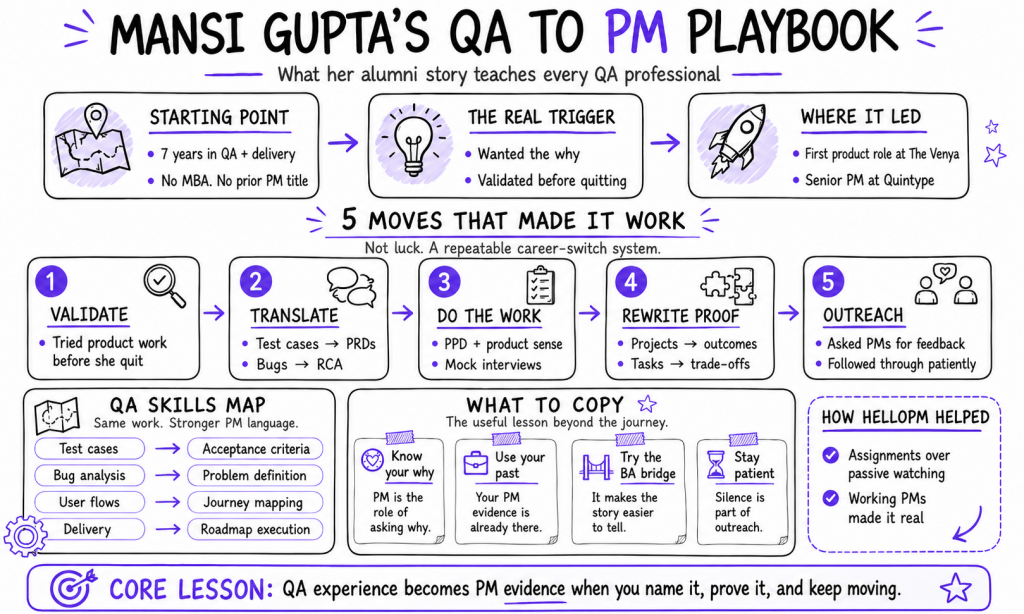
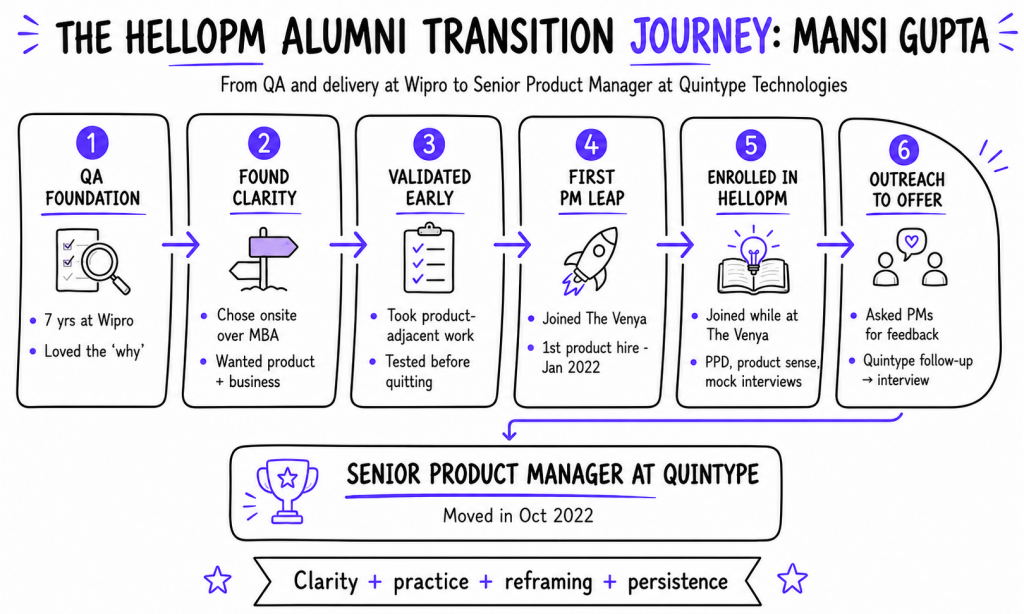
Mansi is an IT engineer who spent around 7 years in QA and delivery management at Wipro, including time onsite. She is now a Senior Product Manager at Quintype Technologies, a SaaS publishing platform used by major Indian media houses. She made this switch without an MBA, without a prior PM title, and without quitting her job before she had proof she actually wanted it.
Most transition stories start with a dramatic quit. However, Mansi’s story isn’t like that.
When she had to choose between an MBA and an on-site opportunity at Wipro, she picked on-site. The exposure to different geographies and working styles gave her something the MBA wouldn’t have: clarity. She came back knowing she wanted the product and business side of software, not the delivery track she was already on.
She dropped her papers at Wipro, joined The Venya – an early-stage startup – as their only product person, enrolled in HelloPM while working there, and eventually landed at Quintype Technologies as a Senior Product Manager. Check out Mansi’s Profile here
Why Mansi Wanted to Move Beyond QA and Testing?
It wasn’t about hating the job. It was about realising the job wasn’t the whole picture.
Ask Mansi about her time at Wipro, and she’ll tell you she was never really a techie at heart, even as a QA and delivery manager. What she was interested in was the layer underneath: why a feature was being built, who actually needed it, and what the business was trying to achieve. The testing was the vehicle. She wanted to drive.
| “I was more interested in working on the business and software and product side of things versus working just on the tech part.”– Mansi Gupta, Senior Product Manager at Quintype Technologies |
QA has a clear track. Mansi could see it from where she was standing, and she knew it wasn’t the direction she wanted. She wanted a role that touched every part of the company: customers, business, tech, and product. Product management was the only one that did all of that.
Can QA Professionals Become Product Managers?
Yes. QA engineers already have most of what product management requires; they just haven’t been calling it that.
Mansi has seen people make this switch from customer success, account management, sales, and design. What they all had in common wasn’t technical depth; it was that they understood customers, the business, the product, and the problems. QA engineers tick all four. They understand what breaks and why. They know the gap between what was specified and what got built. They communicate failure clearly to developers. They see the product from the user’s perspective because they’re the last person between the build and the customer.
Product thinking is the foundation. If you have it, you can move in almost any direction. Most QA engineers already have it. They just haven’t been calling it that.
One thing Mansi is honest about: it’s not automatic. The study has to happen. The patience has to be there. But the raw material? Most of it is already in your head.
What QA Skills Transfer to Product Management?
Same work. Different name. Here is what it looks like when you reframe it.
| What You Do in QA | What is it called in PM |
| Writing test cases and acceptance criteria | Writing PRDs and user stories |
| Bug analysis and root cause identification | Problem definition and RCA |
| Testing user flows end to end | User journey mapping |
| Communicating defects to developers | Cross-functional collaboration |
| Understanding edge cases and failure modes | Risk assessment and feature scoping |
| Delivery and project management | Roadmap execution and sprint ownership |
Beyond the skills, there’s a mindset QA builds that’s harder to put in a table. QA engineers are trained to ask “what could go wrong before this ships?” PMs who don’t have that habit build features that fall apart in edge cases. Mansi had that instinct for years. She just hadn’t named it product thinking yet. And her years weren’t just testing, onsite coordination, cross-geo delivery, and team leadership; all of it maps to the communication, prioritisation, and ownership a PM needs every day.
For the full step-by-step roadmap on making this switch, read the full 7-step QA to PM roadmap. This article explores what that path actually looks like through Mansi’s story.
How to Get Your First PM Experience Without Quitting Your Job?
Here’s the move most people skip. Don’t quit first.
Before Mansi left Wipro, she started volunteering for anything that touched the product or business side of her projects. She described it as a free project to test her own interest, a way to find out whether she actually wanted this before making any irreversible decisions about her income.
That sequencing matters more than most people realise. Most career-switchers quit, then discover what they actually want. Mansi did it the other way around. By the time she left, she wasn’t guessing.
The simplest version of this for any QA reading right now: find one product decision in your current sprint. Ask your PM why that feature was prioritised over the others. Write your own take on what you’d have decided differently. That is product thinking. Start there, without changing anything about your job title.
If you can go further, look for a BA track inside your current organisation. Mansi wishes someone had told her this years earlier. She reflected that if she’d moved into a BA role at Wipro first, the path to Quintype would have been shorter. Business analysts write requirements, talk to customers, and define what gets built, which is most of what a PM does. Getting that experience on paper before you apply for PM roles makes the interview story much easier to tell. And while you’re building that evidence, a product teardown is one of the fastest ways to show product thinking without a PM title.
How HelloPM Helped Mansi Build Product Thinking?
Three things made the difference: a curriculum built for someone starting from zero, assignments that forced doing over watching, and access to working PMs sharing real problems from their actual teams.
Before enrolling, Mansi reached out to people with HelloPM in their LinkedIn profiles and asked them directly what they thought. She got mixed reviews: some said it was too slow, others said it was too detailed. She picked it anyway because she needed something methodical enough for someone who had no prior PM exposure. Most programs she looked at assumed you already understood how product teams worked. This one didn’t.
What made it click for her wasn’t the classes. It was the assignments.
The PPD work and product sense exercises are what she came back to when asked what stayed with her. She was the guinea pig of her batch for mock interview practice, the first one to go through it. The doing was the learning, not the watching.
| “I thoroughly enjoyed doing the assignments, the PPD part and the product sense activity where we had to break down and answer those product thinking questions.”– Mansi Gupta |
The sessions with working PMs were the other thing she kept mentioning.
Not case studies from books. Actual SPMs and PMs from product companies coming in to talk about the problems they face on the job. How they tried to implement frameworks. Where things didn’t work the way the curriculum said they would. That gap between theory and reality is what made the learning real for Mansi.
| “Having people working in product companies talking to you and telling you the problems they face in real life, I think that was very insightful.”– Mansi Gupta |
How to Rewrite Your QA Resume for a Product Manager Role?
Most QA engineers applying for PM roles submit a QA resume. The work they’ve done is PM-relevant. The language they’re using isn’t. That’s the gap.
Mansi went back through her years of Wipro projects, asking one question: where had she actually been doing product management work without calling it that? The answer was almost everywhere. She had been writing requirements, talking to business teams, making trade-off calls, and managing delivery. All of it could be reframed with the right words.
| “I ended up realising that every project that I did, probably did do product management somewhere or the other.”– Mansi Gupta |
Try this now: pick your last three projects. For each one, answer four questions. What problem was being solved? Who was the user? What did success look like? What trade-offs were made? Write one bullet in that language. That’s a PM bullet. It was already in your history.
Reframe Your QA Experience for a Product Manager Role
Three illustrative examples. Same kind of work, written differently.
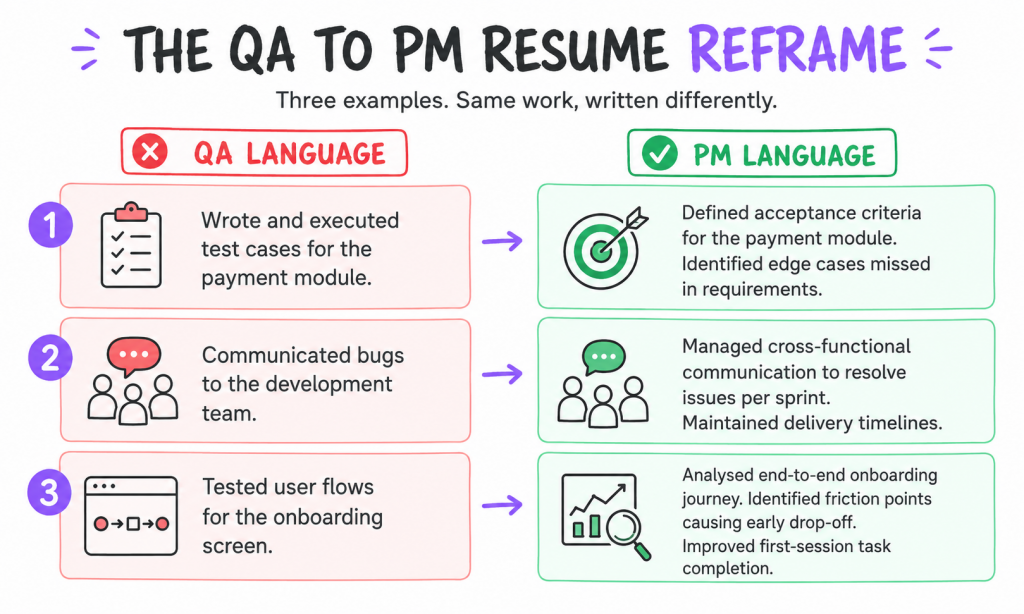
Learn how to build a Strong Product Manager Resume with this complete step-by-step guide. Also, pair your prep with this PM Portfolio Guide to build proof artifacts alongside the resume.
How to Use LinkedIn to Break Into Product Management From QA?
Most people use LinkedIn the wrong way during a PM job search. They apply through job posts and wait. Mansi did the opposite.
She wrote to a lot of people. Not asking for jobs. Not asking for referrals. Just asking what they do and why. That framing changes everything. A cold job ask gets ignored. A genuine question about someone’s work gets a reply. Some people gave her resume feedback. Some told her what they’d change. Some didn’t reply. She kept going. Every bit of feedback that came back, she used, including from people who had nothing else to offer.
HelloPM’s first assignment for every new batch is exactly this: write to five working PMs this week and ask about their work. Not for anything. Just to start the conversation. Mansi had figured this out on her own before she ever enrolled.
Then there’s the follow-up.
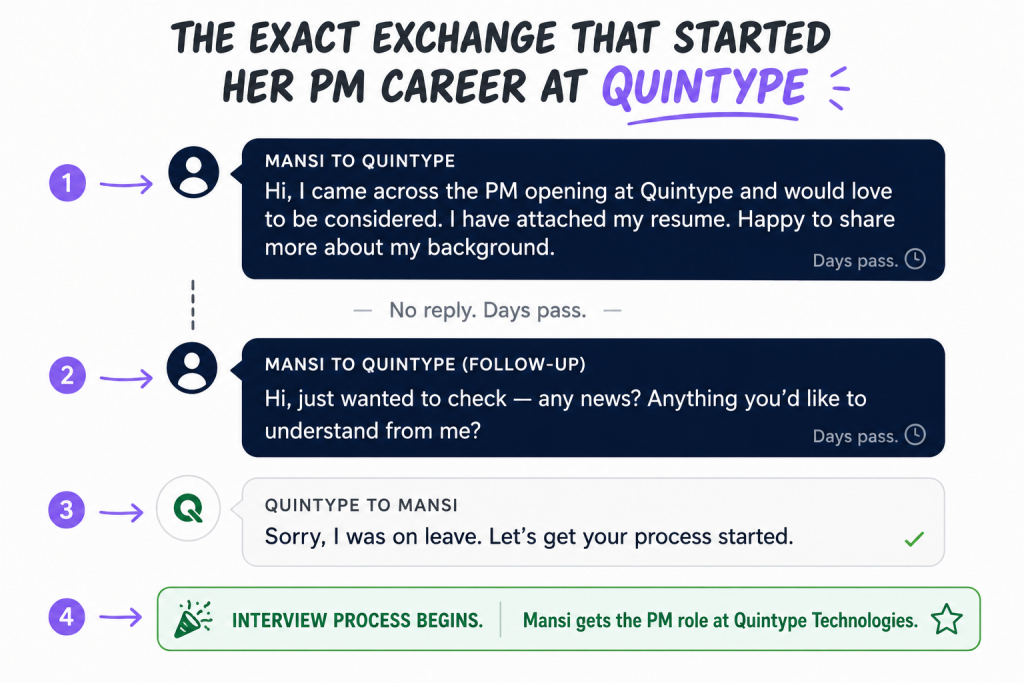
Most people send one message, hear nothing, and move on.
But in Mansi’s case, the recruiter had simply been on leave. And that one follow-up her application from being lost in the pile.
If you are also preparing for PM interviews, check out this Ultimate PM Interview Playlist by Ankit Shukla.
Mansi’s Advice for Aspiring Product Managers
- Know your why before anything else. “A product manager is supposed to ask the why, let’s first answer why I want to enter this.” If you can’t answer why you want PM specifically, not just why you want out of QA, the transition will be harder than it needs to be. And when someone asks you in an interview, your why is your answer.
- Use your past, don’t discard it. Go back through your career history the way Mansi did. The PM work is already in there. It just needs to be named. Every year in QA has product-relevant content for someone who knows how to surface it.
- Leave the ego at the door and be patient. “Go with the least amount of expectations because you have nothing to lose.” She reached out to many people. Got silence. Kept going. Got feedback from people who had no job to give. Used it. The follow-up to Quintype was that the same persistence.
Final Takeaway: QA to PM Is Possible, But It Needs Action
- QA experience is often PM experience in disguise. Test cases are acceptance criteria, bug analysis is root-cause thinking, and delivery management is roadmap execution. The capability is already there; what changes is the framing.
- Validate your interest before making a big career move. Mansi did not quit first and figure things out later. She took up product-adjacent work at Wipro on weekends to test her interest, then made the move with greater clarity.
- The BA track is an underrated bridge for QA professionals. QA to BA to PM is a much easier story to explain in interviews than a sudden direct jump. Mansi wishes someone had told her this earlier.
- Go back through your career history and look for product work that wasn’t called product work. Mansi found it in almost every Wipro project once she started naming her testing, delivery, RCA, and stakeholder work in the right product language.
- Never underestimate the follow-up. One message to Quintype helped Mansi get the role. Most people stop after the interview or application. You shouldn’t be one of them.
Frequently Asked Questions
Q: Can a QA tester become a Product Manager?
A: Yes. Mansi Gupta did exactly this after around 7 years in QA and delivery management at Wipro, becoming Senior Product Manager at Quintype Technologies without an MBA or prior PM title. QA engineers already have most of what PMs need: they understand what breaks, why it breaks, how to communicate failure to developers, and how to manage delivery across teams. The gap is framing, not capability.
Q: Why is QA experience useful for Product Management?
A: QA engineers understand what breaks and why, the gap between what was specified and what got built, how to communicate failure clearly to developers, and how to manage delivery across teams. Those are PM skills. The difference is that in QA, nobody calls it product management. The reframe is the work.
Q: What skills should QA professionals build to become Product Managers?
A: The biggest gaps for most QA professionals moving into PM are product strategy and vision, customer empathy beyond quality assurance, prioritisation frameworks, writing PRDs and user stories, and understanding business metrics. The technical understanding of how products are built is already there. The business and customer layer is what needs building. Start with core PM frameworks and the full QA to PM guide for a structured path.
Q: Do you need an MBA to move from QA to Product Management?
A: No. Mansi transitioned without one. An MBA can be a catalyst, but it is not a requirement. What matters more is demonstrating product thinking through resume language, a portfolio of PM artifacts, and the ability to articulate decisions in business and user terms during interviews.
Q: Do you need to know coding to become a Product Manager?
A: No. You need to understand how software is built well enough to have credible conversations with engineers and make realistic trade-off decisions. You do not need to write code. Mansi describes herself as never having been fond of the technical side, even as a QA engineer. That did not stop her from becoming a PM.
Q: Is a Business Analyst Profile a good bridge role for transitioning from QA to Product Manager?
A: Yes, and Mansi explicitly says she wishes someone had told her this earlier. BA roles sit between technical and business, require writing requirements, talking to customers, and defining what gets built, all PM skills. Going QA to BA to PM creates a logical story that is much easier to tell in interviews than jumping directly from QA to PM.
Q: How can QA professionals get Product Management experience without a PM title?
A: Volunteer for product-adjacent work inside your current job. Sit in on sprint planning. Write a user story for something your team is building. Mansi treated this as a free project inside Wipro to test her own interest before quitting. Every small win becomes a resume bullet and validation that you actually want to do this.
Q: How should a QA professional rewrite their resume for Product Manager roles?
A: Go back through every project and answer four questions: what problem was being solved, who was the user, what did success look like, and what trade-offs were made? Write one bullet per project in that language. Replace task descriptions with business outcomes. See the full PM resume guide for a step-by-step walkthrough.
Q: How can LinkedIn outreach help in a Product Management career transition?
A: Don’t start by asking for jobs or referrals. Start by asking working PMs what they do and why. That framing gets responses; a genuine question about someone’s work is very different from a cold job ask. Mansi got resume feedback, perspective, and eventually connections that mattered, all from conversations that started with a simple question. HelloPM’s first assignment for every batch is to do exactly this with five people in week one.
Q: What was the hardest part of transitioning from QA to Product Management?
A: Two things come up consistently. The psychological weight of leaving a stable career and income. Mansi describes the decision to leave Wipro as requiring “a lot of gumption.” And the patience required during the job search: reaching out to many people, getting cold responses or silence, and continuing anyway. The persistence is itself the skill that eventually gets you through.
Q: What advice do people who made the QA to PM switch give to aspiring PMs?
A: Three things come up consistently. Know your why before anything else; if you can’t answer why you want PM specifically, the transition is harder. Use your past experience instead of discarding it; the PM work is already in your history, it just needs reframing. And be patient with the process, reach out to people, follow up with everyone, and send the second message. The follow-up that got Mansi her Quintype interview was one sentence long.
Q: How long does a QA to Product Manager transition take?
A: It varies based on how much groundwork you do before applying. The more you validate your interest while still employed, build evidence of product thinking, and actively reach out to PMs during your search, the shorter the active job-hunting phase tends to be. Doing the learning and the outreach simultaneously, rather than sequentially, is what compresses the timeline most.
| CURIOUS IF THIS PATH IS RIGHT FOR YOU? Mansi’s sequence is what HelloPM teaches across QA, engineering, sales, and non-tech backgrounds. Take a look at the curriculum, or book a free counselling session with our experts to understand your PM career path. |