How to Build Habit-Forming Products: Hooked Book Summary
Hooked: How to Build Habit-Forming Products by Nir Eyal (with Ryan Hoover) explains why some products become part of daily […]

Why habits are the most valuable thing a product can build
A habit is an automatic behavior triggered by a situational cue, something you do with little or no conscious thought. By some estimates, habits guide nearly half of our daily actions. The brain stores these automatic responses in the basal ganglia and stops actively deliberating, which frees up attention for everything else. When a product slots into that automatic layer, something changes for the business behind it: people come back on their own, without being paid for through ads or promotions.
Eyal lays out four compounding benefits that follow.
- Higher customer lifetime value. Customer lifetime value is the total value a customer generates before they leave or stop using the product. Habits raise both how often and how long people use something, thereby increasing that number. Evernote’s data, which its CEO Phil Libin nicknamed the “smile graph,” showed usage dropping in the first month and then climbing steadily as habits formed: only 0.5% of users paid after month one, but by month 33, it was 11%, and by month 42, 26% were paying for a service they had once used for free. This is the same logic behind focusing on user engagement metrics rather than one-time signups.
- More room to raise prices. Warren Buffett once said you can judge a business by how much agony it goes through to raise prices. As people build routines around a product, they get less price-sensitive. Free-to-play games use this on purpose. Candy Crush Saga, downloaded by over 500 million people as of December 2013, held off on charging until the compulsion to play was set, and then earned close to a million dollars a day.
- Faster growth. Frequent users start more viral loops and respond to invitations faster. Investor David Skok put numbers on it: at a viral cycle time of two days, a product reaches 20,470 users in 20 days; halve the cycle to one day and the same product reaches over 20 million. Part of how Facebook overtook earlier networks like MySpace and Friendster, despite launching later, was simply that people used it more often, and more frequent use drives more sharing.
- A harder product to leave. Harvard’s John Gourville found that a new product can’t just be a little better to pull people out of an existing habit. It has to be about nine times better. The QWERTY keyboard, designed in the 1870s to stop typewriters jamming, is still here despite better layouts existing. On top of that, people store value inside products they use, like a Gmail archive, Twitter followers, or years of Instagram memories, and that value doesn’t come with you when you switch.
The Habit Zone: Is your product frequent, useful, or both?
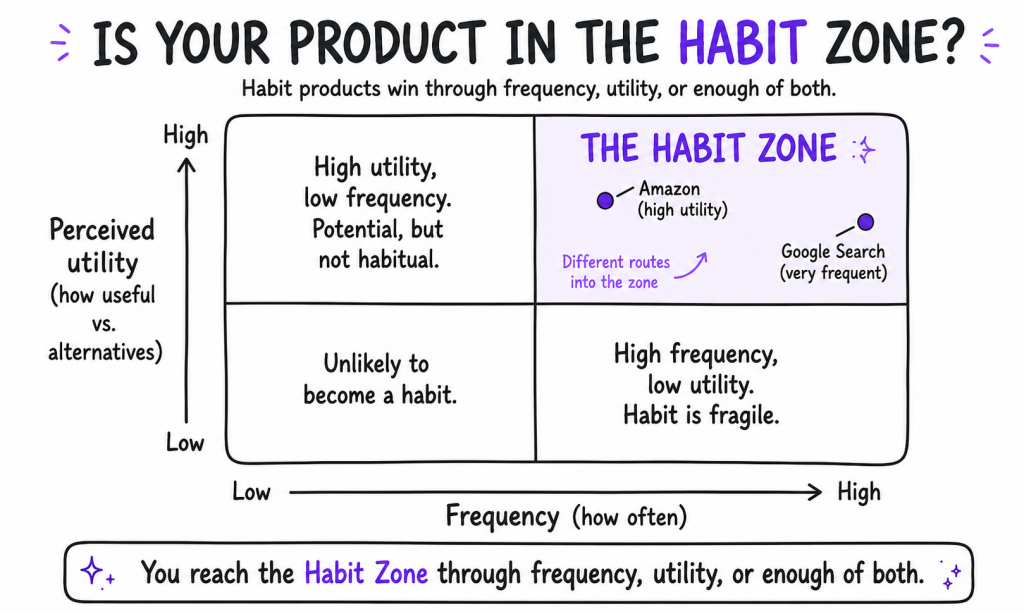
You can estimate a product’s habit-forming potential using two factors: frequency (how often the behavior occurs) and perceived utility (how useful it feels compared to alternatives). Enough of both, and a behavior enters the Habit Zone, where it becomes a default. Google Search happens many times a day, and any single search is barely different from Bing, but habit keeps people loyal. Amazon happens less often, but people perceive so much value that it stays the default anyway. Both live in the Habit Zone, reached by different routes.
Vitamin or painkiller?
Investors like to ask whether a product is a vitamin (nice to have) or a painkiller (solves an urgent need), and they usually want to hear painkiller. Eyal reframes it. Products like Facebook and Instagram look like vitamins at first. But once the habit forms, not using them creates a low-grade itch, and relieving that itch is exactly what a painkiller does. A habit-forming product starts as a vitamin and quietly becomes a cure. That is the working definition of a habit: not doing the action causes a small amount of discomfort.
Habits are not the same thing as addictions. Addictions are persistent, compulsive dependencies on a behavior or substance that are, by definition, self-destructive. A habit can have a positive influence on a person’s life. — Nir Eyal
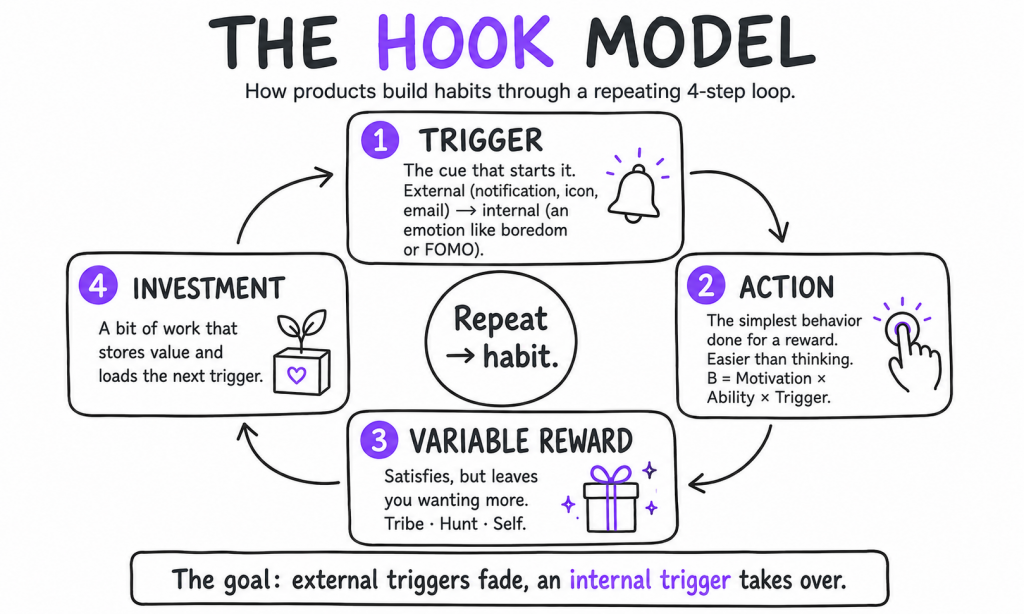
Habits are clearly worth building. The catch is that you can’t will one into existence. It gets built in a loop of four steps, run over and over. Here is the first.
Step 1: The trigger that starts the behavior
Every habit starts with a trigger, the cue that sets the behavior in motion. There are two kinds, and a habit-forming product moves people from one to the other.
External triggers live in the environment and tell the user what to do next. They come in four forms. Paid triggers are ads and search marketing, good for acquiring new users, but too expensive to keep re-engaging the same person. Earned triggers are press, viral clips, and app-store features, free but hard to control. Relationship triggers are when one person tells another. PayPal grew in the late 1990s because receiving money online pushed non-users to open accounts. Owned triggers matter most for building a habit: the app icon on the home screen, the email newsletter, and the push notification. They sit in the user’s world with permission and prompt repeat use until an internal trigger takes over.
Internal triggers are the real prize. When a product gets tied to a thought, an emotion, or an existing routine, the user no longer needs a nudge. You can’t see or hear an internal trigger; it fires in the mind. Emotions, especially uncomfortable ones, are the strongest of them. Boredom, loneliness, frustration, confusion, and indecision each create a small discomfort that pushes an almost instant, often mindless action to relieve it. A 2011 University of Missouri study followed 216 undergraduates’ internet use over a school year and found that students with depressive symptoms used email, video, and chat significantly more, which suggests they were reaching for technology to lift their mood.
A simple example: Instagram
The fear of losing a moment, a faint negative emotion barely at the level of thought, is the internal trigger that opens the app. Early on, external triggers like the icon and friend notifications built the habit, until the feeling took over. As one user told Eyal, “I just use it whenever I see something cool. I feel I need to grab it before it’s gone.” She wasn’t answering a notification anymore. She was answering a feeling.
Finding the internal trigger with the 5 Whys
People can’t reliably tell you what emotionally drives them; what they say and what they do come apart. To get to the bottom of the answer, Eyal borrows Toyota’s 5 Whys method.
- Ask why someone uses email: to send messages (why 1),
- to share information quickly (why 2),
- to know what’s happening with people (why 3),
- to know if someone needs them (why 4),
- because they fear being out of the loop (why 5).
Fear is the internal trigger, and that’s what the product actually addresses. Jack Dorsey called these “user narratives” at Twitter and Square: detailed stories from the user’s point of view so that engineers, designers, and business teams all line up behind the same human need. It is the same instinct behind jobs to be done, where you design for the underlying job, not the surface request.
| The ultimate goal of habit-forming products is to solve the user’s pain by creating an association so that the user identifies the company’s product as the source of relief. — Nir Eyal |
A trigger only matters if the person can act on it without much effort. That is the next step, and it is where most products quietly lose people.
Step 2: The action, and why the easiest product usually wins
The trigger cues the user; the action is the simplest thing they do in anticipation of a reward. For a habit to form, doing has to be easier than thinking. The more physical or mental effort a behavior takes, the less likely it is to happen. BJ Fogg of Stanford captured this in the Fogg Behavior Model: B = MAT.
Behavior happens when Motivation, Ability, and a Trigger show up at the same moment and in enough strength. Weaken any one of the three, and the behavior doesn’t occur.
Motivation is the energy for action. Fogg names three core motivators: seeking pleasure and avoiding pain, seeking hope and avoiding fear, and seeking acceptance and avoiding rejection. Obama’s 2008 campaign poster ran on hope, helmet ads ran on fear, and beer ads ran on belonging. Effective products pull one of those three levers on purpose.
Ability comes first, though. When you’re deciding whether to boost motivation or make the action easier, Eyal is blunt: start with ability. Raising motivation is slow and expensive; removing friction is faster and sticks better. Fogg lists six things that decide how hard a task feels: time, money, physical effort, brain cycles, social deviance, and how far it falls outside a routine. The designer’s job is to find the one that is most scarce for the user at that moment and take it away.
The history of the web is one long version of this. Early on, almost nobody created content. Blogger removed domain registration, DNS, and hosting, and more people posted. Twitter capped posts at 140 characters and removed the pressure to write well, and by late 2013, people were sending 340 million tweets a day. Pinterest and Instagram cut content creation down to a single tap. Each new wave came not from a new motivation but from less friction. Companies show the same pattern: Facebook Login erased multi-step signup for other apps, the iPhone camera opened straight from the lock screen, Pinterest’s infinite scroll killed the click-and-wait, and Google’s bare homepage stripped out the clutter its rivals had in 1998.
The mental shortcuts that make action more likely
Beyond motivation and ability, a few well-studied biases drive people’s behavior. The scarcity effect: In a 1975 study, cookies in a nearly empty jar were rated more valuable than identical cookies in a full one, which is exactly what Amazon’s “Only 14 left in stock” is doing. The framing effect: violinist Joshua Bell played a DC subway station and was almost ignored, yet commands hundreds of dollars a ticket in a concert hall; a 2007 study found that people’s rated enjoyment of wine rose as its stated price rose. The endowed progress effect: customers handed a punch card with two of the required punches already filled in finished at an 82% higher rate than those given a blank card needing the same number of purchases, which is why LinkedIn and Facebook start you with a partly complete profile bar.
| Make your product so simple that users already know how to use it, and you’ve got a winner. — Nir Eyal |
Getting the action is not enough on its own. A predictable action doesn’t create a craving. For that, the reward has to be uncertain.
Step 3: The variable reward that creates craving
What separates the Hook Model from an ordinary feedback loop is that it creates wanting. Predictable feedback doesn’t. Your fridge light turning on when you open the door doesn’t make you keep opening it. Add variability, and everything shifts.
The brain science is old and consistent. In the 1940s, James Olds and Peter Milner wired lab mice to self-administer tiny shocks to the nucleus accumbens, and the mice pressed the lever so compulsively they ignored food and water. Stanford’s Brian Knutson later found the key detail: it wasn’t the reward that lit up that brain region; it was the anticipation of it.
The stress of wanting is what drives us, not the satisfaction. B.F. Skinner had shown the same thing with pigeons in the 1950s: birds fed on a random schedule pressed a lever far more often than birds fed on every press. Variability multiplies the dopamine response and pushes us into a focused, wanting state. Eyal groups the payoffs into three types.
Rewards of the tribe come from feeling accepted, seen, and included. Facebook’s feed serves an unpredictable stream of social reactions, and the Like button hands out variable validation. Stack Overflow gets thousands of free answers a day from developers chasing variable upvotes, points, and badges. League of Legends cut down its toxic community by adding Honor Points, peer-awarded kudos for good sportsmanship, turning recognition into a variable reward for behaving well.
Rewards of the hunt come from chasing resources and information, which Eyal argues is hardwired. Twitter’s endless feed mixes the dull and the interesting, so you keep scrolling for the next good tweet. Pinterest loads images cut off at the bottom of the screen, so you scroll to see the rest. Slot machines run on the same wiring, sustaining roughly a billion dollars a day in American casinos on the variable chance of a jackpot.
Rewards of the self come from mastery and completion, with no outside prize needed. Finishing a jigsaw puzzle pays nothing but the satisfaction of finishing. Video games use leveling up and unlocks. Codecademy turns learning to code, normally slow and error-prone, into a run of small, variable wins by giving instant feedback on each step. Mailbox built email around reaching “inbox zero,” a moment of completion that becomes its own reward each time you hit it.
What variable rewards can’t do
Variable rewards are not magic, and Eyal is careful about the limits. Mahalo’s Q&A forum failed despite paying real cash, because money wasn’t what people wanted there, while Quora launched in 2010 with no cash rewards and thrived on recognition. Points and badges only work when they line up with what the user actually came for. Autonomy matters too: a French study found that adding the phrase “but you are free to accept or refuse” doubled how often people complied with a request, and Quora learned the reverse when it auto-opted users into exposing their browsing history, and they revolted.
There is also a shelf-life problem. Finite variability runs out. FarmVille hit 83.8 million monthly players in 2009 and collapsed by 2012 once people realized the games were re-skins of the same mechanics, and Zynga’s stock fell over 80% in eight months. Infinite variability keeps its novelty. World of Warcraft, played against other unpredictable humans, still had over 10 million players eight years after launch, and YouTube, Facebook, Pinterest, and Twitter all lean on user-generated content for a never-ending supply of new material.
A reward brings someone back once. To make the loop self-reinforcing, the user has to put something into the product. That is the final and most overlooked step.
Step 4: The investment that makes people come back on their own
The investment phase is the last step and the one that makes the loop feed itself. Unlike the action, which should be as frictionless as possible, the investment asks the user to do a little work after they’ve had their reward. The timing matters. This small effort raises the odds they return, not by pressuring them, but by making the product better with every use.
Why we overvalue what we build
In a 2011 study by Dan Ariely, Michael Norton, and Daniel Mochon, students folded origami and then bid on their own creations. They valued their own work about five times as much as outside observers did, nearly as much as expert-made origami. Ariely calls it the IKEA effect: labor leads to love. Asking customers to assemble their own furniture generates genuine affection for the result, and the same is true in software. The more someone invests in a product, the more they value it.
Two related tendencies push in the same direction. We want to stay consistent with our past behavior; one study found suburban residents who first agreed to a small “Be a safe driver” window sign were 76% more likely to later allow a large ugly “Drive Carefully” sign on their lawn, versus 17% of those not asked first. Small commitments grow into large ones. And we avoid the discomfort of holding two conflicting beliefs, so, like Aesop’s fox calling the grapes sour, we build reasons why our past effort was worth it rather than admit it was wasted.
The five forms of stored value
Investments make a product more valuable by building up stored value, which, unlike an action’s instant reward, accrues over time. Eyal names five forms:
- Content. Every song added to a library makes it more valuable and switching more costly.
- Data. LinkedIn found users who entered even a little information were far more likely to return, and Mint grows more useful with every linked account and categorized transaction.
- Followers. Twitter’s enterprise value can’t be cloned by copying the technology, because the followers people spent years building don’t transfer. A working clone, App.net, never caught on.
- Reputation. eBay, Airbnb, and Yelp all run on user-earned quality scores that grow more valuable over time and can’t be carried to a rival.
- Skill. Hours learning Photoshop don’t transfer to a competing tool, which makes professionals reluctant to switch even when good alternatives appear.
Loading the next trigger
The investment does one more thing: it loads the next external trigger and restarts the loop. Any.do asks users during first use to connect their calendar, which grants permission to send a notification after each meeting ends, right when the anxiety of forgetting a follow-up is highest. Tinder’s swipes create match notifications that pull both people back. Snapchat’s disappearing messages create a quiet social obligation to reply, and the double-tap reply makes returning a photo effortless, loading the next trigger with every send.
| Like a good friendship, the more effort people put in, the more both parties benefit. — Nir Eyal |
Run this loop enough, and you have real influence over someone’s behavior. That power raises a question that the most responsible builders don’t dodge.
The line between a Habit and Manipulation
Building habit-forming technology is a form of manipulation, and Eyal doesn’t hedge on that. The Hook Model changes what people do, and that demands some accountability. He offers a simple decision tool, the Manipulation Matrix, built on two questions: Would I use this product myself? And will it materially improve users’ lives? The answers sort builders into four types.
| Improves the user’s life | Doesn’t improve their life | |
| The maker would use it | The Facilitator · the only clear conscience quadrant | The Entertainer · legitimate, but hits-driven and dependent on novelty |
| Maker wouldn’t use it | The Peddler · good intentions, but too disconnected from users to build what they truly want | The Dealer · builds for neither side; pure extraction, which Eyal calls exploitation |
The Facilitator builds something they’d use and believe helps people. Jake Harriman founded Nuru International to fight extreme poverty, but only after living among the farmers he wanted to help and discovering the real barrier was financing for good seeds, not farming knowledge. Building a habit for a person you’ve never been is close to impossible. The Peddler means well but wouldn’t use the product themselves, which makes it hard to understand users well enough to build something they genuinely want; most gamified apps and branded campaigns fall into this category.
The Entertainer builds something they enjoy that doesn’t really improve lives, which is legitimate but structurally dependent on a stream of new content. The Dealer builds for neither themselves nor the user.
The wider context is worth taking seriously. Game designer Ian Bogost has called habit-forming tech “the cigarette of this century,” and investor Paul Graham has warned that society hasn’t had time to grow “antibodies” to addictive new products. Eyal’s own position is that companies have a duty to spot users forming unhealthy dependencies and help them. Industry estimates put pathological users of even the most habit-forming technologies, including slot-machine gambling, at roughly 1% of users. Small, but not nothing, and companies now hold the data that could flag overuse if they chose to act.
How to run the Hook Model on your own product
The value of Hooked isn’t the case studies; it’s that the model turns into five questions you can hold your own product against. Eyal leaves builders with these, and they are the most useful things to take away:
- Internal trigger. What pain or emotion does the product relieve? What is the person actually feeling right before they reach for it?
- External trigger. What brings them to the product in the first place, and do you own that trigger or rent it?
- Action. What is the simplest action they take in anticipation of a reward, and what friction can you strip out to make it easier?
- Variable reward. Does using it satisfy the person while still leaving them wanting more, and does the reward fit why they came?
- Investment. What small bit of work do they put in, and does it both store value and load the next trigger?
These aren’t questions about features. There are questions about behavior, and answering them honestly is the actual work. A last caution worth keeping in view: the Hook Model amplifies whatever it is attached to. Point it at a product that genuinely solves a recurring problem, and it compounds real value. Point it at engagement for its own sake, and you get the Dealer’s quadrant.
| Habits are a double-edged sword. They can be used to help people do the things they already want to do but, for lack of a good solution, don’t. That is the Hook Model’s promise and its obligation. — Nir Eyal |
Frequently asked questions
1. What is Hooked about in one line?
It explains why some products become daily habits while others are forgotten, and gives you a four-step model, the Hook, to design products people return to on their own instead of having to buy their attention over and over.
2. What is the difference between a habit and an addiction?
Eyal draws a firm line. A habit is an automatic behavior that can improve daily life, and the person can still choose to stop. An addiction is a compulsive, self-destructive dependency. The Hook Model is aimed at building beneficial habits, and the Manipulation Matrix exists precisely to keep builders on the right side of that line.
3. How is Hooked different from Atomic Habits?
James Clear’s Atomic Habits helps individuals build better personal habits. Hooked is written for the people building products, and teaches them how to design an experience that encourages repeated use. One is about your own behavior; the other is about designing for someone else’s.
4. Can early-stage startups use the Hook Model?
Yes, for activation, onboarding, and retention. But it works only when the product already solves a real problem. Bolting a hook onto something nobody needs manufactures engagement that doesn’t last, which is exactly the trap FarmVille fell into.
5. Is Hooked still relevant in 2026?
The mechanics still hold. Triggers, easy actions, variable rewards, and investment describe how modern apps, SaaS, games, and AI products earn repeat use. What has grown since 2014 is the ethical weight, as more people question whether engagement-at-all-costs design is good for the people on the other side, which makes the Manipulation Matrix the most relevant part of the book today.
6. What is the single biggest takeaway?
People don’t form habits solely because of great technology. They build them when a product reliably solves a recurring problem through a simple action, a satisfying but uncertain reward, and a small personal investment that makes it better every time. Get that loop right, ethically, and you don’t have to keep buying your users back.