Mechanical Engineer to Product Manager: What Krishna Allani’s Transition Actually Looked Like
Krishna Allani moved from mechanical engineering to product management with no computer science degree and no prior PM title. He […]

Who Is Krishna Allani?
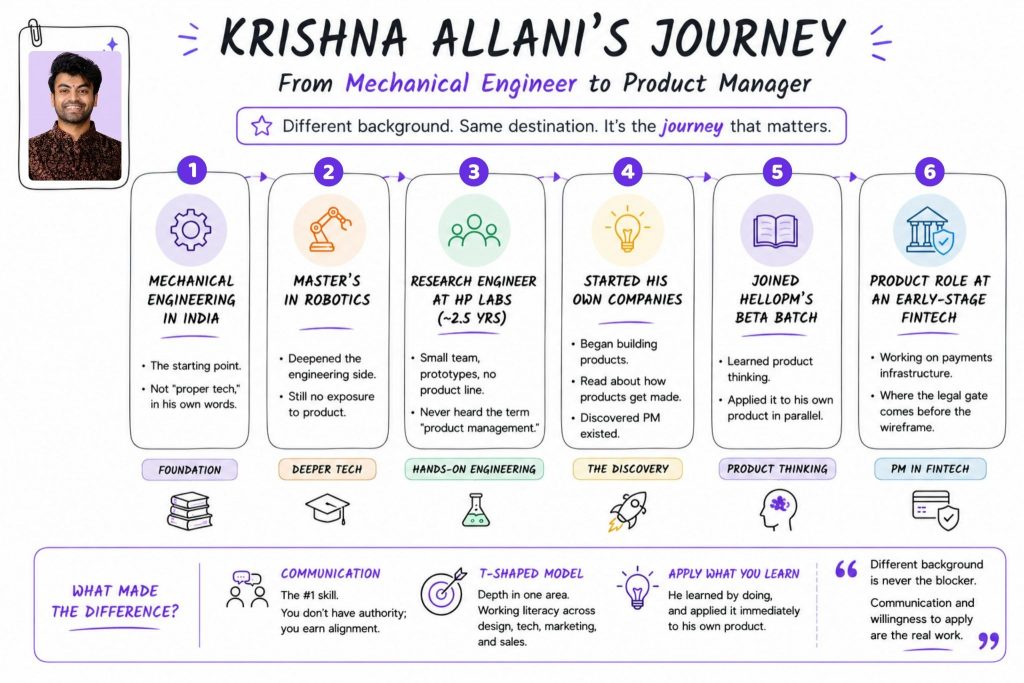
Krishna Allani is a mechanical engineer who moved into product. He studied mechanical engineering in India, earned a master’s in robotics, and spent about 2.5 years as a research engineer at HP Labs before moving into product work.
His engineering background was not “proper tech” in the way most people picture a product manager’s. At HP Labs, he worked in a small team on prototypes. There was no product line, no roadmap, no users in the usual sense. He wrote a few lines of code and built things, but he had never designed a screen, run a user study, or shipped a product to customers.
Then he started his own companies. That is where the whole idea of product management entered his life, and it entered late. He had already been doing the groundwork of building a product without knowing there was a name for the discipline he was practicing.
Can a Mechanical Engineer Become a Product Manager?
Yes. You do not have to come from a specific field to become a PM. Krishna is a mechanical engineer with no formal software background, and he made the switch. He has also seen people move into product from sales and other non-tech roles.
His reasoning is simple, and it is the most useful thing in this whole story. Product management is not a separate island; it reaches only from “tech.” It sits in the middle of several functions at once.
| “If you draw Venn diagrams for sales, design, marketing, and tech, the PM kind of sits in between.” – Krishna Allani |
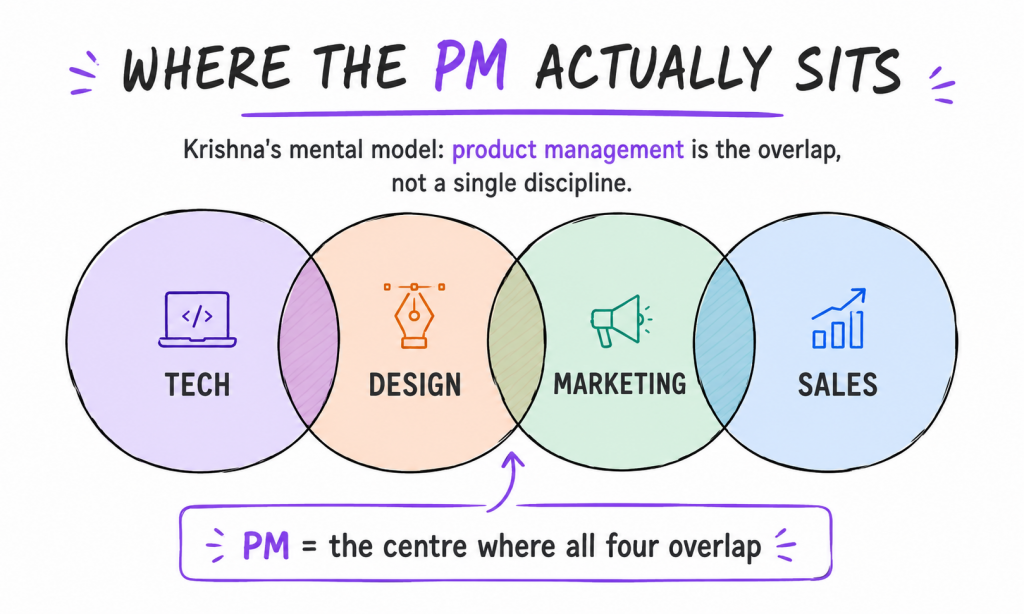
That said, he is honest about the catch. Sitting in the middle does not mean you can be ignorant of every side. You cannot be brilliant at marketing with zero idea of how design or engineering works and expect to walk into a PM role. What you need is depth in one area and working literacy in the others. He calls it a T-shaped model.
| “You need to have in-depth knowledge of one subject, but at least have some idea about how other streams work. And you should be a really, really good communicator.” – Krishna Allani |
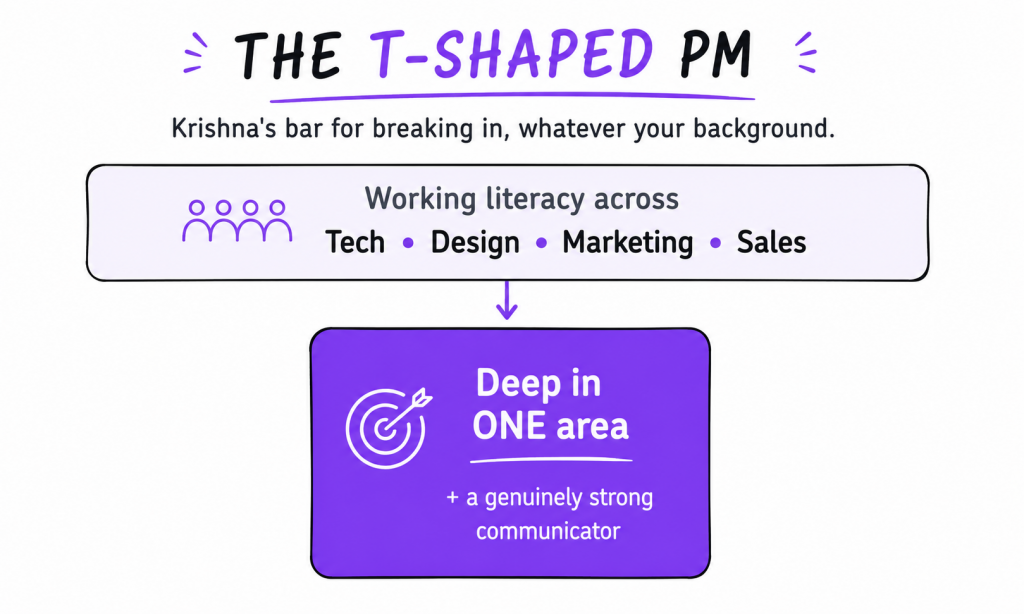
For an engineer, this is good news. Your depth is already there. The job is to build literacy in the streams you have not touched, and to get sharp at communication, which is the part most engineers underrate. If you want a structured way to build the design and discovery side, the jobs-to-be-done guide is a practical place to start.
How Do You Even Discover Product Management With No Exposure to It?
Most engineers discover product management the way Krishna did, by trying to build something and realizing they need a name for the work. He did not learn it in a classroom or from a job title. He found it by starting his own companies and asking how products actually get made. This is worth sitting with, because it is common and rarely said out loud. In a research or pure-engineering seat, you can go years without the discipline ever crossing your path. There is no product line in front of you, so there is no reason for the word to come up.
| “Even when I was doing all the groundwork, I didn’t know that there was something called product management. It’s only after I started reading about how you build products that I came across the term.” – Krishna Allani |
So the first move, if you are an engineer wondering whether this is for you, is not to wait for permission or a title. It is time to start building or studying the product side and let the gaps reveal themselves. The gaps are in the curriculum.
What Does the Jump From Engineer to PM Actually Demand?
The hardest part of being a PM is not the tech. It is alignment. Getting engineering, design, and the people above you all moving in the same direction is the single biggest challenge Krishna names, for new and experienced PMs alike.
Engineers often assume the difficulty of the product will be technical. Krishna’s experience says the opposite. The technical literacy he already had. What stretched him was the human coordination: giving the tech team enough context, bringing design along, keeping founders and management aligned, all at once.
| “Aligning the team to do everything is a really, really tough job. Make sure you give enough context to the tech team, the design team, and the people above you. That’s one of the biggest hurdles I faced.” – Krishna Allani |
This is why he keeps returning to communication. A PM usually has no authority over the people doing the work. You move them by being clear, providing context, and backing your calls with reasoning. For Krishna, this is the one skill that shows up in every transition he has seen, whatever the starting background.
| “No matter how many books you read, no matter how many courses you’ve done, it doesn’t help you. You need to go out and talk to people.” – Krishna Allani |
For the engineering side of that relationship specifically, check this guide on how to work with engineers as a PM, which covers the ground Krishna learned the hard way.
What Is It Like Being a PM at an Early-Stage Fintech?
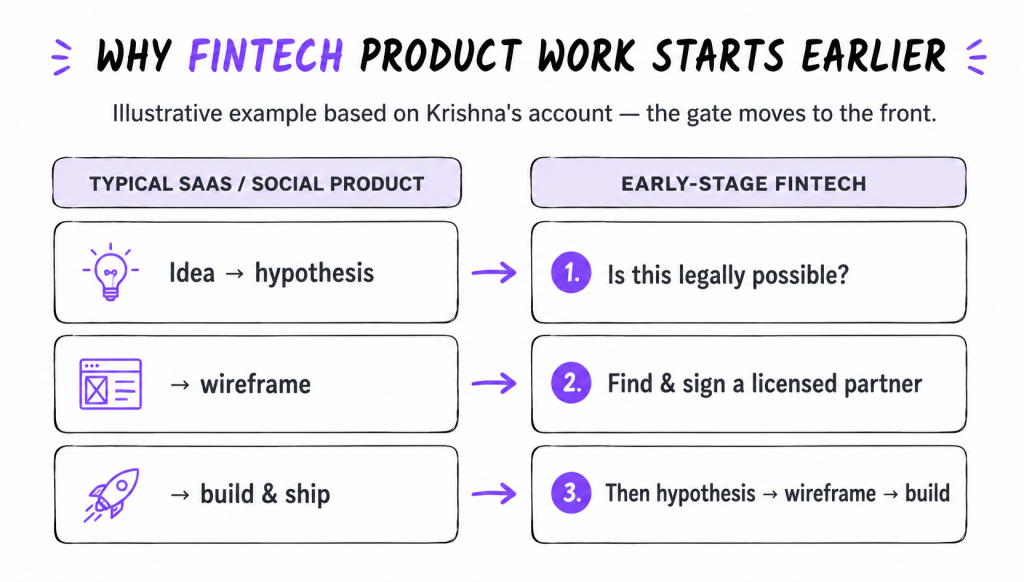
At an early-stage fintech, the first question on any new product is not “how do we build it” but “is this even legally possible?” Krishna works on payments infrastructure at a young fintech, and the regulatory layer changes the job before a single line of code gets written.
This is the part of Krishna’s story an engineer-turned-PM rarely sees coming. At a typical SaaS or social product, you can go from hypothesis to wireframe to build with few external gates. In fintech, the gate comes first.
| “Before writing a single line of code or designing a single wireframe, the biggest thing is: is this legally possible, can we clear all the paperwork?” – Krishna Allani |
And clearing it is rarely something you can do alone. Most fintech products require a licensed partner because obtaining a license yourself is slow or out of reach for a young company. So a large part of the job becomes finding institutions willing to partner and getting them to say yes. That partnership and compliance work is real product work, and it is invisible from the outside.
If you want the wider picture of this space, including the skills and regulatory landscape, we have a dedicated guide on fintech product management in India. Krishna’s account here is the lived version of what that guide maps out.
What Helped Krishna Most in the HelloPM Beta Batch?
Three things stood out for Krishna: a clear week-by-week structure he could follow with zero prior PM knowledge, Ankit teaching through real examples from products he had actually built, and a cohort of people sharper than him that he could learn from.
Krishna was in the very first HelloPM batch, the beta, when Ankit was running it for the first time. He had no product management background at all, so the thing that mattered most was that the course was methodical. He knew what he would learn in week one, week four, and week six, and how each piece fed into building his own product.
He was learning and applying in parallel because he was running his own startup at the same time. Every framework he picked up on Monday, he could stress-test on his own product by Friday. That overlap- study one day and apply it the next- is the same habit that became his single piece of advice. The other thing he keeps mentioning is the people. The cohort had folks more talented than him, and the conversations with them did as much as the curriculum.
Krishna’s One Piece of Advice for Aspiring PMs
Apply what you learn immediately. Krishna refuses to give three or five tips. He has exactly one: the day you learn something, go use it. If you wait three or six months to practice, you will not make it into product.
His whole transition runs on this. Product management, in his words, is all about application. You can read every book and finish every course, and it will not move you, because the actual skill, aligning people and communicating clearly, only shows up when you go and do it with real humans.
| “As soon as you’re done with the course or class, just go and apply it. You learn something today, go do it tomorrow. Because product management is all about application.” – Krishna Allani |
He even has a version for people with no product to work on: make up an idea, however rough, and go talk to a couple of people about it. Only then do you start to feel what the work actually is. He also rates collaboration over working alone, and his reasoning is sharp. Solo work produces answers. Collaborative work produces the habits the job actually demands: defending your reasoning with data, communicating clearly when someone pushes back, and holding your ground across competing ideas. A product portfolio is one concrete way to turn that applied work into proof you can show. Mechanical engineering in India.
Lessons from Krishna’s Journey
- Background is not the gate. A mechanical engineer with no CS degree moved into product. The Venn overlap of tech, design, marketing, and sales is where PMs live, and you can reach it from any one of those edges.
- Be T-shaped, not narrow. Depth in one area plus working literacy across the rest, plus genuinely strong communication. That is the bar.
- The hard part is alignment, not tech. The biggest hurdle Krishna names is getting engineering, design, and leadership moving together. Engineers usually have the tech and underrate this.
- Fintech moves the gate to the front. “Is this legally possible?” and “Who will partner with us?” come before any code. That is the job at an early-stage fintech.
- Apply it tomorrow. His one rule. Learn a thing today, use it tomorrow. Product management is an application, not consumption.
Frequently Asked Questions
1. Can a mechanical engineer become a product manager?
Yes. Krishna Allani did it with a mechanical engineering degree and a robotics master’s, no computer science background, and no prior PM title. Product management sits at the overlap of tech, design, marketing, and sales, so you can enter from any one of those backgrounds as long as you build literacy in the others and become a strong communicator.
2. Do you need a computer science degree to be a PM?
No. You need enough technical literacy to have credible conversations with engineers and make realistic calls, not a CS degree. Krishna describes his background as “not even proper tech,” yet he still moved into product. Depth in one area plus working knowledge of the others matters more than the specific degree.
3. What is the T-shaped skills model for product managers?
It means having deep expertise in one area and a working understanding of the adjacent ones. For a PM who is deep in your home discipline, plus literacy across tech, design, marketing, and sales, all held together by strong communication. Krishna uses this as his test for whether someone is ready to break into product.
4. Do you need an MBA to become a product manager?
No. An MBA is not a requirement for product management. What employers look for is product thinking, the ability to align teams, and proof that you can do the work. Krishna moved into product without one, learning through a structured course and immediate application instead.
5. Is a four-month product management course enough to switch careers?
There is no fixed amount of time that “completes” product management, because subjects like user research go very deep. What matters more than the length is whether you apply what you learn straight away. Krishna’s view is blunt: learn something today, use it tomorrow, or it won’t stick.
6. How is product management at a fintech different from a SaaS company?
At a fintech, regulation and licensing come first. Before building, you have to confirm that the product is legally possible and usually find a licensed institution to partner with, because licenses are slow or out of reach for young companies. At a typical SaaS or social product, you can move from hypothesis to wireframe to build with far fewer external gates.
7. How do engineers usually discover product management?
Often, by building something, one realizes the work needs a name. In pure engineering or research roles, there may be no product line in front of you, so the discipline never comes up. Krishna only discovered product management after starting his own company and reading about how products get made.