How to Get a Product Manager Job in Germany Without EU Experience- HelloPM Alumni Transition
Breaking into Product Management in Germany without EU experience is possible by repositioning your existing work as PM-relevant & not […]
Breaking into Product Management in Germany without EU experience is possible by repositioning your existing work as PM-relevant & not necessarily by starting over. That’s exactly how Jillian did it.
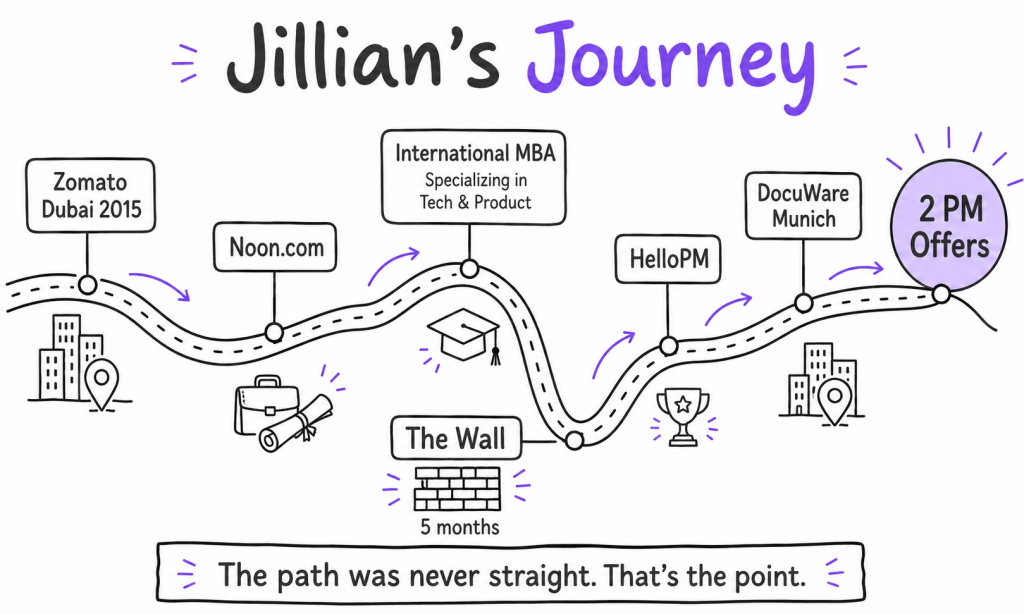
After completing her International MBA in Germany, Jillian had no prior EU work experience, a five-month post-MBA career gap, and no formal Product Manager title. Yet she still landed two PM offers and accepted a Product Manager role at DocuWare in Munich. Jillian, a HelloPM Alum, stopped positioning herself as a generic MBA graduate and instead reframed her background in sales, growth operations, analytics, and program management as clear evidence of her Product Management skills. By aligning her experience with core PM responsibilities- that is, problem discovery, stakeholder alignment, data-driven decisions, and execution— she changed how recruiters and hiring managers evaluated her profile. This shift in positioning is the foundation of how she broke into Product Management in Germany without EU experience.
The starting point: An MBA, 9 years of experience, and still no PM offer
Jillian looked like someone who should have been ready for a Product Management role.
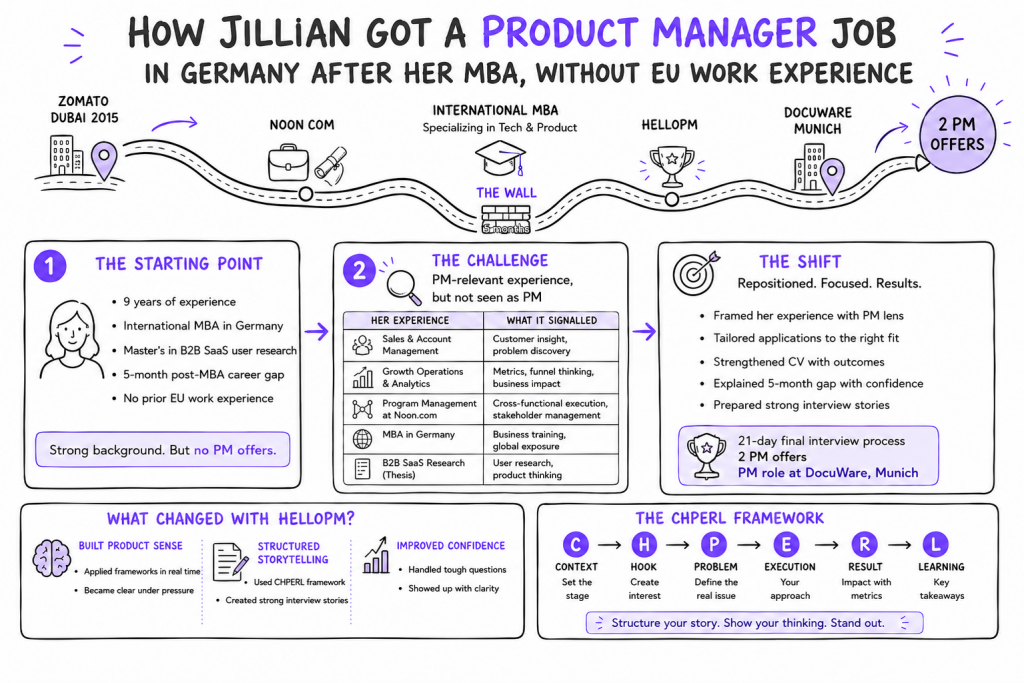
She had 9 years of professional experience, an International MBA from Germany, and a master’s thesis focused on B2B SaaS user research. Before her MBA, she had spent 6 years at Zomato Dubai, moving from Sales into Account Management, Growth Operations, and Analytics. She later worked as a Program Manager at Noon.com, where she handled cross-functional complexity, stakeholder pressure, and execution at scale.
Her background had strong PM-adjacent signals. She understood customers, worked with business metrics, solved operational problems, collaborated across teams, and had already started thinking deeply about users through her MBA research.
But after graduation, she hit the wall that many international MBA graduates face.
She had the experience.
She had the degree.
She had the ambition.
But she was still not being recognised as a Product Manager candidate.
The Problem: Why was Jillian not getting PM offers despite having relevant experience?
Jillian’s challenge was not that she lacked capability. Her challenge was that her experience was not being translated into Product Management language.
A hiring manager does not automatically read Sales, Growth Operations, Analytics, or Program Management and think “Product Manager.” The candidate has to make that connection obvious.
For Jillian, that meant showing how her previous roles had already built core PM skills:
| Jillian’s experience | What it signalled for PM roles |
| Sales and Account Management at Zomato | Customer understanding, market insight, and problem discovery |
| Growth Operations and Analytics | Funnel thinking, metrics, retention, and business impact |
| Program Management at Noon.com | Cross-functional execution and stakeholder management |
| MBA in Germany | Business training and international market exposure |
| Thesis on B2B SaaS user research | User research, product thinking, and SaaS context |
The raw material was there. But her CV, outreach, and interview answers needed to sharpen the PM connection.
This is where many career switchers get stuck. They assume their experience will speak for itself. In Product Management hiring, it usually does not.
Hiring managers look for specific signals:
- Can this person understand users?
- Can this person identify the real problem?
- Can this person prioritise under ambiguity?
- Can this person work across functions?
- Can this person connect decisions to business outcomes?
- Can this person explain trade-offs clearly?
- Can this person learn from results?
Jillian had already built many of these muscles. The missing piece was positioning.
The shift: How Jillian repositioned her background for Product Management roles in Germany?
Jillian’s transition changed when she stopped presenting herself as a general MBA graduate and began presenting herself as a PM-ready candidate with a nonlinear yet highly relevant background.
Instead of leading with job titles, she began leading with transferable PM strengths: customer understanding, growth thinking, analytics, execution, user research, and stakeholder management.
Her job search also became more structured. She sent 60 applications, mostly cold, but she was no longer applying blindly. She narrowed her search by fit, rewrote her CV around ownership and outcomes, prepared stronger interview stories, and learned to explain her 5-month post-MBA gap with confidence instead of defensiveness.
That repositioning changed the outcome.
Her final interview process with DocuWare took 21 days. She received two Product Manager offers and accepted the PM role at DocuWare in Munich.
The lesson from Jillian’s story is simple: a non-traditional background is not a weakness if you know how to translate it.
She did not need to erase her past experience to become a Product Manager. She needed to show hiring managers how that experience had already prepared her to think, communicate, and operate like one.
What changed after HelloPM?
HelloPM helped Jillian make three important shifts: how she thought, how she positioned herself, and how she showed up in interviews.
1. Built product sense that worked in real interviews
Jillian already had product theory from her MBA. What she needed was the ability to apply that thinking in real time.
In PM interviews, candidates are judged on how they break down ambiguous problems, understand users, prioritise trade-offs, and connect solutions to business outcomes. It is not enough to know frameworks. You have to use them clearly under pressure.
HelloPM helped her move from knowing product concepts to applying them in a way that sounded structured, practical, and interview-ready.
2. Feedback from practitioners
Jillian received feedback from people who understood how PM hiring works in real companies.
That mattered because product interviews are not only about the “right” answer. They are about judgment, clarity, self-awareness, and structured thinking.
Practitioner feedback helped her see where her answers were strong, where they were vague, and where she needed to show more PM-level thinking.
3. Prepared with a serious PM transition cohort
The cohort gave her accountability, standards, and momentum.
Instead of preparing alone, Jillian was surrounded by people working towards the same transition. That changed the quality of her practice and helped her stay consistent during a difficult job search.
How did Jillian get recruiter responses?
Jillian treated her job search like a product funnel.
She sent 60 applications, most of them cold. But the search was not random. She became more intentional about the roles she applied to, the story her CV told, and the way she presented her background.
She stopped positioning herself as: “An MBA graduate looking for a Product Manager role.”
And started positioning herself more like: “A candidate with growth, operations, analytics, customer-facing, and program management experience who can apply that background to product problems.”
That difference matters.
The first version sounds generic. The second version helps hiring managers understand why her past experience is relevant to PM.
What did Jillian actually do to land a PM role?
Jillian’s transition was not based on one lucky interview. It came from a set of deliberate actions.
1. Started broad, then narrowed by fit
At first, Jillian explored various PM opportunities. But over time, she became sharper about where her background made the most sense.
She looked for roles where her experience in growth, operations, analytics, marketplaces, and cross-functional execution would be relevant. This helped her move from applying by title to applying by fit.
That shift made her job search more focused.
2. Rewrote her CV around ownership and outcomes
Jillian’s CV had to stop reading like a list of responsibilities.
For PM roles, hiring managers want to see ownership, decision-making, and impact. So instead of relying on passive statements, her CV needed stronger signals of what she had owned, improved, led, or influenced.
A weak CV line sounds like: Contributed to cross-functional projects.
A stronger PM-oriented CV line sounds like: Led growth operations across multiple markets, improving account retention and strengthening cross-functional execution.
The second version shows ownership. It makes the PM signal easier to see.
3. Showed up at product meetups in Germany
Jillian did not rely only on online applications.
She attended product meetups in Germany to understand the local PM market, meet people, and build genuine relationships. This was not about handing out CVs. It was about entering the product community with curiosity and consistency.
For international candidates, this matters. Local market exposure can help you understand how companies talk about products, what hiring teams value, and how to communicate your experience more effectively.
4. Replaced STAR with CHPERL for behavioural interviews
STAR is common in interviews, but it can sound generic if every answer follows the same basic structure.
Jillian used HelloPM’s CHPERL framework to make her PM interview answers more layered and reflective.
CHPERL helped her show not just what happened, but how she thought through the problem, what decisions she made, what impact she created, and what she learned.
5.Built a personal story repository
Before interviews, Jillian prepared a bank of 15+ stories mapped to PM competencies.
This meant she did not have to invent examples during the interview. She could retrieve the right story and adapt it to the question.
Her story bank helped her prepare for questions about leadership, conflict, ambiguity, failure, stakeholder management, execution, customer understanding, and business impact.
6. Practised the two-second pause
One small change made her answers stronger: she stopped rushing.
Instead of answering immediately, Jillian practised taking a short pause before responding. This helped her sound more thoughtful, structured, and composed.
In interviews, the pause signals that you are thinking. For PM roles, that matters because companies are hiring for judgment, not just speed.
7. Owned her 5-month career gap
Jillian did not apologise for her post-MBA gap.
She explained what the time had built: research depth, PM preparation, market understanding, interview readiness, and a more intentional search.
That changed the gap from defensive to purposeful.
8. Shifted from scarcity to selection
At first, Jillian felt the pressure many career switchers feel: take whatever comes, be grateful for every callback, and avoid being too selective.
Over time, her mindset shifted.
She started acting like someone looking for the right PM role, not just any job. That changed how she showed up in interviews. She became more confident, more deliberate, and more willing to evaluate fit.
What is the CHPERL framework for PM interviews?
CHPERL stands for:
- Context
- Hook
- Problem
- Execution
- Result
- Learning
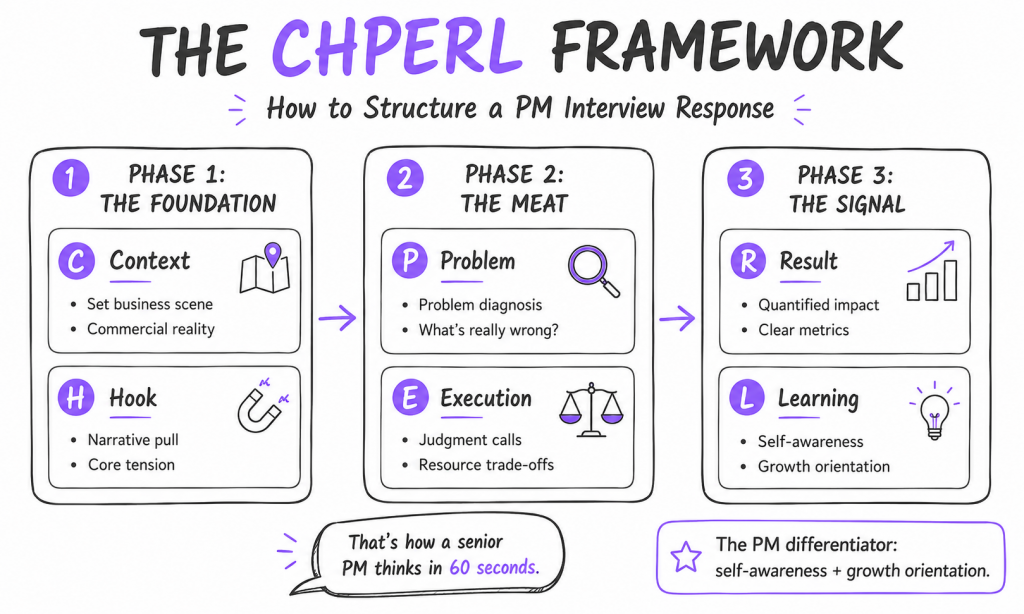
It is a Product Manager interview storytelling framework used to answer behavioural interview questions with more structure and depth.
Unlike STAR, which focuses on Situation, Task, Action, and Result, CHPERL adds two important layers: Hook and Learning.
The Hook creates narrative tension. It helps the interviewer understand why the story matters.
The Learning shows self-awareness. It helps the interviewer understand how the candidate reflects, improves, and grows from experience.
That is especially important in PM interviews because companies are not only evaluating what you did. They are evaluating how you think.
STAR vs CHPERL for Product Manager interviews
| STAR | CHPERL |
| Situation | Context |
| Task | Hook and Problem |
| Action | Execution |
| Result | Result |
| Often ends at the outcome | Ends with Learning |
| Generic interview structure | PM-specific story structure |
| Shows what happened | Shows judgment, reflection, and growth |
A strong PM interview answer should not sound like a status update.
It should show how you diagnosed the problem, made trade-offs, influenced others, measured success, and changed your approach based on what you learned.
That is what CHPERL helped Jillian do.
How should you explain a career gap after an MBA?
Do not minimise it. Own it.
Jillian had a 5-month career gap after her MBA. Instead of treating it like something to hide, she learned to explain what she used that time for.
A strong career gap answer could sound like this:
“After my MBA, I used the gap intentionally to prepare for a PM transition. I focused on understanding the German product market, sharpening my PM interview stories, improving my CV positioning, and building a structured search system. That time helped me become clearer about the roles I was targeting and more prepared for the interviews I entered.”
This kind of answer works because it is specific, calm, and intentional.
The goal is not to pretend the gap does not exist. The goal is to show that the gap produced something valuable.
How many applications does it take to get a PM job in Europe?
There is no fixed number.
In Jillian’s case, she sent 60 applications and received 2 Product Manager offers. Most of her applications were cold, but her improved positioning helped her generate stronger recruiter engagement and move through the process.
The lesson is not that everyone needs exactly 60 applications.
The lesson is that a PM job search should be treated like a funnel:
- Define the right target roles.
- Position your background clearly.
- Send focused applications.
- Track recruiter responses.
- Improve your CV and outreach message.
- Prepare deeply for interviews.
- Convert interviews into offers.
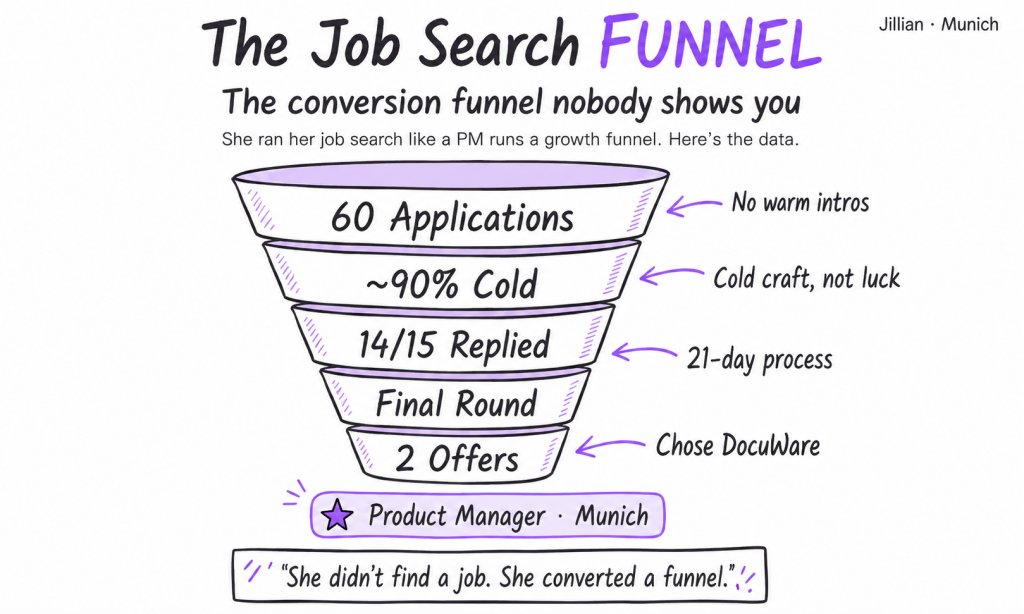
Jillian did not just apply more. She improved the system.
Before HelloPM vs After HelloPM
| Dimension | Before HelloPM | After HelloPM |
| Interview framework | STAR, sequential, generic | CHPERL, layered, PM-specific |
| CV positioning | Responsibilities and contributions | Ownership, impact, and initiative |
| Story preparation | Recalled examples during interviews | Pre-built repository of 15+ stories |
| Outreach strategy | Waited for warm intros | Used cold outreach more effectively |
| Career gap | Something to explain | Something to own |
| Networking | Passive LinkedIn activity | Active product meetups in Germany |
| Interview delivery | Immediate and sometimes reactive | Paused, structured, deliberate |
| Mindset | Scarcity | Selection |
| Outcome | 5 months of near-misses | 2 PM offers and a PM role in Munich |
What was the final outcome?
Jillian received two Product Manager offers.
She accepted a Product Manager role at DocuWare in Munich after a 21-day final interview process.
She did it without prior EU work experience.
She did it after a 5-month career gap.
She did it without a traditional PM title in her background.
Her transition worked because she learned how to translate her experience into the language of product hiring.
What can MBA graduates learn from Jillian’s story?
If you are an international MBA graduate trying to move into Product Management in Germany or Europe, Jillian’s story gives you a clear lesson:
An MBA can give you knowledge, but it may not automatically give you PM positioning.
To become a stronger PM candidate, you need to show:
- Why your previous experience maps to PM
- What customer problems do you understand
- How do you make decisions with data
- How do you work with cross-functional teams
- How you handle ambiguity
- How do you explain trade-offs
- How do you learn from outcomes
- Why your background is an advantage, not a detour
Jillian’s success came from turning a non-linear career path into a clear PM story.
Key Takeaways
- An MBA alone may not be enough for a PM job.
- Jillian’s issue was not a lack of experience. It was positioning.
- Sales, analytics, operations, and program management can become PM signals.
- Her CV had to show ownership, outcomes, and product thinking.
- CHPERL helped her structure her PM interviews.
- Her 5-month career gap became a purposeful transition period.
- She converted 60 applications into 2 PM offers.
Frequently Asked Questions
- Can you get a Product Manager job in Germany without prior EU work experience?
Yes. Jillian landed a Product Manager role at DocuWare in Munich without prior EU work experience. Her success came from translating her Zomato, Noon.com, MBA, and B2B SaaS research experience into PM-relevant positioning.
- Is an MBA enough to get a Product Manager job?
Not always. An MBA can provide product theory, business knowledge, and credibility, but candidates still need strong positioning, interview preparation, product sense, and a clear story that connects their past work to PM responsibilities.
- How do you transition from Sales to Product Management?
To move from Sales to Product Management, you need to reframe sales experience as customer insight, market understanding, problem discovery, and business impact. Jillian’s Zomato sales and account management experience became valuable because she connected it to user behaviour, growth, and product-relevant decision-making.
- Can a Program Manager become a Product Manager?
Yes. Program Managers often build strong PM-adjacent skills, including cross-functional execution, stakeholder management, prioritisation, and delivery ownership. To move into PM, they need to add stronger product framing around users, problems, metrics, and outcomes.
- How do you explain a career gap after an MBA?
Explain the gap with clarity and ownership. Do not apologise. Show what the time helped you build, such as market understanding, interview preparation, portfolio work, networking, or targeted job search systems.
- What is CHPERL?
CHPERL stands for Context, Hook, Problem, Execution, Result, and Learning. It is a Product Manager interview framework that helps candidates answer behavioural questions with a stronger narrative structure, problem diagnosis, execution detail, measurable impact, and reflection.
- Is CHPERL better than STAR for PM interviews?
CHPERL can be stronger for PM interviews by adding a Hook and a Learning layer. STAR explains what happened. CHPERL helps show how the candidate thinks, what trade-offs they made, and what they learned.
- How many applications did Jillian send?
Jillian sent 60 applications during her PM job search. The majority were cold applications, but her improved positioning led to strong recruiter engagement and eventually two PM offers.
- How long did Jillian’s final PM interview process take?
Jillian’s final interview process with DocuWare took 21 days.
- What role did Jillian finally accept?
Jillian accepted a Product Manager role at DocuWare in Munich, Germany.
If your story looks like Jillian’s
You may already have the experience.
You may already have the MBA.
You may already have the potential for the product.
But if hiring managers aren’t seeing it, the problem may be the positioning.
Jillian did not become a different person. She learned how to present her experience as PM-ready, prepare stories that showed product judgment, and walk into interviews with structure and confidence.
That is what changed the outcome.
Join our counselling session to understand how to position your background for Product Management roles.