99 Ways Your Brain Lies to You: The Art of Thinking Clearly Summary
Key Takeaways First, the bad news You are not as rational as you think. Nobody is. The gap between how […]

Key Takeaways
- You can’t out-clever your own bias. You beat it with a checklist of known traps: the same way pilots and surgeons do.
- Match the effort to the stakes. On big, irreversible decisions, slow down and reason hard; on small ones inside your expertise, let intuition run and save your energy.
- You only ever see the survivors. The failures are invisible, so you wildly overestimate your odds at almost everything.
- Your mind is a one-way filter. It welcomes evidence that flatters your beliefs and quietly discards the rest. This is the mother of all biases.
- Losing $100 hurts about twice as much as gaining $100 feels good. This single asymmetry distorts most of your risk decisions.
- Your gut cannot do probability. Rare events, base rates, and exponential growth break it every single time.
- The single most reliable upgrade to your judgment isn’t more knowledge: it’s catching yourself in the act, while you still have time to change course.
First, the bad news
You are not as rational as you think. Nobody is. The gap between how clearly we believe we think and how clearly we actually think is enormous, and it’s where bad hires, blown budgets, doomed products, and decisions you’d take back come from.
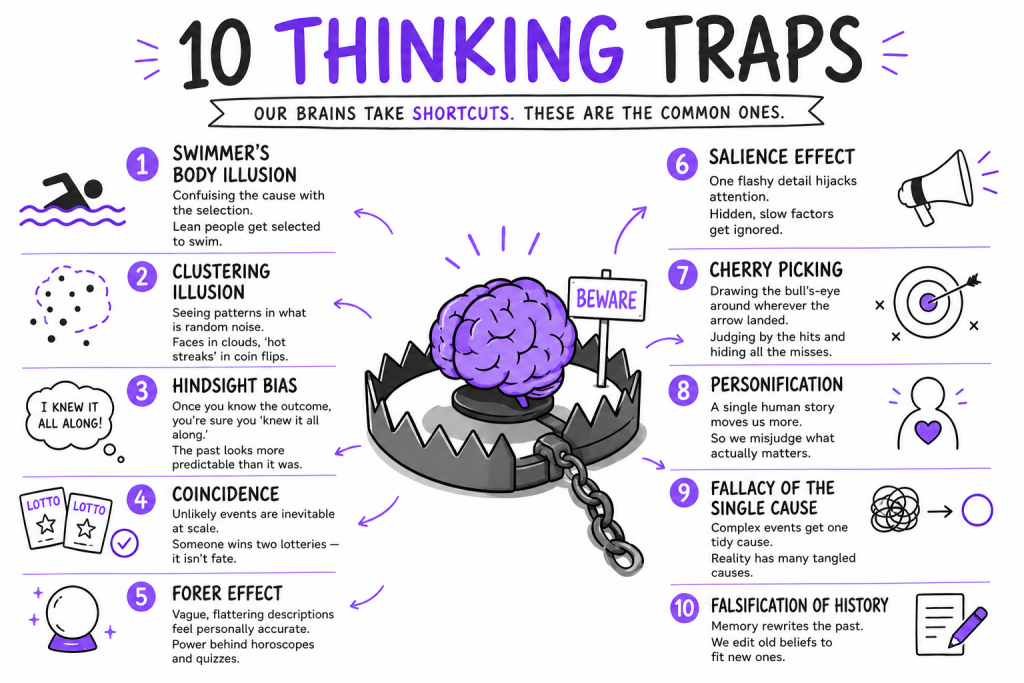
Dobelli’s insight is freeing: you don’t need to get smarter to make better decisions. You need to spot the recurring traps. As he puts it, avoiding stupidity is easier than seeking brilliance: eliminate the obvious errors, and better thinking follows on its own. This summary maps all 99 of his thinking errors into five families, goes deep on the sixteen that cost you the most, and hands you a one-page field guide at the end.
Is The Art of Thinking Clearly Book for you?
Dobelli gives you no theory, no jargon, and no self-help fluff: just 99 short, blunt chapters, each naming one way the mind misfires and how to dodge it. He compiled the original list for himself, after building wealth and fearing he’d lose it to his own bad judgment. It’s a field manual, not a textbook.
The One Idea Behind All 99 Thinking Errors
Here’s the trap most readers fall into with a book like this: they treat 99 biases as 99 things to memorize, get overwhelmed somewhere around number twenty, and quietly give up. Don’t. The biases aren’t 99 separate facts: they’re variations on five basic mistakes your brain makes. Learn the five families; the individual biases are examples, not homework.
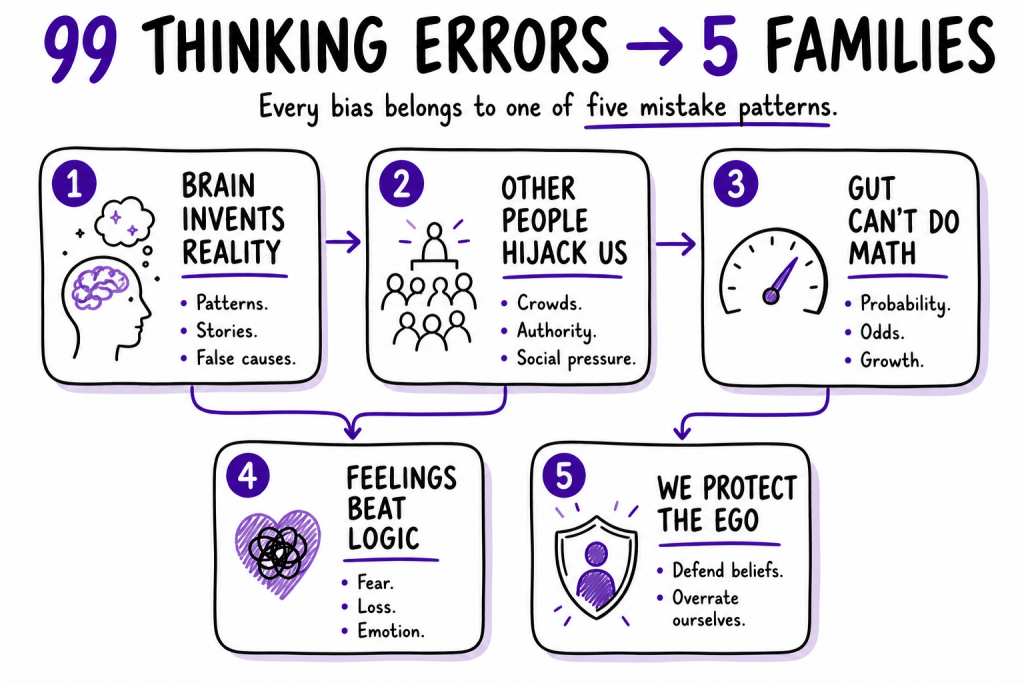
| 🛡️ THE ANTIDOTE Before any important decision, ask which of the five families is most likely operating right now. That single question catches more errors than memorizing all 99 names. The field guide at the end turns it into five quick checks you can run in the moment. |
Family 1: Our brain invents reality
Your brain is a meaning-making machine that cannot tolerate randomness. So it invents patterns, causes, and tidy narratives where none exist, and builds its picture of the world from whatever is easiest to recall. This family is the fiction we mistake for understanding.
BIAS 01 · Survivorship Bias: Why You Should Visit Cemeteries
Picture a teenager who wants to be a rock star. Everywhere he looks: streaming charts, magazine covers, sold-out shows: he sees musicians who made it. So he concludes the odds are decent. They are not. For every visible star, tens of thousands of equally talented, equally driven musicians ended up in the graveyard of failed bands. No one interviews them. No one writes their story. The failures are silent, so they vanish from your mental math.
Once you see it, you see it everywhere. The stack of ’how I built my startup’ books is written entirely by founders who survived: the far larger pile of identical strategies that failed never got a book deal. Stock indices make it seem as if the economy always climbs because bankrupt companies quietly drop out. You are forever looking at a filtered sample and mistaking it for the whole.
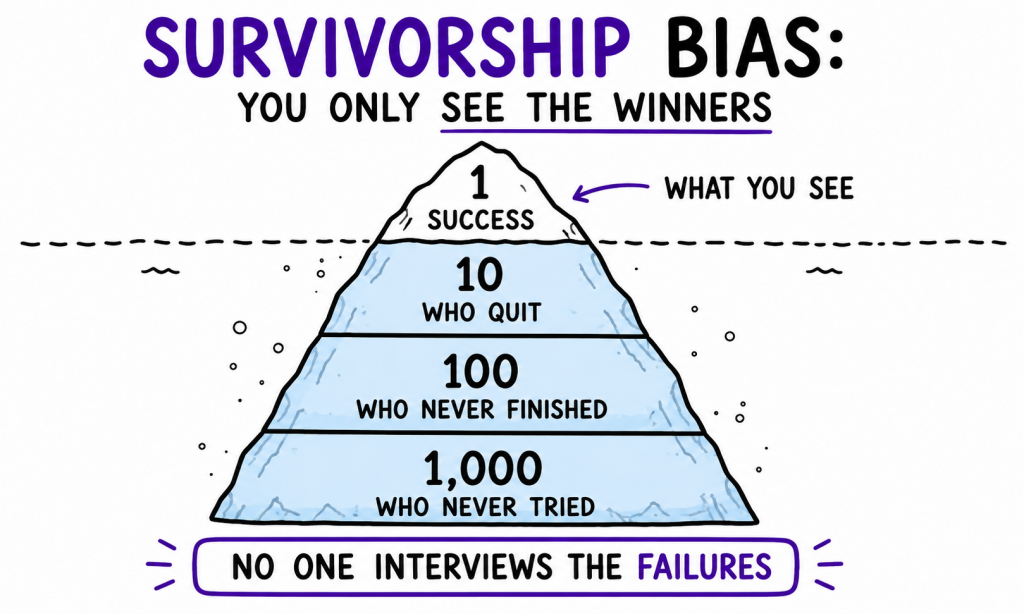
People systematically overestimate their chances of success.
: Rolf Dobelli
| 🛡️ THE ANTIDOTEWhen you study winners, deliberately go looking for the losers who did the exact same things. The graveyard of failed projects that used your ’success factors’ is the most honest data you’ll ever find. |
BIAS 11 · Availability Bias: why we prefer a wrong map to none
You build your picture of the world from whatever comes to mind most easily: not from what’s actually true. After seeing news coverage of a plane crash, flying feels dangerous, even though driving to the airport is far riskier. Vivid, recent, emotional examples crowd out the boring statistics that would give you the real picture.
This quietly warps strategy. Leaders fixate on the dramatic risk that’s easy to picture and ignore the slow, statistically larger one that isn’t. We confuse ’easy to recall’ with ’likely to happen’ and act on the wrong one.
| 🛡️ THE ANTIDOTE When a risk or example feels vivid, ask whether it’s actually common or just memorable. Deliberately seek out the dull, complete data, and spend time with people whose experience differs from yours, so different examples come to mind. |
BIAS 13 · Story Bias: even true stories are fairy tales
We remember stories, not facts. A narrative with a hero, a turning point, and neat cause-and-effect feels like truth, even when reality is a messy pile of coincidences. The danger is that any tidy explanation ’clicks,’ so we stop questioning it. A company’s success gets retold as a brilliant strategy when half of it was luck and timing.
Journalists, founders, and politicians all exploit this. The moment information arrives wrapped in a compelling story, your guard drops. Distortion enters not through the facts but through the shape we force them into.
BIAS 37 · False Causality: don’t believe in the stork
Villages with more storks had more babies born. So storks deliver babies? Obviously not: bigger villages simply had more of both. But we make this error constantly: we see two things move together and invent a cause. Correlation feels like causation because our pattern-hungry brain wants it to.
This poisons business decisions daily. ’Our best reps all use this tool, so the tool makes reps great’: when really, great reps were handed the best tools. Mistaking the arrow’s direction, or inventing one entirely, leads to confident, expensive mistakes.
Family 2: Other people hijack our judgment
We are social animals who evolved to copy the group and defer to those in charge. Usually useful, occasionally catastrophic: this family is about outsourcing your judgment to others, whether it’s the crowd, an expert, or the person you happen to like.
BIAS 04 · Social Proof: fifty million people can be foolish
When unsure, we look at what everyone else is doing and copy it. In a famous 1950s experiment, people gave obviously wrong answers to simple questions just because a roomful of others had done so first. The pull of the group can override the evidence in front of your own eyes.
Social proof drives stock bubbles, fashion crazes, management fads, and the panic when everyone sells at once. ’Everyone’s doing it’ feels like safety, but a crowd can be confidently, expensively wrong, and you with it.
If fifty million people say something foolish, it is still foolish.
: Rolf Dobelli
| 🛡️ THE ANTIDOTE When you catch yourself reaching for ’but everyone is doing this,’ treat it as a yellow flag, not a green light. The size of a crowd tells you nothing about whether it’s right. |
BIAS 09 · Authority Bias: don’t bow to authority
We’re trained from childhood to trust authority: doctors, experts, bosses, anyone with a title or a confident voice. So we suspend our own judgment in their presence, even when they’re plainly outside their expertise or simply wrong. Economists miss recessions and pundits miss elections, yet the next confident forecast still gets a respectful hearing.
The deeper problem: authorities have every incentive to project more certainty than they actually have. A title is not an argument, and confidence is not evidence.
BIAS 38 · Halo Effect: why attractive people get promoted faster
One strong impression bleeds across everything else. A company with a soaring stock price gets praised for its ’brilliant culture’ and ’visionary leadership’: until the stock drops, at which point the same culture is suddenly ’toxic’ and ’arrogant.’ Nothing changed but the one visible signal.
In hiring, a polished candidate is assumed competent. In products, good design makes us assume reliability. We let one easy-to-see trait stand in for a full, careful judgment we never actually made, which is also why a celebrity selling a car makes us like the car.
A single aspect dazzles us and affects how we see the full picture.
More from this family: the quick reference
| THE ERROR | WHAT IT MEANS |
| Groupthink | To keep harmony, a group suppresses doubts and converges on a bad decision nobody privately supports. |
| Reciprocity | A small free gift or favor creates a nagging urge to repay: which salespeople and lobbyists exploit ruthlessly. |
| Liking Bias | The more we like someone, the more we trust, buy, and agree: regardless of the merits of what they’re saying. |
| Contrast Effect | We judge things against whatever sits beside them: a $70 item looks great next to a $100 one, but dull on its own. |
| Social Loafing | People put in less effort in a group than they do alone, hiding in the collective and assuming others will pick up the slack. |
| In-Group / Out-Group | We overvalue our ’tribe’ and unfairly judge outsiders: the root of needless rivalry, from sports to office politics. |
| Social Comparison Bias | We resist helping talented newcomers who might outshine us, quietly protecting our own status instead. |
| Not-Invented-Here | We overvalue our own ideas and dismiss others: ’we’ll build it ourselves,’ even when buying is smarter. |
| Chauffeur Knowledge | Confident-sounding talkers who can recite the script but don’t actually understand the subject underneath. |
Family 3: Our gut can’t do math
Your intuition was built for a world of small numbers and immediate threats, not probabilities, base rates, or compound growth. This family is every way your gut botches the numbers, and it botches them reliably.
BIAS 34 · Exponential Growth: stumped by a sheet of paper
Fold a sheet of paper 50 times: how thick is it? Your gut says maybe a few centimeters, a notebook perhaps. The real answer: the stack would reach the sun. Our minds think in straight lines, so anything compounding- interest, infections, audience growth, technical debt- ambushes us completely.
This is why people underestimate savings if they start late, why pandemics feel sudden when the math was visible weeks earlier, and why ’just 1% growth a day’ sounds trivial but isn’t. When something grows by a percentage rather than a fixed amount, your intuition isn’t just wrong: it’s wrong by orders of magnitude.
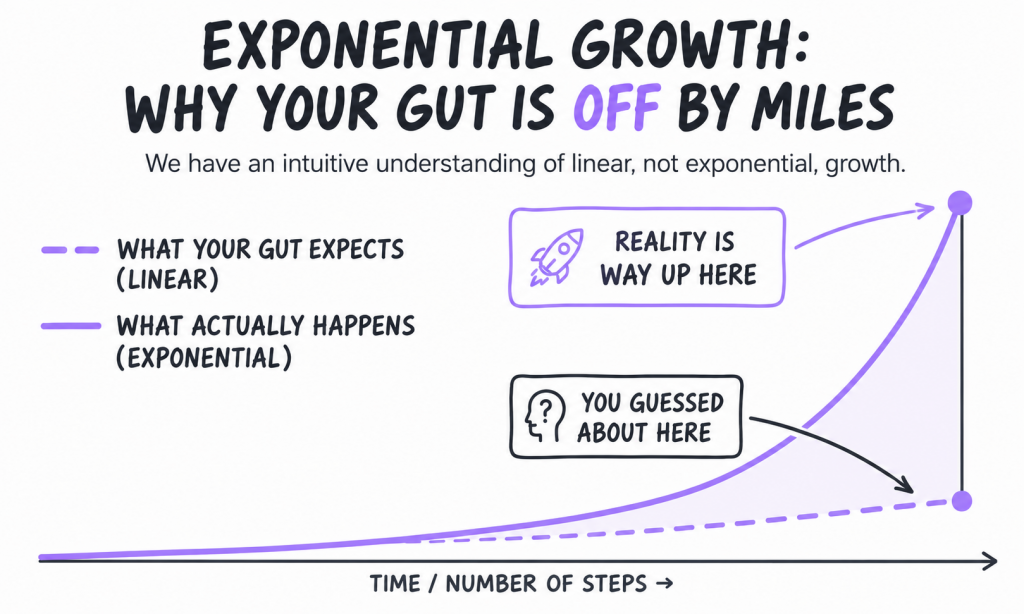
We have an intuitive understanding of linear, not exponential, growth.
| 🛡️ THE ANTIDOTE Whenever a quantity grows by a percentage rather than a fixed amount, stop trusting your gut and do the arithmetic, or use the rule of 70: divide 70 by the growth rate to get the doubling time. |
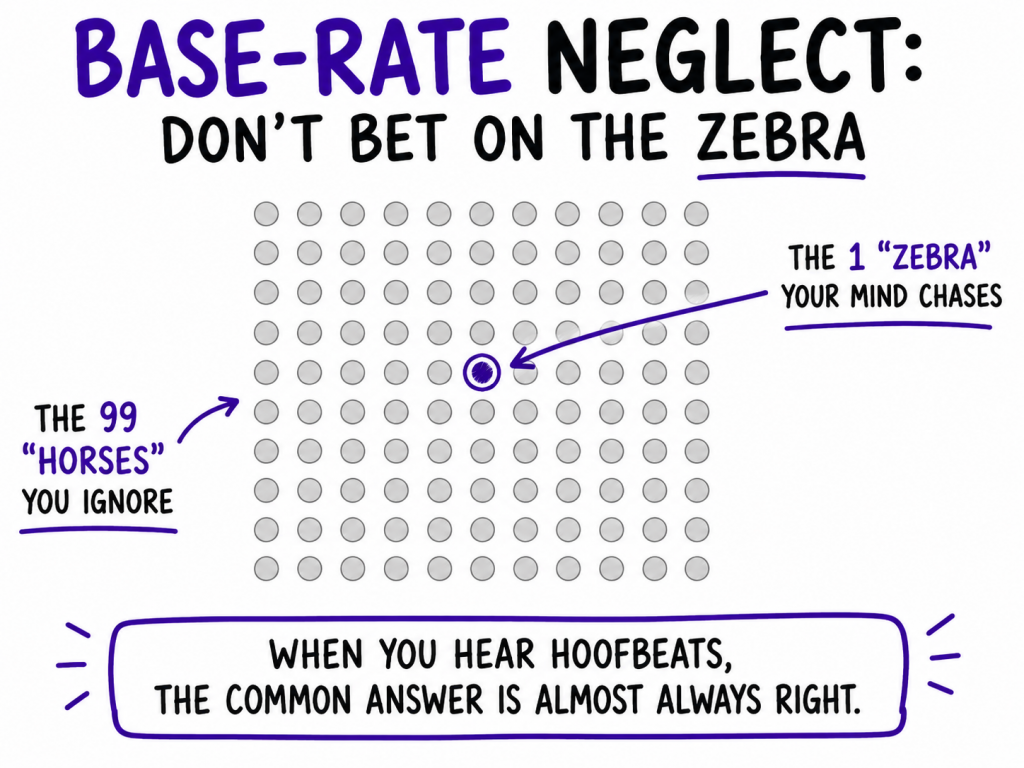
BIAS 28 · Base-Rate Neglect: hear hoofbeats, don’t expect a zebra
A patient’s symptoms fit a rare disease perfectly. Doctors who chase the exotic diagnosis often miss that a common illness explains the same symptoms and is a hundred times more likely. We fixate on the vivid, specific case and ignore the background rate: how common the thing actually is to begin with.
In business, a candidate seems like the next visionary founder, so you ignore that the base rate of any startup succeeding is brutally low. The specific story is loud; the base rate is quiet and almost always more informative.
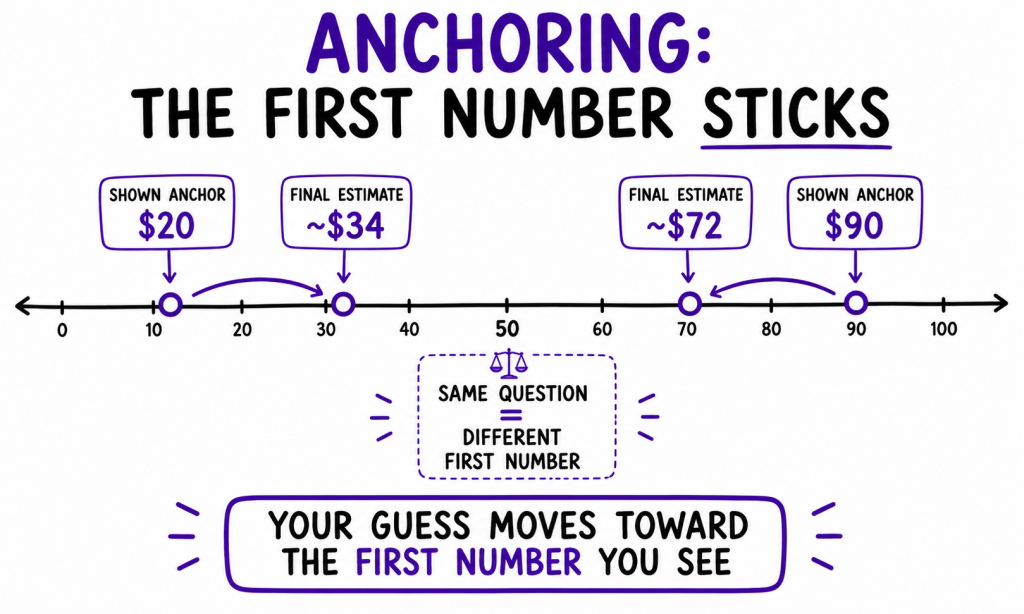
BIAS 30 · The Anchor: why the first number sticks
Show someone any number before they estimate something: even a random, irrelevant one, and their guess drifts toward it. The first figure on the table becomes a gravitational anchor, and every later judgment orbits it. This is exactly why the opening offer in any negotiation matters so much.
List price, first salary figure, initial budget estimate: whoever sets the anchor quietly sets the range. Knowing the number is arbitrary barely helps; the pull operates even when you’re watching for it.
More from this family: the quick reference
| THE ERROR | WHAT IT MEANS |
| Gambler’s Fallacy | Believing a run of reds makes black ’due.’ Independent events have no memory: the coin owes you nothing. |
| Neglect of Probability | We react to how vivid an outcome is, not how likely : fearing the rare disaster, ignoring the common one. |
| Conjunction Fallacy | A detailed, specific story feels more probable than a general one : though more detail can only make it less likely. |
| Law of Small Numbers | Tiny samples produce wild swings we mistake for signal : the smallest towns top both ’best’ and ’worst’ lists. |
| Problem with Averages | One extreme value hides inside an average. Never cross a river that is ’on average’ four feet deep. |
| Regression to the Mean | Extreme results drift back to normal on their own : so we credit our ’fix’ for what time would’ve done anyway. |
| Induction | Assuming the future repeats the past : the turkey feels safe right up until the day before Thanksgiving. |
| Forecast Illusion | Confident expert predictions about complex systems are barely better than chance, but we reward the confidence. |
| The Black Swan | Rare, massive, unpredictable events dominate history: yet we plan as if tomorrow looks like the recent average. |
| Ambiguity Aversion | We prefer a known risk to an unknown one, overpaying for the illusion of certainty when odds are merely unclear. |
Family 4: Feelings beat logic
We are loss-fearing, comfort-seeking, emotion-driven creatures. We dread losing far more than we enjoy gaining, overvalue whatever we already hold, and freeze when handed too many choices. This family is the emotional drag on clear thinking.
BIAS 32 · Loss Aversion: why evil looms larger than good
Losing $100 hurts roughly twice as much as gaining $100 feels good. That single asymmetry, measured repeatedly, quietly warps an astonishing share of your decisions. We hold losing stocks too long, refusing to ’lock in’ a loss even when the smart move is to sell.
Negative information hits harder, too: one criticism outweighs five compliments, one bad review drowns ten good ones. Understanding this won’t switch it off, but it explains why fear so reliably beats hope in driving behavior: and why the safest-sounding option is often just the one that avoids a visible loss.
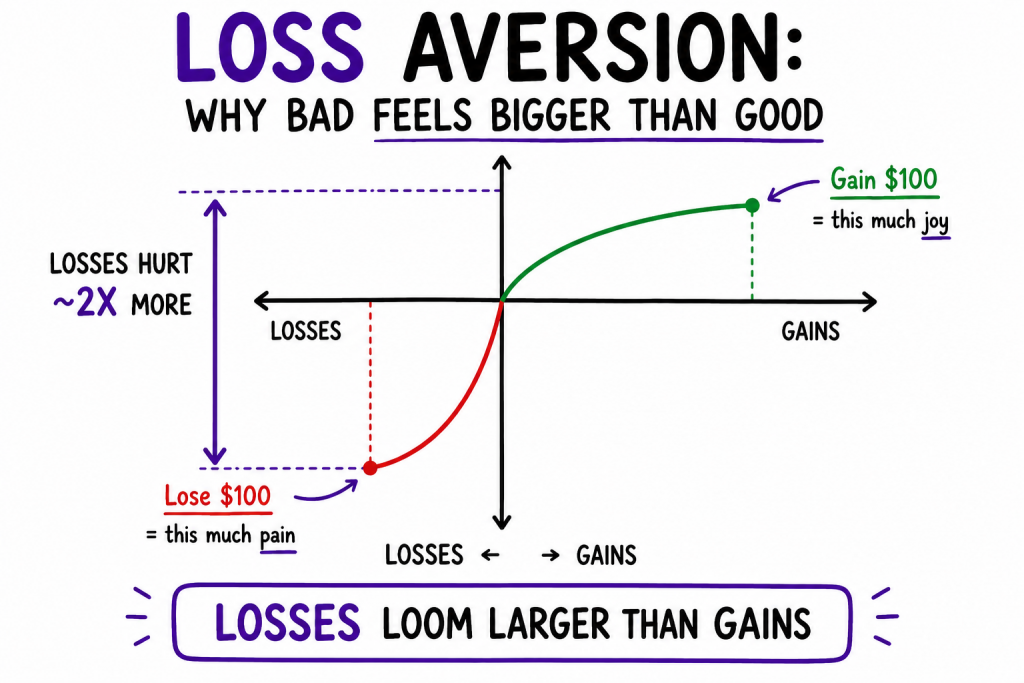
Losses loom larger than gains.
| 🛡️ THE ANTIDOTE Before refusing to walk away from something, ask: ’If I didn’t already own this- this stock, this project, this job- would I buy it today at this price?’ If no, the only thing keeping you is loss aversion. |
BIAS 05 · Sunk Cost Fallacy: why you should forget the past
You’re 90 minutes into a terrible movie. Do you stay because you ’already paid’? The money and time are gone either way: staying only adds 2 wasted hours to the loss. Yet we constantly throw good resources after bad: failing projects get more funding precisely because so much is already invested, which is exactly backward.
The money already spent should be irrelevant to what you do next. The only honest question is whether continuing is worth it from right now, looking forward. The past is a cost you cannot recover: don’t let it buy your future, too.
BIAS 21 · Paradox of Choice: less is more
In a famous study, a grocery display offering 24 jams drew bigger crowds than one offering 6, but the smaller display sold about ten times as much. Too many options don’t liberate us; they paralyze us. Faced with an overwhelming menu, we delay, second-guess, and often choose nothing.
More choice also makes us less happy with whatever we pick, because every option we didn’t take feels like something lost. For product and pricing decisions, this flips the usual instinct: cutting options can lift both conversion and satisfaction.
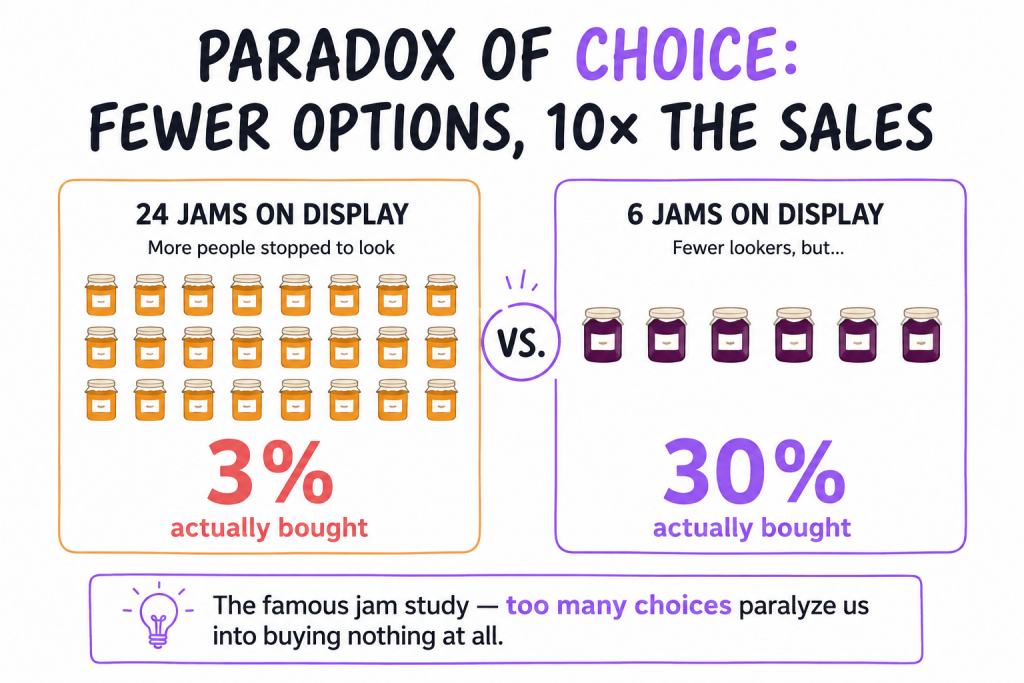
A larger selection leads to inner paralysis.
More from this family: the quick reference
| THE ERROR | WHAT IT MEANS |
| Endowment Effect | The moment something is yours, you value it more : sellers demand far more than buyers will pay for the same thing. |
| Scarcity Error | ’Almost gone’ and ’limited edition’ inflate desire: we want the last cookie far more than the first. |
| Hedonic Treadmill | We adapt to every win and return to baseline: so the raise, the car, the title thrill us far less than expected. |
| Framing | The same fact in different words changes our reaction: ’90% survive’ lands very differently from ’10% die.’ |
| Affect Heuristic | We let our gut feeling about something determine its risks and benefits, rather than weighing them independently. |
| Fear of Regret | Dread of future regret makes us cling, panic at ’last chances,’ and choose badly just to avoid feeling we missed out. |
| Default Effect | We stick with the pre-set option out of inertia, which is why opt-out organ donation rates dwarf opt-in ones. |
| Hyperbolic Discounting | We grab a smaller reward now rather than a bigger one later: ’now’ has an irrational gravitational pull on our choices. |
| House-Money Effect | We treat money we won or inherited far more recklessly than money we earned: as if it were less real. |
Family 5: We protect the ego
Admitting we’re wrong is painful, and feeling competent is pleasant. So we filter reality to defend our existing beliefs, overrate our own knowledge, and rewrite the story so we come out looking good. This family is the ego quietly bending your judgment to protect itself.
BIAS 07 · Confirmation Bias: the mother of all biases
This is the big one: Dobelli calls it the mother of all biases, and the rest of this family is really its children. We welcome any evidence that fits what we already believe and quietly discard whatever contradicts it. The belief never gets tested; it just keeps getting reinforced, growing more certain even as the world sends warning signs.
It’s why investors only read bullish takes on stocks they own, why we dismiss the one data point that breaks our theory as ’an outlier,’ and why two people can watch the same event and walk away more convinced of opposite conclusions. The contradictory evidence was right there: it simply bounced off.
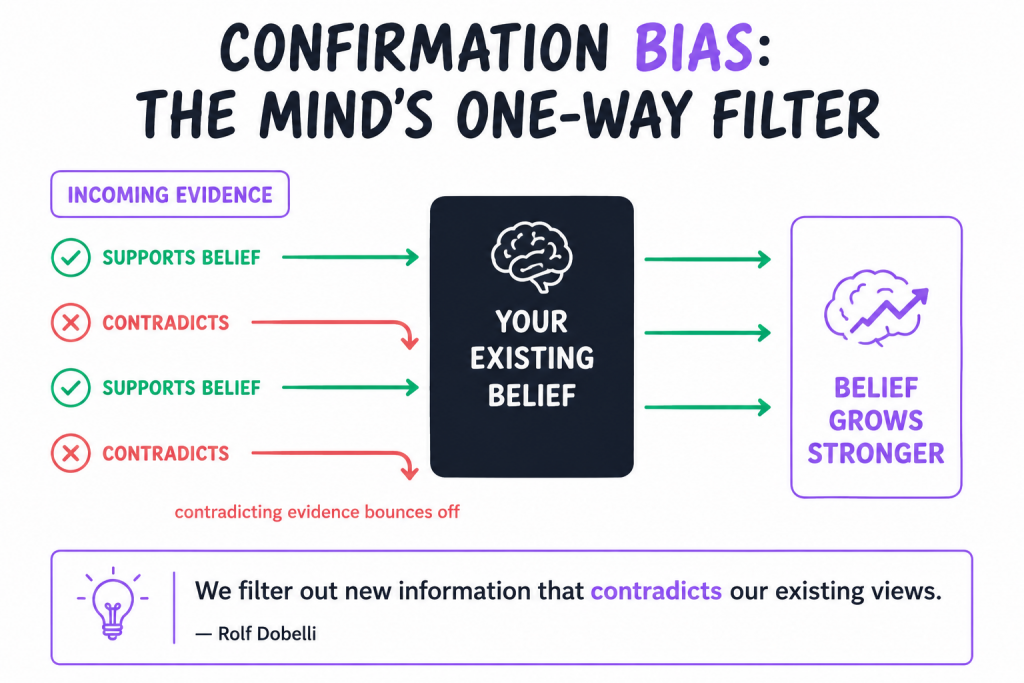
We filter out new information that contradicts our existing views: Rolf Dobelli
| 🛡️ THE ANTIDOTE Actively hunt for disconfirming evidence: the facts that would prove you wrong. Write down what you believe and what would have to be true for it to be false, then go looking for exactly that. In teams, appoint someone to argue the opposite on purpose. |
BIAS 15 · Overconfidence Effect: you know less than you think
Ask people how confident they are in their estimates, then check how often they’re right: the confidence wildly outruns the accuracy. We systematically overrate our own knowledge, skill, and ability to predict. Famously, surveys find the large majority of people rate themselves above-average drivers, which is statistically impossible.
The dangerous part is that it’s invisible from the inside: the gap between what you know and what you think you know feels like solid ground. It’s why projects blow past deadlines, why forecasts are too narrow, and why experts are often more overconfident than amateurs.
It is much more common for us to overestimate our knowledge than to underestimate it: Rolf Dobelli
BIAS 17 · Illusion of Control: You control less than you think
We believe our influence reaches things it plainly doesn’t. In one experiment, people endured louder noise when given a ’panic’ button, even though the button did nothing. Just believing they could act made it bearable. The world is full of these placebo buttons: most crosswalk and elevator ’close door’ buttons are wired to nothing.
Believing we have control brings comfort and hope, which is why the illusion is so sticky. But acting on it- mistaking the things we can’t move for things we can- wastes energy and breeds false confidence.
| 🛡️ THE ANTIDOTE Sort any situation into what you can actually control and what you can’t, then put your energy only on the first list. Worrying about the second is the illusion doing its work. |
More from this family: the quick reference
| THE ERROR | WHAT IT MEANS |
| Cognitive Dissonance | After a bad call, we invent comforting reasons rather than admit error: the fox decides the grapes were sour anyway. |
| Self-Serving Bias | Success is ’my skill,’ failure is ’bad luck.’ We claim the wins and outsource the blame to protect the ego. |
| Outcome Bias | We judge a decision by how it turned out, not by whether it was sound: rewarding lucky fools, punishing wise bets. |
| Action Bias | When anxious, we feel compelled to do something: anything: even when watching and waiting is the smarter move. |
| Fundamental Attribution Error | We blame people’s character for outcomes and underweight the situation: ’he’s lazy,’ not ’the system failed him.’ |
| Illusion of Skill | In many fields, luck dominates results, but we credit skill: the boat matters more than the rowing. |
| Planning Fallacy | We underestimate the time, cost, and risk of our own projects, while overestimating the benefits, every time. |
| Self-Selection Bias | We skew our own conclusions by quietly picking an unrepresentative sample: then marvel at the ’result.’ |
| Introspection Illusion | We trust our own reading of our motives over outside evidence: reflection feels like truth, but often isn’t. |
The field guide: bookmark this
You won’t remember 99 biases in the moment a decision lands on your desk. You don’t need to. You need five questions: one per family, and the discipline actually to ask them before you commit.
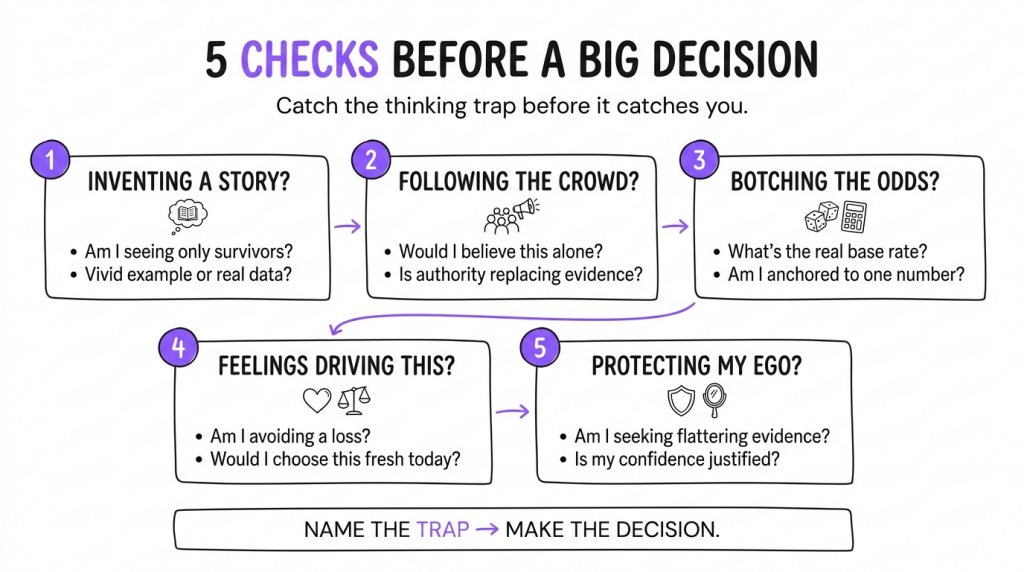
Stop reading, start applying
In your next big decision
Write down the decision and, beside it, which of the five families is most likely fooling you here. Naming the trap out loud robs it of most of its power.
In your next team debate
Appoint someone to argue the opposite case on purpose. This is the direct antidote to confirmation bias and groupthink: it forces the disconfirming evidence onto the table instead of letting the room quietly agree itself into a bad call.
In your next forecast or estimate
Start from the base rate, then adjust: never the other way around. Ask how similar past efforts actually turned out before you trust this one’s specific, flattering story. Distrust the first number anyone puts on the table; it’s just an anchor. And pad your timeline, because the planning fallacy is already lying to you.
You don’t need to be brilliant to think clearly. You just need to be reliably less foolish: to spot the trap one beat before you fall in. That beat is the entire skill.
Dobelli’s real gift isn’t the list. It’s the calm that comes from having names for the things that fool you. Thunder didn’t stop after Franklin’s kite: it just stopped being terrifying once people understood it. Your own irrationality works the same way: you won’t become flawless, but you’ll become a little harder to fool, and over a lifetime of decisions, that compounds.
FAQs
1. What is The Art of Thinking Clearly about?
The Art of Thinking Clearly by Rolf Dobelli is about the common cognitive biases and thinking errors that lead people to make poor decisions. The book explores 99 errors in thinking, including survivorship bias, confirmation bias, social proof, loss aversion, the sunk cost fallacy, and overconfidence. Its central lesson is that recognising these predictable mental traps can help us make clearer decisions.
2. What are the main lessons from The Art of Thinking Clearly?
The main lesson is that human thinking is far less rational than we assume. We are influenced by incomplete information, other people, emotions, poor intuition about probability, and the desire to protect our existing beliefs. Instead of trying to eliminate every bias, Dobelli encourages readers to recognise recurring thinking errors before making important decisions. Your summary captures this as identifying the type of mental trap operating before acting.
3. What are the 5 main types of thinking errors in The Art of Thinking Clearly?
The 99 thinking errors can be understood through five broad categories: our brain invents reality, other people hijack our judgement, our gut struggles with maths and probability, feelings beat logic, and we protect our ego. Grouping biases this way makes them easier to recognise and apply in everyday decision-making.
4. What are some examples of cognitive biases in The Art of Thinking Clearly?
Some of the most important biases discussed include survivorship bias, availability bias, social proof, authority bias, anchoring, base-rate neglect, loss aversion, sunk cost fallacy, confirmation bias and the overconfidence effect. For example, survivorship bias causes us to focus on visible successes while overlooking the much larger number of failures.
5. What is the most important bias in The Art of Thinking Clearly?
Confirmation bias is one of the most important biases in the book. Dobelli describes it as the “mother of all biases.” It causes us to notice and accept information that supports what we already believe while ignoring or dismissing evidence that contradicts us.
6. Is The Art of Thinking Clearly worth reading?
Yes, especially if you want a practical introduction to cognitive biases without a heavily academic approach. The book consists of short chapters, with each focusing on a particular thinking error and how it affects judgement. It is particularly useful for people who regularly make decisions involving business, investing, management, hiring, or uncertainty.